

ρ
d
1
2 v
2
dt
¼
X 3
i, j¼1
∂
∂x j
σ ji v i
À
Á À
X 3
i, j¼1
σ ji
∂
∂x j
v i þ ρb i v i i ¼ 1, 2, 3
ð
Þ
ð 5:52Þ
or in tensor notation
ρ
d
1
2 v
2
dt
¼ div σ Á v
ð
ÞÀσ : L þ ρb Á v
ð5:53Þ
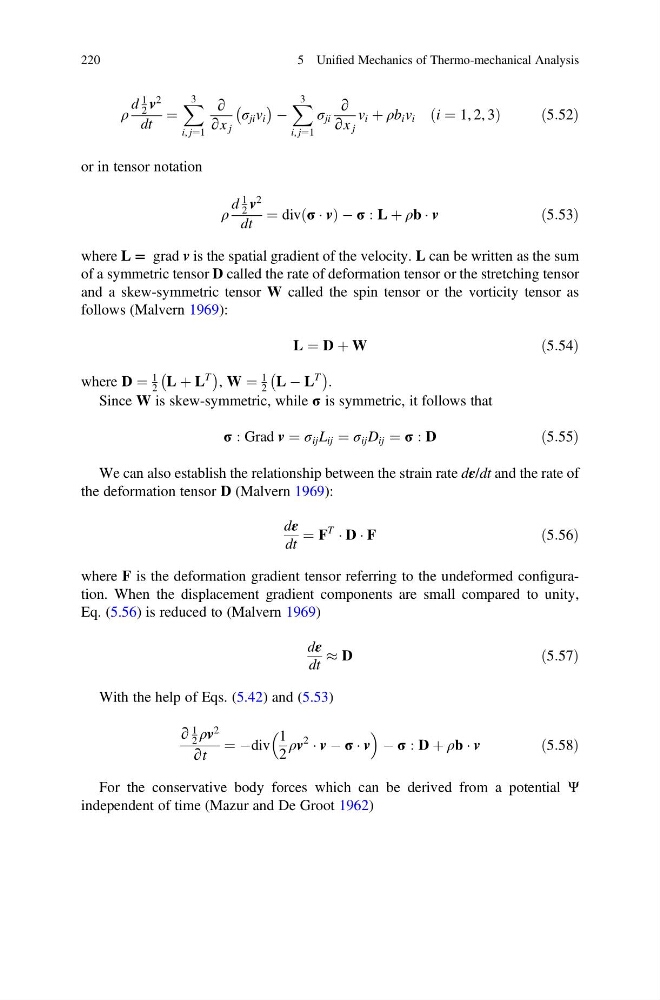
where L = grad v is the spatial gradient of the velocity. L can be written as the sum
of a symmetric tensor D called the rate of deformation tensor or the stretching tensor
and a skew-symmetric tensor W called the spin tensor or the vorticity tensor as
follows (Malvern 1969):
L ¼ D þ W
ð5:54Þ
where D ¼
1
2 L þ L
T
À
Á
, W ¼
1
2 L À L
T
À
Á
.
Since W is skew-symmetric, while σ is symmetric, it follows that
σ : Grad v ¼ σ ij L ij ¼ σ ij D ij ¼ σ : D
ð5:55Þ
We can also establish the relationship between the strain rate dε/dt and the rate of
the deformation tensor D (Malvern 1969):
dε
dt
¼ F
T
Á D Á F
ð5:56Þ
where F is the deformation gradient tensor referring to the undeformed configuration. When the displacement gradient components are small compared to unity,
Eq. (5.56) is reduced to (Malvern 1969)
dε
dt
% D
ð5:57Þ
With the help of Eqs. (5.42) and (5.53)
∂
1
2 ρv
2
∂t
¼ Àdiv
1
2
ρv
2
Á v À σ Á v
À σ : D þ ρb Á v
ð5:58Þ
For the conservative body forces which can be derived from a potential Ψ
independent of time (Mazur and De Groot 1962)
220
5 Unified Mechanics of Thermo-mechanical Analysis
d
1
2 v
2
dt
¼
X 3
i, j¼1
∂
∂x j
σ ji v i
À
Á À
X 3
i, j¼1
σ ji
∂
∂x j
v i þ ρb i v i i ¼ 1, 2, 3
ð
Þ
ð 5:52Þ
or in tensor notation
ρ
d
1
2 v
2
dt
¼ div σ Á v
ð
ÞÀσ : L þ ρb Á v
ð5:53Þ
where L = grad v is the spatial gradient of the velocity. L can be written as the sum
of a symmetric tensor D called the rate of deformation tensor or the stretching tensor
and a skew-symmetric tensor W called the spin tensor or the vorticity tensor as
follows (Malvern 1969):
L ¼ D þ W
ð5:54Þ
where D ¼
1
2 L þ L
T
À
Á
, W ¼
1
2 L À L
T
À
Á
.
Since W is skew-symmetric, while σ is symmetric, it follows that
σ : Grad v ¼ σ ij L ij ¼ σ ij D ij ¼ σ : D
ð5:55Þ
We can also establish the relationship between the strain rate dε/dt and the rate of
the deformation tensor D (Malvern 1969):
dε
dt
¼ F
T
Á D Á F
ð5:56Þ
where F is the deformation gradient tensor referring to the undeformed configuration. When the displacement gradient components are small compared to unity,
Eq. (5.56) is reduced to (Malvern 1969)
dε
dt
% D
ð5:57Þ
With the help of Eqs. (5.42) and (5.53)
∂
1
2 ρv
2
∂t
¼ Àdiv
1
2
ρv
2
Á v À σ Á v
À σ : D þ ρb Á v
ð5:58Þ
For the conservative body forces which can be derived from a potential Ψ
independent of time (Mazur and De Groot 1962)
220
5 Unified Mechanics of Thermo-mechanical Analysis