

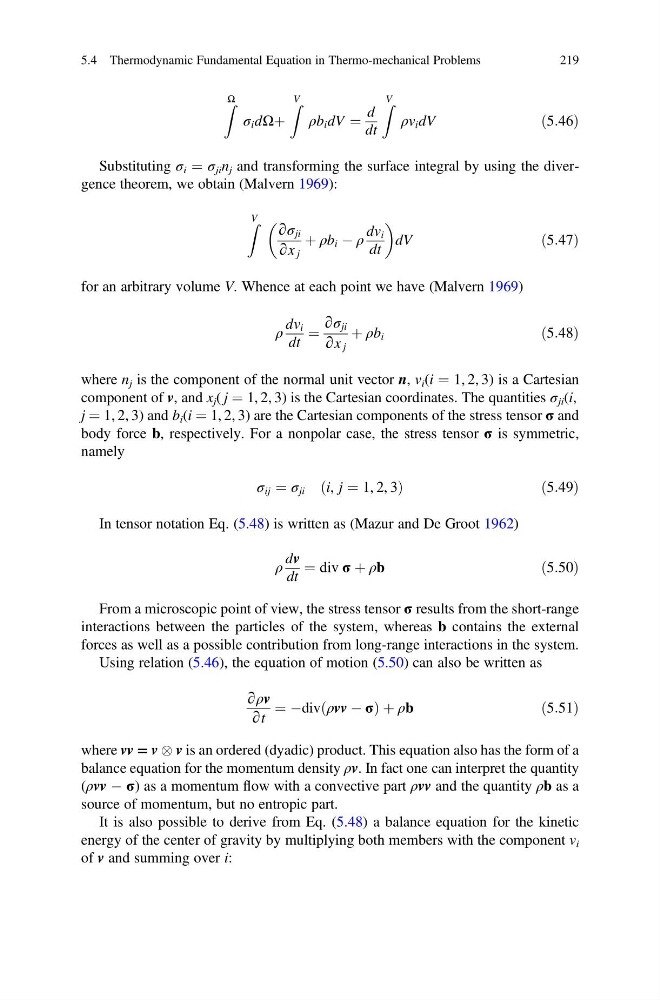
Z Ω
σ i dΩþ
Z V
ρb i dV ¼
d
dt
Z V
ρv i dV
ð5:46Þ
Substituting σ i ¼ σ ji n j and transforming the surface integral by using the divergence theorem, we obtain (Malvern 1969):
Z V ∂σ ji
∂x j
þ ρb i À ρ
dv i
dt
dV
ð5:47Þ
for an arbitrary volume V. Whence at each point we have (Malvern 1969)
ρ
dv i
dt
¼
∂σ ji
∂x j
þ ρb i
ð5:48Þ
where n j is the component of the normal unit vector n, v i (i ¼ 1, 2, 3) is a Cartesian
component of v, and x j ( j ¼ 1, 2, 3) is the Cartesian coordinates. The quantities σ ji (i,
j ¼ 1, 2, 3) and b i (i ¼ 1, 2, 3) are the Cartesian components of the stress tensor σ and
body force b, respectively. For a nonpolar case, the stress tensor σ is symmetric,
namely
σ ij ¼ σ ji i, j ¼ 1, 2, 3
ð
Þ
ð 5:49Þ
In tensor notation Eq. (5.48) is written as (Mazur and De Groot 1962)
ρ
dv
dt
¼ div σ þ ρb
ð5:50Þ
From a microscopic point of view, the stress tensor σ results from the short-range
interactions between the particles of the system, whereas b contains the external
forces as well as a possible contribution from long-range interactions in the system.
Using relation (5.46), the equation of motion (5.50) can also be written as
∂ρv
∂t
¼ Àdiv ρvv À σ
ð
Þþρb
ð5:51Þ
where vv = v v is an ordered (dyadic) product. This equation also has the form of a
balance equation for the momentum density ρv. In fact one can interpret the quantity
(ρvv À σ) as a momentum flow with a convective part ρvv and the quantity ρb as a
source of momentum, but no entropic part.
It is also possible to derive from Eq. (5.48) a balance equation for the kinetic
energy of the center of gravity by multiplying both members with the component v i
of v and summing over i:
5.4 Thermodynamic Fundamental Equation in Thermo-mechanical Problems
219
σ i dΩþ
Z V
ρb i dV ¼
d
dt
Z V
ρv i dV
ð5:46Þ
Substituting σ i ¼ σ ji n j and transforming the surface integral by using the divergence theorem, we obtain (Malvern 1969):
Z V ∂σ ji
∂x j
þ ρb i À ρ
dv i
dt
dV
ð5:47Þ
for an arbitrary volume V. Whence at each point we have (Malvern 1969)
ρ
dv i
dt
¼
∂σ ji
∂x j
þ ρb i
ð5:48Þ
where n j is the component of the normal unit vector n, v i (i ¼ 1, 2, 3) is a Cartesian
component of v, and x j ( j ¼ 1, 2, 3) is the Cartesian coordinates. The quantities σ ji (i,
j ¼ 1, 2, 3) and b i (i ¼ 1, 2, 3) are the Cartesian components of the stress tensor σ and
body force b, respectively. For a nonpolar case, the stress tensor σ is symmetric,
namely
σ ij ¼ σ ji i, j ¼ 1, 2, 3
ð
Þ
ð 5:49Þ
In tensor notation Eq. (5.48) is written as (Mazur and De Groot 1962)
ρ
dv
dt
¼ div σ þ ρb
ð5:50Þ
From a microscopic point of view, the stress tensor σ results from the short-range
interactions between the particles of the system, whereas b contains the external
forces as well as a possible contribution from long-range interactions in the system.
Using relation (5.46), the equation of motion (5.50) can also be written as
∂ρv
∂t
¼ Àdiv ρvv À σ
ð
Þþρb
ð5:51Þ
where vv = v v is an ordered (dyadic) product. This equation also has the form of a
balance equation for the momentum density ρv. In fact one can interpret the quantity
(ρvv À σ) as a momentum flow with a convective part ρvv and the quantity ρb as a
source of momentum, but no entropic part.
It is also possible to derive from Eq. (5.48) a balance equation for the kinetic
energy of the center of gravity by multiplying both members with the component v i
of v and summing over i:
5.4 Thermodynamic Fundamental Equation in Thermo-mechanical Problems
219