

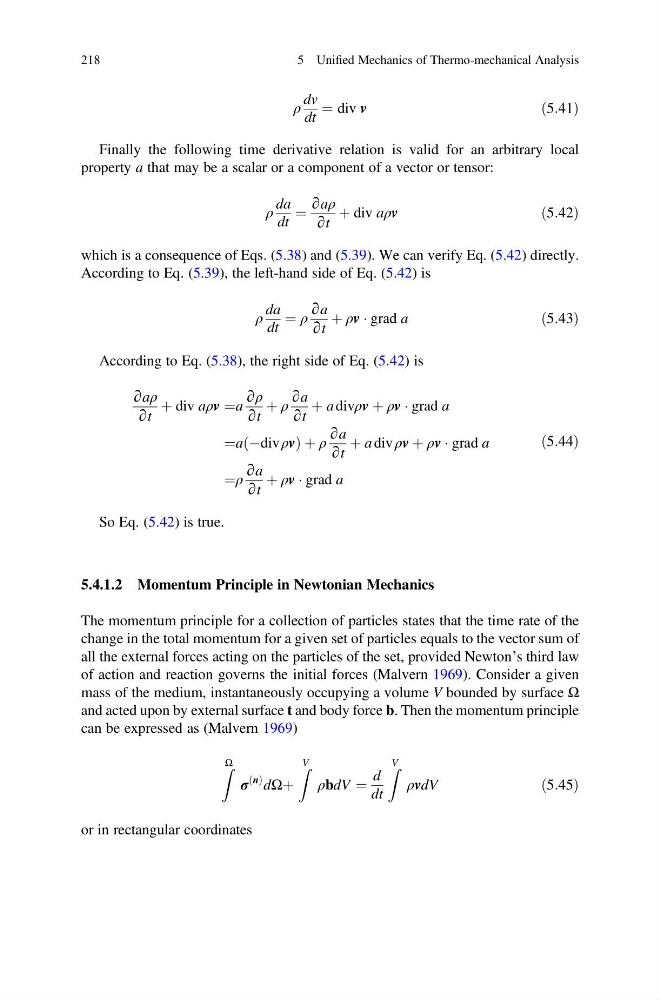
ρ
dv
dt
¼ div v
ð5:41Þ
Finally the following time derivative relation is valid for an arbitrary local
property a that may be a scalar or a component of a vector or tensor:
ρ
da
dt
¼
∂aρ
∂t
þ div aρv
ð5:42Þ
which is a consequence of Eqs. (5.38) and (5.39). We can verify Eq. (5.42) directly.
According to Eq. (5.39), the left-hand side of Eq. (5.42) is
ρ
da
dt
¼ ρ
∂a
∂t
þ ρv Á grad a
ð5:43Þ
According to Eq. (5.38), the right side of Eq. (5.42) is
∂aρ
∂t
þ div aρv ¼a
∂ρ
∂t
þ ρ
∂a
∂t
þ a divρv þ ρv Á grad a
¼a Àdiv ρv
ð
Þþρ
∂a
∂t
þ a div ρv þ ρv Á grad a
¼ρ
∂a
∂t
þ ρv Á grad a
ð5:44Þ
So Eq. (5.42) is true.
5.4.1.2 Momentum Principle in Newtonian Mechanics
The momentum principle for a collection of particles states that the time rate of the
change in the total momentum for a given set of particles equals to the vector sum of
all the external forces acting on the particles of the set, provided Newton’s third law
of action and reaction governs the initial forces (Malvern 1969). Consider a given
mass of the medium, instantaneously occupying a volume V bounded by surface Ω
and acted upon by external surface t and body force b. Then the momentum principle
can be expressed as (Malvern 1969)
Z Ω
σ
n
ð Þ dΩþ
Z V
ρbdV ¼
d
dt
Z V
ρvdV
ð5:45Þ
or in rectangular coordinates
218
5 Unified Mechanics of Thermo-mechanical Analysis
dv
dt
¼ div v
ð5:41Þ
Finally the following time derivative relation is valid for an arbitrary local
property a that may be a scalar or a component of a vector or tensor:
ρ
da
dt
¼
∂aρ
∂t
þ div aρv
ð5:42Þ
which is a consequence of Eqs. (5.38) and (5.39). We can verify Eq. (5.42) directly.
According to Eq. (5.39), the left-hand side of Eq. (5.42) is
ρ
da
dt
¼ ρ
∂a
∂t
þ ρv Á grad a
ð5:43Þ
According to Eq. (5.38), the right side of Eq. (5.42) is
∂aρ
∂t
þ div aρv ¼a
∂ρ
∂t
þ ρ
∂a
∂t
þ a divρv þ ρv Á grad a
¼a Àdiv ρv
ð
Þþρ
∂a
∂t
þ a div ρv þ ρv Á grad a
¼ρ
∂a
∂t
þ ρv Á grad a
ð5:44Þ
So Eq. (5.42) is true.
5.4.1.2 Momentum Principle in Newtonian Mechanics
The momentum principle for a collection of particles states that the time rate of the
change in the total momentum for a given set of particles equals to the vector sum of
all the external forces acting on the particles of the set, provided Newton’s third law
of action and reaction governs the initial forces (Malvern 1969). Consider a given
mass of the medium, instantaneously occupying a volume V bounded by surface Ω
and acted upon by external surface t and body force b. Then the momentum principle
can be expressed as (Malvern 1969)
Z Ω
σ
n
ð Þ dΩþ
Z V
ρbdV ¼
d
dt
Z V
ρvdV
ð5:45Þ
or in rectangular coordinates
218
5 Unified Mechanics of Thermo-mechanical Analysis