

e σ ¼
F
!
δS À δS Dx
ð5:11Þ
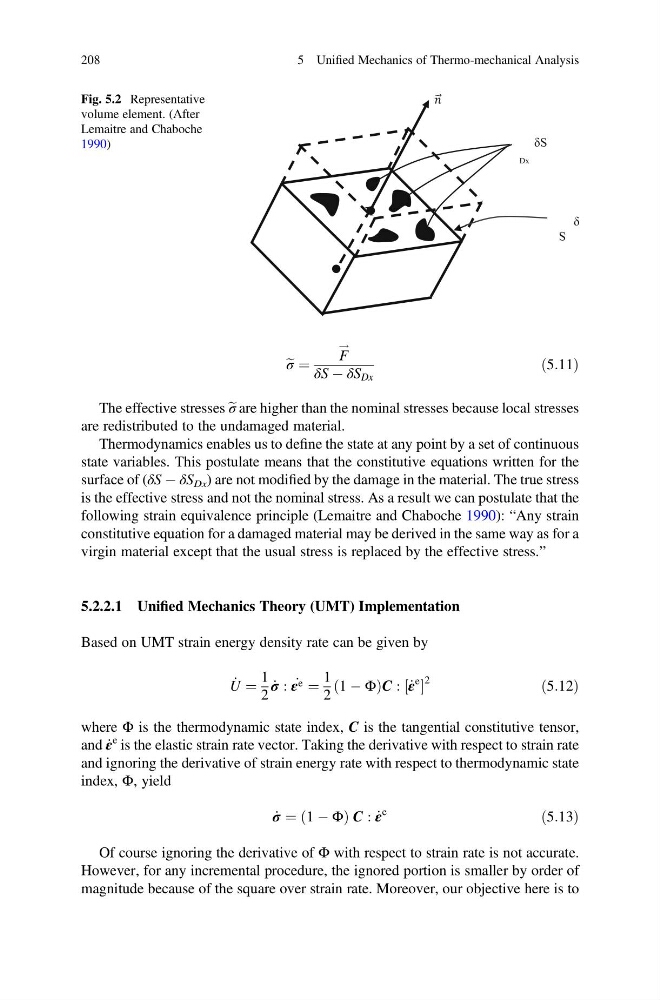
The effective stresses e σ are higher than the nominal stresses because local stresses
are redistributed to the undamaged material.
Thermodynamics enables us to define the state at any point by a set of continuous
state variables. This postulate means that the constitutive equations written for the
surface of (δS À δS Dx ) are not modified by the damage in the material. The true stress
is the effective stress and not the nominal stress. As a result we can postulate that the
following strain equivalence principle (Lemaitre and Chaboche 1990): “Any strain
constitutive equation for a damaged material may be derived in the same way as for a
virgin material except that the usual stress is replaced by the effective stress.”
5.2.2.1 Unified Mechanics Theory (UMT) Implementation
Based on UMT strain energy density rate can be given by
_
U ¼
1
2
_
σ : _
ε e ¼
1
2
1 À Φ
ð
ÞC : _
ε
e
½
2
ð5:12Þ
where Φ is the thermodynamic state index, C is the tangential constitutive tensor,
and _
ε
e is the elastic strain rate vector. Taking the derivative with respect to strain rate
and ignoring the derivative of strain energy rate with respect to thermodynamic state
index, Φ, yield
_
σ ¼ 1 À Φ
ð
ÞC : _
ε
e
ð5:13Þ
Of course ignoring the derivative of Φ with respect to strain rate is not accurate.
However, for any incremental procedure, the ignored portion is smaller by order of
magnitude because of the square over strain rate. Moreover, our objective here is to
Fig. 5.2 Representative
volume element. (After
Lemaitre and Chaboche
1990)
208
5 Unified Mechanics of Thermo-mechanical Analysis
F
!
δS À δS Dx
ð5:11Þ
The effective stresses e σ are higher than the nominal stresses because local stresses
are redistributed to the undamaged material.
Thermodynamics enables us to define the state at any point by a set of continuous
state variables. This postulate means that the constitutive equations written for the
surface of (δS À δS Dx ) are not modified by the damage in the material. The true stress
is the effective stress and not the nominal stress. As a result we can postulate that the
following strain equivalence principle (Lemaitre and Chaboche 1990): “Any strain
constitutive equation for a damaged material may be derived in the same way as for a
virgin material except that the usual stress is replaced by the effective stress.”
5.2.2.1 Unified Mechanics Theory (UMT) Implementation
Based on UMT strain energy density rate can be given by
_
U ¼
1
2
_
σ : _
ε e ¼
1
2
1 À Φ
ð
ÞC : _
ε
e
½
2
ð5:12Þ
where Φ is the thermodynamic state index, C is the tangential constitutive tensor,
and _
ε
e is the elastic strain rate vector. Taking the derivative with respect to strain rate
and ignoring the derivative of strain energy rate with respect to thermodynamic state
index, Φ, yield
_
σ ¼ 1 À Φ
ð
ÞC : _
ε
e
ð5:13Þ
Of course ignoring the derivative of Φ with respect to strain rate is not accurate.
However, for any incremental procedure, the ignored portion is smaller by order of
magnitude because of the square over strain rate. Moreover, our objective here is to
Fig. 5.2 Representative
volume element. (After
Lemaitre and Chaboche
1990)
208
5 Unified Mechanics of Thermo-mechanical Analysis