

5.2.1.7 Viscoplastic Creep Rate Law
The relation between γ and η expressed in Eq. (5.8) is a general constitutive equation,
and different forms of the constitutive relationship describing the material-specific
evolution of the viscoplastic strain can be implemented. The creep law proposed by
Kashyap and Murty (1981) and extended to the multiaxial case by Basaran et al.
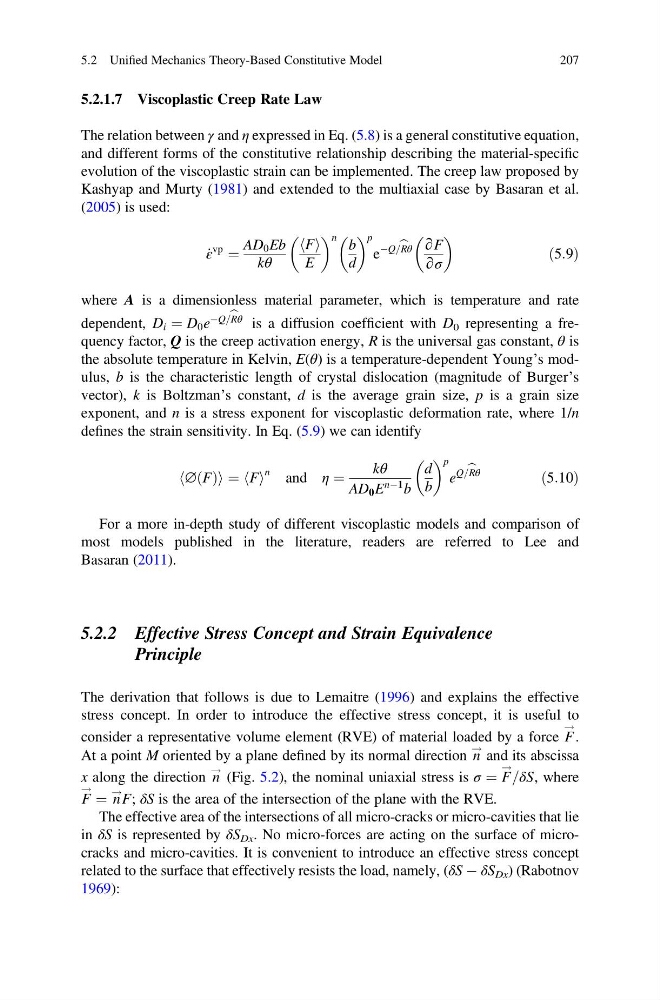
(2005) is used:
_
ε
vp
¼
AD 0 Eb
kθ
F
h i
E
n b
d
p
e
ÀQ= b Rθ ∂F
∂σ
ð5:9Þ
where A is a dimensionless material parameter, which is temperature and rate
dependent, D i ¼ D 0 e
ÀQ= b Rθ is a diffusion coefficient with D 0 representing a frequency factor, Q is the creep activation energy, R is the universal gas constant, θ is
the absolute temperature in Kelvin, E(θ) is a temperature-dependent Young’s modulus, b is the characteristic length of crystal dislocation (magnitude of Burger’s
vector), k is Boltzman’s constant, d is the average grain size, p is a grain size
exponent, and n is a stress exponent for viscoplastic deformation rate, where 1/n
defines the strain sensitivity. In Eq. (5.9) we can identify
∅ F
ð Þ
h
i¼ F
h i
n and η ¼
kθ
AD 0 E
nÀ1 b
d
b
p
e
Q= b Rθ
ð5:10Þ
For a more in-depth study of different viscoplastic models and comparison of
most models published in the literature, readers are referred to Lee and
Basaran (2011).
5.2.2 Effective Stress Concept and Strain Equivalence
Principle
The derivation that follows is due to Lemaitre (1996) and explains the effective
stress concept. In order to introduce the effective stress concept, it is useful to
consider a representative volume element (RVE) of material loaded by a force F
!
.
At a point M oriented by a plane defined by its normal direction n
! and its abscissa
x along the direction n
! (Fig. 5.2), the nominal uniaxial stress is σ ¼ F
!
=δS, where
F
! ¼ n
!
F; δS is the area of the intersection of the plane with the RVE.
The effective area of the intersections of all micro-cracks or micro-cavities that lie
in δS is represented by δS Dx . No micro-forces are acting on the surface of microcracks and micro-cavities. It is convenient to introduce an effective stress concept
related to the surface that effectively resists the load, namely, (δS À δS Dx ) (Rabotnov
1969):
5.2 Unified Mechanics Theory-Based Constitutive Model
207
The relation between γ and η expressed in Eq. (5.8) is a general constitutive equation,
and different forms of the constitutive relationship describing the material-specific
evolution of the viscoplastic strain can be implemented. The creep law proposed by
Kashyap and Murty (1981) and extended to the multiaxial case by Basaran et al.
(2005) is used:
_
ε
vp
¼
AD 0 Eb
kθ
F
h i
E
n b
d
p
e
ÀQ= b Rθ ∂F
∂σ
ð5:9Þ
where A is a dimensionless material parameter, which is temperature and rate
dependent, D i ¼ D 0 e
ÀQ= b Rθ is a diffusion coefficient with D 0 representing a frequency factor, Q is the creep activation energy, R is the universal gas constant, θ is
the absolute temperature in Kelvin, E(θ) is a temperature-dependent Young’s modulus, b is the characteristic length of crystal dislocation (magnitude of Burger’s
vector), k is Boltzman’s constant, d is the average grain size, p is a grain size
exponent, and n is a stress exponent for viscoplastic deformation rate, where 1/n
defines the strain sensitivity. In Eq. (5.9) we can identify
∅ F
ð Þ
h
i¼ F
h i
n and η ¼
kθ
AD 0 E
nÀ1 b
d
b
p
e
Q= b Rθ
ð5:10Þ
For a more in-depth study of different viscoplastic models and comparison of
most models published in the literature, readers are referred to Lee and
Basaran (2011).
5.2.2 Effective Stress Concept and Strain Equivalence
Principle
The derivation that follows is due to Lemaitre (1996) and explains the effective
stress concept. In order to introduce the effective stress concept, it is useful to
consider a representative volume element (RVE) of material loaded by a force F
!
.
At a point M oriented by a plane defined by its normal direction n
! and its abscissa
x along the direction n
! (Fig. 5.2), the nominal uniaxial stress is σ ¼ F
!
=δS, where
F
! ¼ n
!
F; δS is the area of the intersection of the plane with the RVE.
The effective area of the intersections of all micro-cracks or micro-cavities that lie
in δS is represented by δS Dx . No micro-forces are acting on the surface of microcracks and micro-cavities. It is convenient to introduce an effective stress concept
related to the surface that effectively resists the load, namely, (δS À δS Dx ) (Rabotnov
1969):
5.2 Unified Mechanics Theory-Based Constitutive Model
207