

_
X ¼ c 1 _
ε
p
À c 2 X _
α
ð5:5Þ
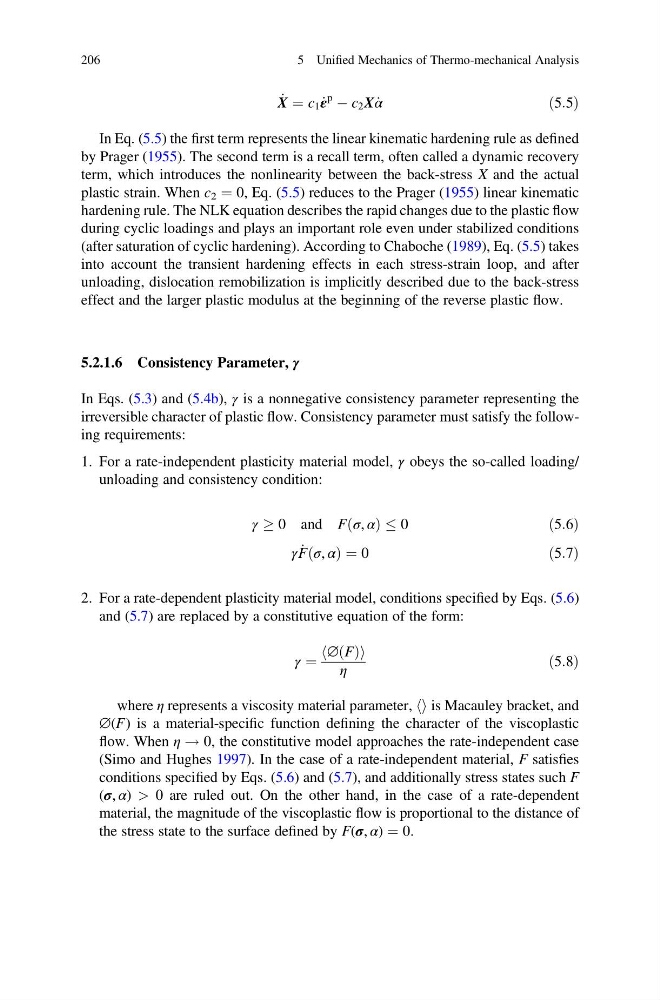
In Eq. (5.5) the first term represents the linear kinematic hardening rule as defined
by Prager (1955). The second term is a recall term, often called a dynamic recovery
term, which introduces the nonlinearity between the back-stress X and the actual
plastic strain. When c 2 ¼ 0, Eq. (5.5) reduces to the Prager (1955) linear kinematic
hardening rule. The NLK equation describes the rapid changes due to the plastic flow
during cyclic loadings and plays an important role even under stabilized conditions
(after saturation of cyclic hardening). According to Chaboche (1989), Eq. (5.5) takes
into account the transient hardening effects in each stress-strain loop, and after
unloading, dislocation remobilization is implicitly described due to the back-stress
effect and the larger plastic modulus at the beginning of the reverse plastic flow.
5.2.1.6 Consistency Parameter, γ
In Eqs. (5.3) and (5.4b), γ is a nonnegative consistency parameter representing the
irreversible character of plastic flow. Consistency parameter must satisfy the following requirements:
1. For a rate-independent plasticity material model, γ obeys the so-called loading/
unloading and consistency condition:
γ ! 0 and F σ, α
ð Þ 0
ð5:6Þ
γ _
F σ, α
ð Þ ¼ 0
ð5:7Þ
2. For a rate-dependent plasticity material model, conditions specified by Eqs. (5.6)
and (5.7) are replaced by a constitutive equation of the form:
γ ¼
∅ F
ð Þ
h
i
η
ð5:8Þ
where η represents a viscosity material parameter, hi is Macauley bracket, and
∅(F) is a material-specific function defining the character of the viscoplastic
flow. When η ! 0, the constitutive model approaches the rate-independent case
(Simo and Hughes 1997). In the case of a rate-independent material, F satisfies
conditions specified by Eqs. (5.6) and (5.7), and additionally stress states such F
(σ, α) > 0 are ruled out. On the other hand, in the case of a rate-dependent
material, the magnitude of the viscoplastic flow is proportional to the distance of
the stress state to the surface defined by F(σ, α) ¼ 0.
206
5 Unified Mechanics of Thermo-mechanical Analysis
X ¼ c 1 _
ε
p
À c 2 X _
α
ð5:5Þ
In Eq. (5.5) the first term represents the linear kinematic hardening rule as defined
by Prager (1955). The second term is a recall term, often called a dynamic recovery
term, which introduces the nonlinearity between the back-stress X and the actual
plastic strain. When c 2 ¼ 0, Eq. (5.5) reduces to the Prager (1955) linear kinematic
hardening rule. The NLK equation describes the rapid changes due to the plastic flow
during cyclic loadings and plays an important role even under stabilized conditions
(after saturation of cyclic hardening). According to Chaboche (1989), Eq. (5.5) takes
into account the transient hardening effects in each stress-strain loop, and after
unloading, dislocation remobilization is implicitly described due to the back-stress
effect and the larger plastic modulus at the beginning of the reverse plastic flow.
5.2.1.6 Consistency Parameter, γ
In Eqs. (5.3) and (5.4b), γ is a nonnegative consistency parameter representing the
irreversible character of plastic flow. Consistency parameter must satisfy the following requirements:
1. For a rate-independent plasticity material model, γ obeys the so-called loading/
unloading and consistency condition:
γ ! 0 and F σ, α
ð Þ 0
ð5:6Þ
γ _
F σ, α
ð Þ ¼ 0
ð5:7Þ
2. For a rate-dependent plasticity material model, conditions specified by Eqs. (5.6)
and (5.7) are replaced by a constitutive equation of the form:
γ ¼
∅ F
ð Þ
h
i
η
ð5:8Þ
where η represents a viscosity material parameter, hi is Macauley bracket, and
∅(F) is a material-specific function defining the character of the viscoplastic
flow. When η ! 0, the constitutive model approaches the rate-independent case
(Simo and Hughes 1997). In the case of a rate-independent material, F satisfies
conditions specified by Eqs. (5.6) and (5.7), and additionally stress states such F
(σ, α) > 0 are ruled out. On the other hand, in the case of a rate-dependent
material, the magnitude of the viscoplastic flow is proportional to the distance of
the stress state to the surface defined by F(σ, α) ¼ 0.
206
5 Unified Mechanics of Thermo-mechanical Analysis