

_
ε
p
¼ γ
∂F
∂σ
γb n
ð5:3Þ
with b n ¼
∂F
∂σ
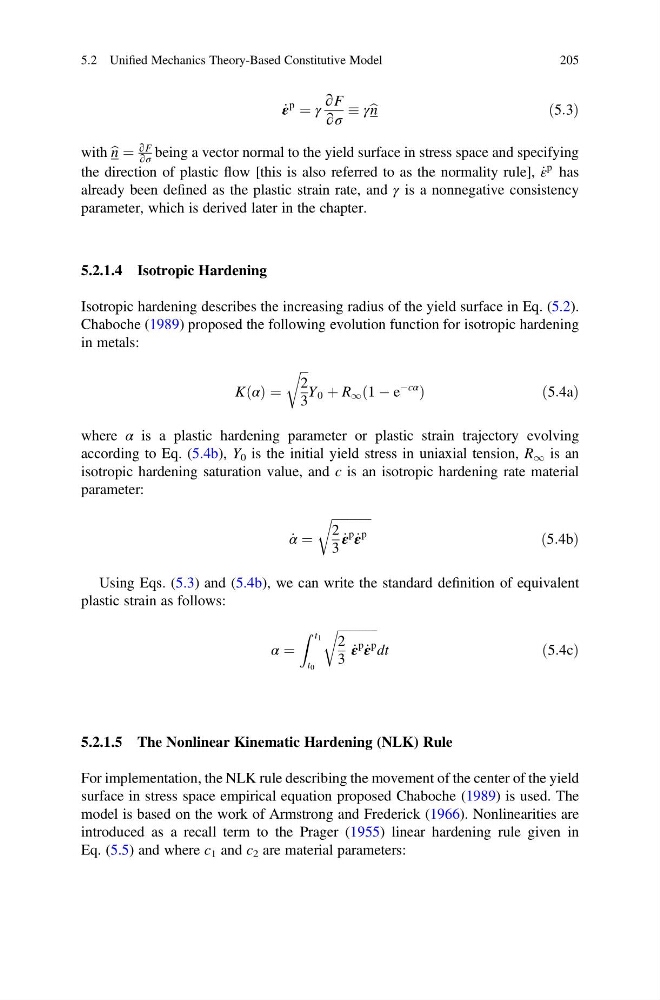
being a vector normal to the yield surface in stress space and specifying
the direction of plastic flow [this is also referred to as the normality rule], _
ε
p has
already been defined as the plastic strain rate, and γ is a nonnegative consistency
parameter, which is derived later in the chapter.
5.2.1.4 Isotropic Hardening
Isotropic hardening describes the increasing radius of the yield surface in Eq. (5.2).
Chaboche (1989) proposed the following evolution function for isotropic hardening
in metals:
K α
ð Þ ¼
ffiffi ffi
2
3
r
Y 0 þ R 1 1 À e
Àcα
ð
Þ
ð 5:4aÞ
where α is a plastic hardening parameter or plastic strain trajectory evolving
according to Eq. (5.4b), Y 0 is the initial yield stress in uniaxial tension, R 1 is an
isotropic hardening saturation value, and c is an isotropic hardening rate material
parameter:
_
α ¼
ffiffiffiffiffiffiffiffiffiffiffiffiffi
2
3
_
ε
p
_
ε
p
r
ð5:4bÞ
Using Eqs. (5.3) and (5.4b), we can write the standard definition of equivalent
plastic strain as follows:
α ¼
Z t 1
t 0
ffiffiffiffiffiffiffiffiffiffiffiffiffi
2
3
_
ε
p
_
ε
p
r
dt
ð5:4cÞ
5.2.1.5 The Nonlinear Kinematic Hardening (NLK) Rule
For implementation, the NLK rule describing the movement of the center of the yield
surface in stress space empirical equation proposed Chaboche (1989) is used. The
model is based on the work of Armstrong and Frederick (1966). Nonlinearities are
introduced as a recall term to the Prager (1955) linear hardening rule given in
Eq. (5.5) and where c 1 and c 2 are material parameters:
5.2 Unified Mechanics Theory-Based Constitutive Model
205
ε
p
¼ γ
∂F
∂σ
γb n
ð5:3Þ
with b n ¼
∂F
∂σ
being a vector normal to the yield surface in stress space and specifying
the direction of plastic flow [this is also referred to as the normality rule], _
ε
p has
already been defined as the plastic strain rate, and γ is a nonnegative consistency
parameter, which is derived later in the chapter.
5.2.1.4 Isotropic Hardening
Isotropic hardening describes the increasing radius of the yield surface in Eq. (5.2).
Chaboche (1989) proposed the following evolution function for isotropic hardening
in metals:
K α
ð Þ ¼
ffiffi ffi
2
3
r
Y 0 þ R 1 1 À e
Àcα
ð
Þ
ð 5:4aÞ
where α is a plastic hardening parameter or plastic strain trajectory evolving
according to Eq. (5.4b), Y 0 is the initial yield stress in uniaxial tension, R 1 is an
isotropic hardening saturation value, and c is an isotropic hardening rate material
parameter:
_
α ¼
ffiffiffiffiffiffiffiffiffiffiffiffiffi
2
3
_
ε
p
_
ε
p
r
ð5:4bÞ
Using Eqs. (5.3) and (5.4b), we can write the standard definition of equivalent
plastic strain as follows:
α ¼
Z t 1
t 0
ffiffiffiffiffiffiffiffiffiffiffiffiffi
2
3
_
ε
p
_
ε
p
r
dt
ð5:4cÞ
5.2.1.5 The Nonlinear Kinematic Hardening (NLK) Rule
For implementation, the NLK rule describing the movement of the center of the yield
surface in stress space empirical equation proposed Chaboche (1989) is used. The
model is based on the work of Armstrong and Frederick (1966). Nonlinearities are
introduced as a recall term to the Prager (1955) linear hardening rule given in
Eq. (5.5) and where c 1 and c 2 are material parameters:
5.2 Unified Mechanics Theory-Based Constitutive Model
205