

5.2.1.2 Yield Surface
There is no uniformity in terminology in the plasticity literature; “yield function,”
“yield surface,” “plastic potential function,” and “plastic flow function” are all used
interchangeably. For most metals an elastoplastic domain is defined according to the
following yield function of the von Mises type:
F σ, α
ð Þ ¼ S À X
k
kÀ
ffiffi ffi
2
3
r
K α
ð Þ S À X
k
kÀ R α
ð Þ
ð5:2Þ
where F(σ, α) is a yield surface separating the elastic from the inelastic domain, σ is
the second-order stress tensor, α is a hardening parameter which specifies the
evolution of the radius of the yield surface, X is the deviatoric component of the
back-stress tensor describing the position of the center of the yield surface in stress
space, S is the deviatoric component of the stress tensor given by S ¼ σ À
1
3 pI where
p is the hydrostatic pressure and I is the second-order identity tensor, R α
ð Þ
ffiffi
2
3
q
K α
ð Þ is the radius of the yield surface in stress space, and k k represents the
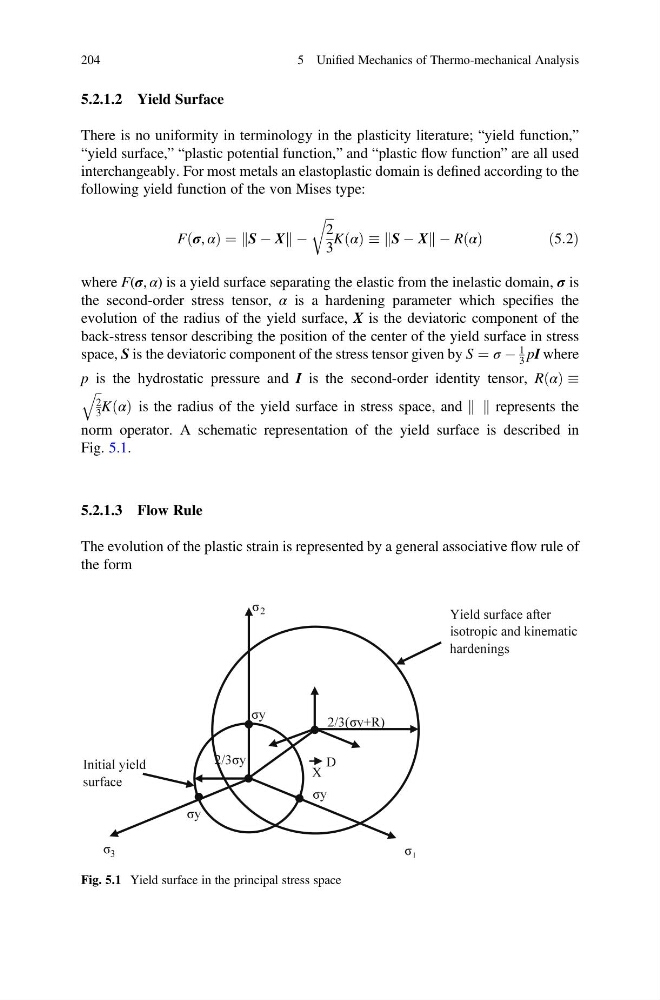
norm operator. A schematic representation of the yield surface is described in
Fig. 5.1.
5.2.1.3 Flow Rule
The evolution of the plastic strain is represented by a general associative flow rule of
the form
Fig. 5.1 Yield surface in the principal stress space
204
5 Unified Mechanics of Thermo-mechanical Analysis
There is no uniformity in terminology in the plasticity literature; “yield function,”
“yield surface,” “plastic potential function,” and “plastic flow function” are all used
interchangeably. For most metals an elastoplastic domain is defined according to the
following yield function of the von Mises type:
F σ, α
ð Þ ¼ S À X
k
kÀ
ffiffi ffi
2
3
r
K α
ð Þ S À X
k
kÀ R α
ð Þ
ð5:2Þ
where F(σ, α) is a yield surface separating the elastic from the inelastic domain, σ is
the second-order stress tensor, α is a hardening parameter which specifies the
evolution of the radius of the yield surface, X is the deviatoric component of the
back-stress tensor describing the position of the center of the yield surface in stress
space, S is the deviatoric component of the stress tensor given by S ¼ σ À
1
3 pI where
p is the hydrostatic pressure and I is the second-order identity tensor, R α
ð Þ
ffiffi
2
3
q
K α
ð Þ is the radius of the yield surface in stress space, and k k represents the
norm operator. A schematic representation of the yield surface is described in
Fig. 5.1.
5.2.1.3 Flow Rule
The evolution of the plastic strain is represented by a general associative flow rule of
the form
Fig. 5.1 Yield surface in the principal stress space
204
5 Unified Mechanics of Thermo-mechanical Analysis