

Of course, the degradation of elastic energy storage capacity is due to degradation
of stiffness. However, we should point out that here we assumed that
∂Φ
∂δ
is smaller
than
∂
1
2 kδ
2
½
∂δ
by an order of magnitude which might be true for high cycle fatigue but
not true for low cycle fatigue.
It is important to point out that entropy is essentially energy unavailable for work.
Therefore, TSI index degrades total available energy of a closed-isolated system.
Multiplication of stiffness k with (1 À ϕ) is due to simplicity of the example chosen.
Essentially TSI coordinate maps entropy generation rate [fundamental equation] of
any system to a linearly independent axis.
The question may be asked what happens to a system moving from one stable
equilibrium valley to another, gets an external energy boost during travel due to an
external factor. Because entropy is an additive property, and we have to maintain
conservation of energy, we can include the new addition in the system. Actually, in
computational mechanics we solve differential equations in incremental format.
Therefore using Thermodynamic State Index works very well for incremental
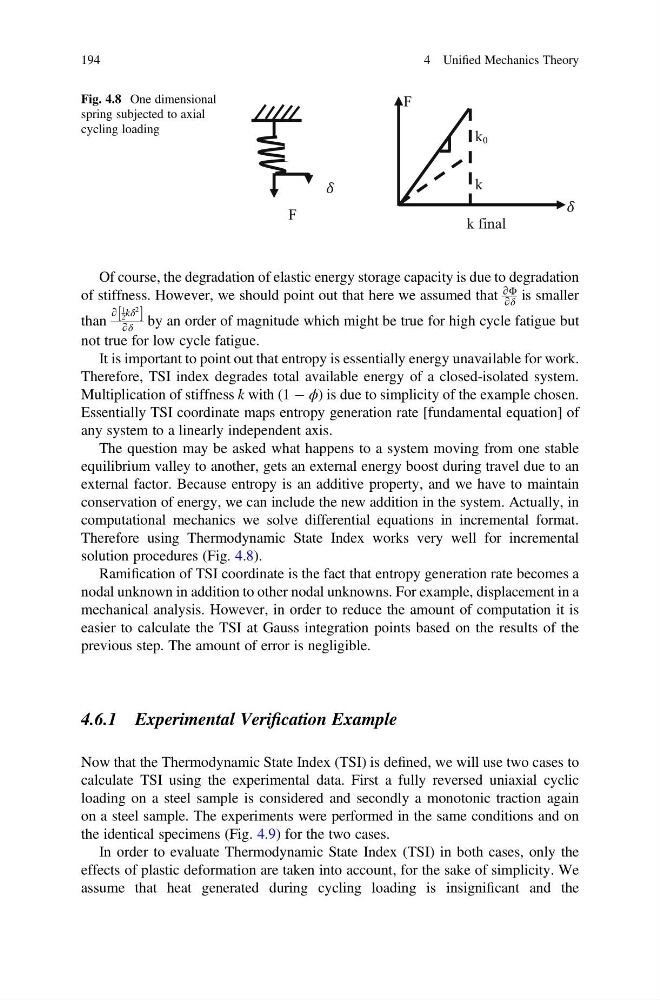
solution procedures (Fig. 4.8).
Ramification of TSI coordinate is the fact that entropy generation rate becomes a
nodal unknown in addition to other nodal unknowns. For example, displacement in a
mechanical analysis. However, in order to reduce the amount of computation it is
easier to calculate the TSI at Gauss integration points based on the results of the
previous step. The amount of error is negligible.
4.6.1 Experimental Verification Example
Now that the Thermodynamic State Index (TSI) is defined, we will use two cases to
calculate TSI using the experimental data. First a fully reversed uniaxial cyclic
loading on a steel sample is considered and secondly a monotonic traction again
on a steel sample. The experiments were performed in the same conditions and on
the identical specimens (Fig. 4.9) for the two cases.
In order to evaluate Thermodynamic State Index (TSI) in both cases, only the
effects of plastic deformation are taken into account, for the sake of simplicity. We
assume that heat generated during cycling loading is insignificant and the
F
F
k final
k 0
k
Fig. 4.8 One dimensional
spring subjected to axial
cycling loading
194
4 Unified Mechanics Theory
of stiffness. However, we should point out that here we assumed that
∂Φ
∂δ
is smaller
than
∂
1
2 kδ
2
½
∂δ
by an order of magnitude which might be true for high cycle fatigue but
not true for low cycle fatigue.
It is important to point out that entropy is essentially energy unavailable for work.
Therefore, TSI index degrades total available energy of a closed-isolated system.
Multiplication of stiffness k with (1 À ϕ) is due to simplicity of the example chosen.
Essentially TSI coordinate maps entropy generation rate [fundamental equation] of
any system to a linearly independent axis.
The question may be asked what happens to a system moving from one stable
equilibrium valley to another, gets an external energy boost during travel due to an
external factor. Because entropy is an additive property, and we have to maintain
conservation of energy, we can include the new addition in the system. Actually, in
computational mechanics we solve differential equations in incremental format.
Therefore using Thermodynamic State Index works very well for incremental
solution procedures (Fig. 4.8).
Ramification of TSI coordinate is the fact that entropy generation rate becomes a
nodal unknown in addition to other nodal unknowns. For example, displacement in a
mechanical analysis. However, in order to reduce the amount of computation it is
easier to calculate the TSI at Gauss integration points based on the results of the
previous step. The amount of error is negligible.
4.6.1 Experimental Verification Example
Now that the Thermodynamic State Index (TSI) is defined, we will use two cases to
calculate TSI using the experimental data. First a fully reversed uniaxial cyclic
loading on a steel sample is considered and secondly a monotonic traction again
on a steel sample. The experiments were performed in the same conditions and on
the identical specimens (Fig. 4.9) for the two cases.
In order to evaluate Thermodynamic State Index (TSI) in both cases, only the
effects of plastic deformation are taken into account, for the sake of simplicity. We
assume that heat generated during cycling loading is insignificant and the
F
F
k final
k 0
k
Fig. 4.8 One dimensional
spring subjected to axial
cycling loading
194
4 Unified Mechanics Theory