

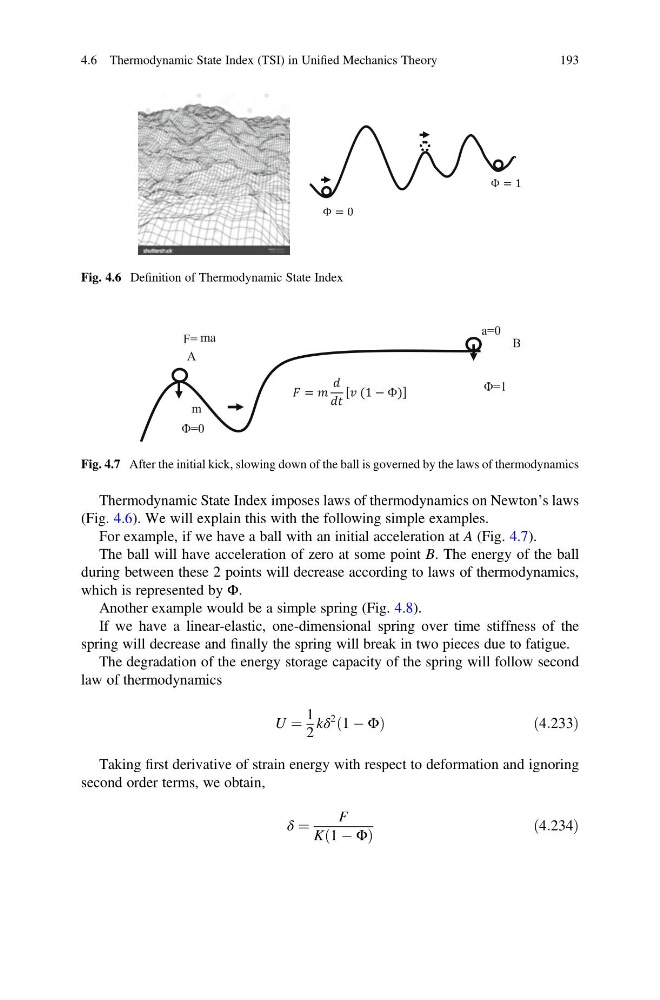
Thermodynamic State Index imposes laws of thermodynamics on Newton’s laws
(Fig. 4.6). We will explain this with the following simple examples.
For example, if we have a ball with an initial acceleration at A (Fig. 4.7).
The ball will have acceleration of zero at some point B. The energy of the ball
during between these 2 points will decrease according to laws of thermodynamics,
which is represented by Φ.
Another example would be a simple spring (Fig. 4.8).
If we have a linear-elastic, one-dimensional spring over time stiffness of the
spring will decrease and finally the spring will break in two pieces due to fatigue.
The degradation of the energy storage capacity of the spring will follow second
law of thermodynamics
U ¼
1
2
kδ
2 1 À Φ
ð
Þ
ð4:233Þ
Taking first derivative of strain energy with respect to deformation and ignoring
second order terms, we obtain,
δ ¼
F
K 1 À Φ
ð
Þ
ð4:234Þ
Fig. 4.7 After the initial kick, slowing down of the ball is governed by the laws of thermodynamics
Φ = 0
Φ = 1
Fig. 4.6 Definition of Thermodynamic State Index
4.6 Thermodynamic State Index (TSI) in Unified Mechanics Theory
193
(Fig. 4.6). We will explain this with the following simple examples.
For example, if we have a ball with an initial acceleration at A (Fig. 4.7).
The ball will have acceleration of zero at some point B. The energy of the ball
during between these 2 points will decrease according to laws of thermodynamics,
which is represented by Φ.
Another example would be a simple spring (Fig. 4.8).
If we have a linear-elastic, one-dimensional spring over time stiffness of the
spring will decrease and finally the spring will break in two pieces due to fatigue.
The degradation of the energy storage capacity of the spring will follow second
law of thermodynamics
U ¼
1
2
kδ
2 1 À Φ
ð
Þ
ð4:233Þ
Taking first derivative of strain energy with respect to deformation and ignoring
second order terms, we obtain,
δ ¼
F
K 1 À Φ
ð
Þ
ð4:234Þ
Fig. 4.7 After the initial kick, slowing down of the ball is governed by the laws of thermodynamics
Φ = 0
Φ = 1
Fig. 4.6 Definition of Thermodynamic State Index
4.6 Thermodynamic State Index (TSI) in Unified Mechanics Theory
193