

It is important to point out that the final form of Boltzmann equation was derived
by Planck 1901. Therefore, we will use Planck’s definition for variable
w (probability or disorder). However, even if we use Ω, the number of microstates,
nothing would change in the formulation of TSI, because we normalize the equation,
as a result it is a nondimensional linearly independent axis.
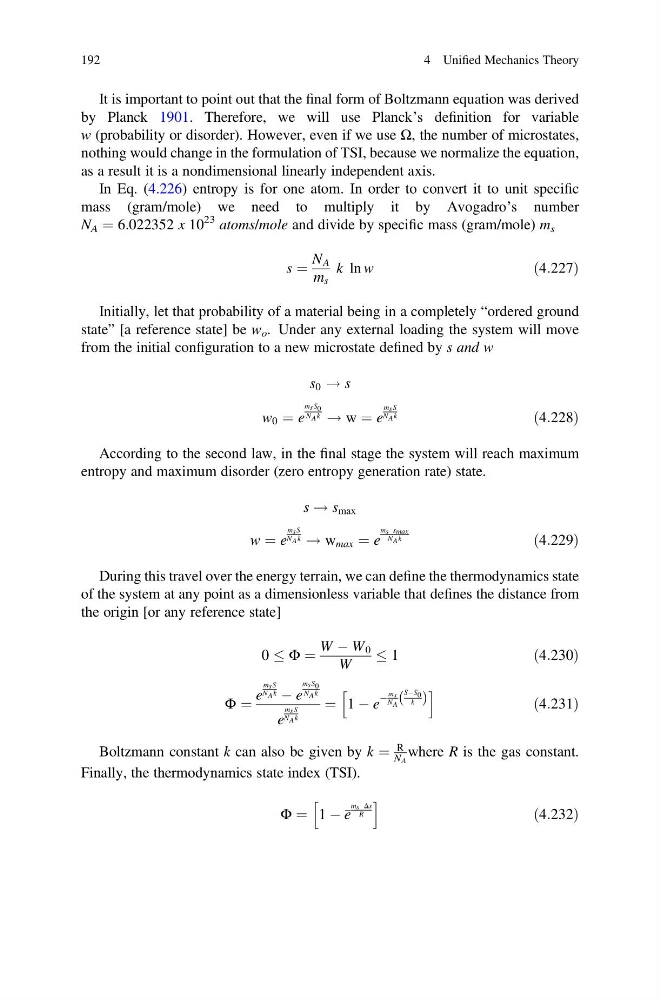
In Eq. (4.226) entropy is for one atom. In order to convert it to unit specific
mass (gram/mole) we need to multiply it by Avogadro’s number
N A ¼ 6.022352 x 10
23 atoms/mole and divide by specific mass (gram/mole) m s
s ¼
N A
m s
k ln w
ð4:227Þ
Initially, let that probability of a material being in a completely “ordered ground
state” [a reference state] be w o . Under any external loading the system will move
from the initial configuration to a new microstate defined by s and w
s 0 ! s
w 0 ¼ e
ms S 0
N A k
! w ¼ e
ms S
N A k
ð4:228Þ
According to the second law, in the final stage the system will reach maximum
entropy and maximum disorder (zero entropy generation rate) state.
s ! s max
w ¼ e
ms S
N A k
! w max ¼ e
ms smax
N A k
ð4:229Þ
During this travel over the energy terrain, we can define the thermodynamics state
of the system at any point as a dimensionless variable that defines the distance from
the origin [or any reference state]
0 Φ ¼
W À W 0
W
1
ð4:230Þ
Φ ¼
e
ms S
N A k
À e
ms S 0
N A k
e
ms S
N A k
¼ 1 À e
À
ms
N A
SÀS 0
k
ð Þ
h
i
ð4:231Þ
Boltzmann constant k can also be given by k ¼
R
N A
where R is the gas constant.
Finally, the thermodynamics state index (TSI).
Φ ¼ 1 À e
ms Δs
R
h
i
ð4:232Þ
192
4 Unified Mechanics Theory
by Planck 1901. Therefore, we will use Planck’s definition for variable
w (probability or disorder). However, even if we use Ω, the number of microstates,
nothing would change in the formulation of TSI, because we normalize the equation,
as a result it is a nondimensional linearly independent axis.
In Eq. (4.226) entropy is for one atom. In order to convert it to unit specific
mass (gram/mole) we need to multiply it by Avogadro’s number
N A ¼ 6.022352 x 10
23 atoms/mole and divide by specific mass (gram/mole) m s
s ¼
N A
m s
k ln w
ð4:227Þ
Initially, let that probability of a material being in a completely “ordered ground
state” [a reference state] be w o . Under any external loading the system will move
from the initial configuration to a new microstate defined by s and w
s 0 ! s
w 0 ¼ e
ms S 0
N A k
! w ¼ e
ms S
N A k
ð4:228Þ
According to the second law, in the final stage the system will reach maximum
entropy and maximum disorder (zero entropy generation rate) state.
s ! s max
w ¼ e
ms S
N A k
! w max ¼ e
ms smax
N A k
ð4:229Þ
During this travel over the energy terrain, we can define the thermodynamics state
of the system at any point as a dimensionless variable that defines the distance from
the origin [or any reference state]
0 Φ ¼
W À W 0
W
1
ð4:230Þ
Φ ¼
e
ms S
N A k
À e
ms S 0
N A k
e
ms S
N A k
¼ 1 À e
À
ms
N A
SÀS 0
k
ð Þ
h
i
ð4:231Þ
Boltzmann constant k can also be given by k ¼
R
N A
where R is the gas constant.
Finally, the thermodynamics state index (TSI).
Φ ¼ 1 À e
ms Δs
R
h
i
ð4:232Þ
192
4 Unified Mechanics Theory