

The TSI axis coordinate cannot be defined by space-time coordinates; therefore it is a
linearly independent axis. Similar to what Boltzmann defined as an additional axis.
The coordinate value of a point on TSI axis defined by laws of thermodynamics and
according to the fundamental equation of the system, we defined earlier. Fundamental equation must account for all irreversible entropy generation mechanisms
according to our failure definition. For example, if color change in a polymer is
our failure definition, then fundamental equation will only have mechanisms that
contribute to color change not mechanical failure.
We have already presented second law of thermodynamics in Boltzmann-Planck
formulation as
S ¼ k ln w
ð4:226Þ
where S in entropy, k is Boltzmann’s constant, and w is the disorder parameter,
which is the probability that the system will exist in the state it is relative to all the
possible states it could be in,
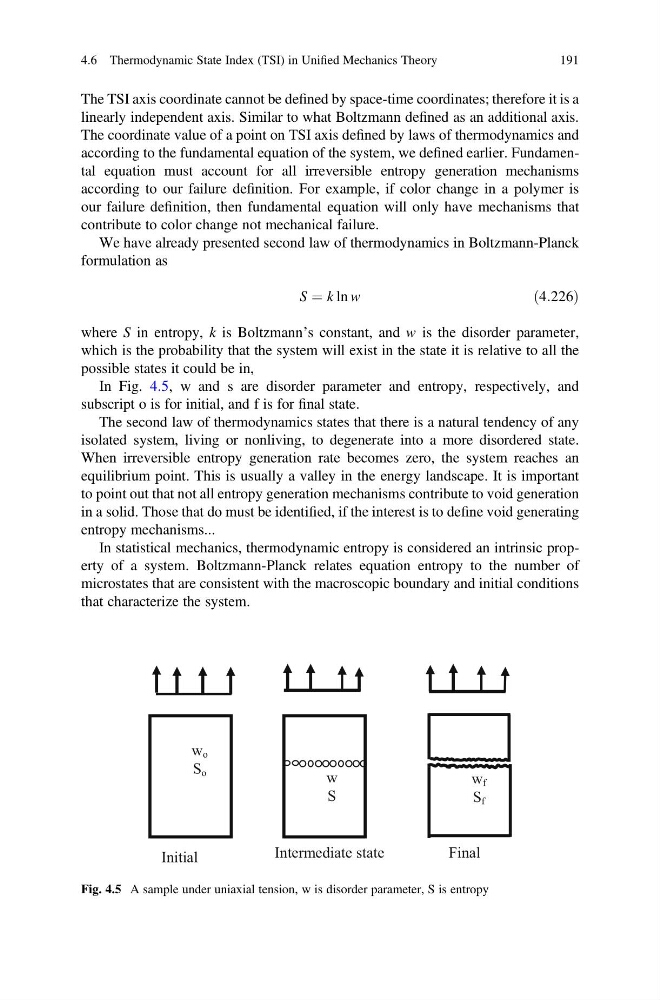
In Fig. 4.5, w and s are disorder parameter and entropy, respectively, and
subscript o is for initial, and f is for final state.
The second law of thermodynamics states that there is a natural tendency of any
isolated system, living or nonliving, to degenerate into a more disordered state.
When irreversible entropy generation rate becomes zero, the system reaches an
equilibrium point. This is usually a valley in the energy landscape. It is important
to point out that not all entropy generation mechanisms contribute to void generation
in a solid. Those that do must be identified, if the interest is to define void generating
entropy mechanisms...
In statistical mechanics, thermodynamic entropy is considered an intrinsic property of a system. Boltzmann-Planck relates equation entropy to the number of
microstates that are consistent with the macroscopic boundary and initial conditions
that characterize the system.
w o
S o
Initial
Intermediate state
Final
w f
S f
w
S
Fig. 4.5 A sample under uniaxial tension, w is disorder parameter, S is entropy
4.6 Thermodynamic State Index (TSI) in Unified Mechanics Theory
191
linearly independent axis. Similar to what Boltzmann defined as an additional axis.
The coordinate value of a point on TSI axis defined by laws of thermodynamics and
according to the fundamental equation of the system, we defined earlier. Fundamental equation must account for all irreversible entropy generation mechanisms
according to our failure definition. For example, if color change in a polymer is
our failure definition, then fundamental equation will only have mechanisms that
contribute to color change not mechanical failure.
We have already presented second law of thermodynamics in Boltzmann-Planck
formulation as
S ¼ k ln w
ð4:226Þ
where S in entropy, k is Boltzmann’s constant, and w is the disorder parameter,
which is the probability that the system will exist in the state it is relative to all the
possible states it could be in,
In Fig. 4.5, w and s are disorder parameter and entropy, respectively, and
subscript o is for initial, and f is for final state.
The second law of thermodynamics states that there is a natural tendency of any
isolated system, living or nonliving, to degenerate into a more disordered state.
When irreversible entropy generation rate becomes zero, the system reaches an
equilibrium point. This is usually a valley in the energy landscape. It is important
to point out that not all entropy generation mechanisms contribute to void generation
in a solid. Those that do must be identified, if the interest is to define void generating
entropy mechanisms...
In statistical mechanics, thermodynamic entropy is considered an intrinsic property of a system. Boltzmann-Planck relates equation entropy to the number of
microstates that are consistent with the macroscopic boundary and initial conditions
that characterize the system.
w o
S o
Initial
Intermediate state
Final
w f
S f
w
S
Fig. 4.5 A sample under uniaxial tension, w is disorder parameter, S is entropy
4.6 Thermodynamic State Index (TSI) in Unified Mechanics Theory
191