

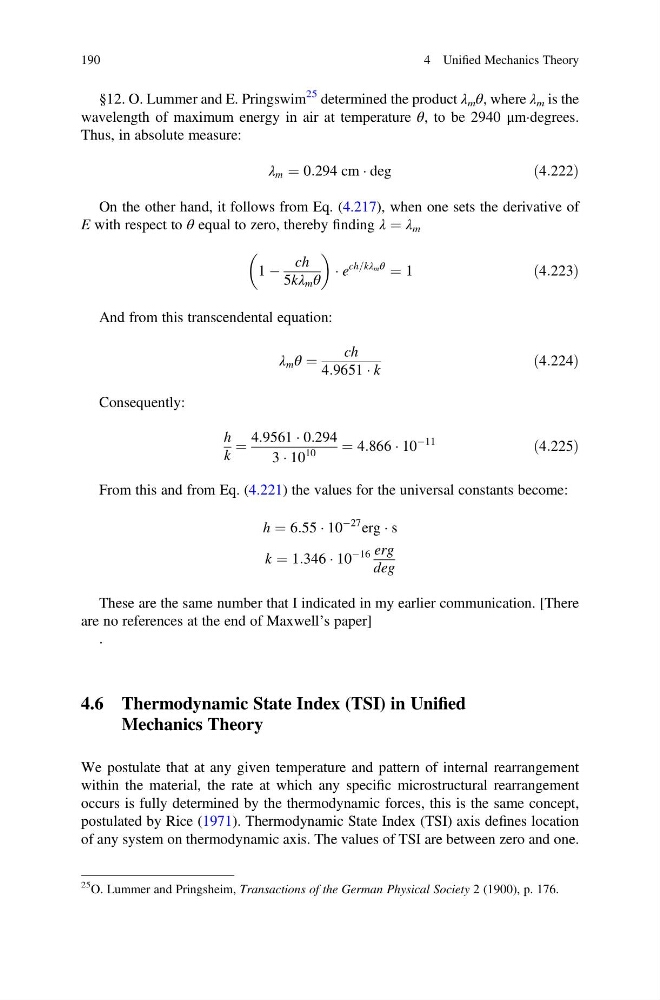
§12. O. Lummer and E. Pringswim
25 determined the product λ m θ, where λ m is the
wavelength of maximum energy in air at temperature θ, to be 2940 μmÁdegrees.
Thus, in absolute measure:
λ m ¼ 0:294 cm Á deg
ð4:222Þ
On the other hand, it follows from Eq. (4.217), when one sets the derivative of
E with respect to θ equal to zero, thereby finding λ ¼ λ m
1 À
ch
5kλ m θ
Á e
ch=kλ m θ
¼ 1
ð4:223Þ
And from this transcendental equation:
λ m θ ¼
ch
4:9651 Á k
ð4:224Þ
Consequently:
h
k
¼
4:9561 Á 0:294
3 Á 10
10
¼ 4:866 Á 10
À11
ð4:225Þ
From this and from Eq. (4.221) the values for the universal constants become:
h ¼ 6:55 Á 10
À27 erg Á s
k ¼ 1:346 Á 10
À16 erg
deg
These are the same number that I indicated in my earlier communication. [There
are no references at the end of Maxwell’s paper]
.
4.6 Thermodynamic State Index (TSI) in Unified
Mechanics Theory
We postulate that at any given temperature and pattern of internal rearrangement
within the material, the rate at which any specific microstructural rearrangement
occurs is fully determined by the thermodynamic forces, this is the same concept,
postulated by Rice (1971). Thermodynamic State Index (TSI) axis defines location
of any system on thermodynamic axis. The values of TSI are between zero and one.
25 O. Lummer and Pringsheim, Transactions of the German Physical Society 2 (1900), p. 176.
190
4 Unified Mechanics Theory
25 determined the product λ m θ, where λ m is the
wavelength of maximum energy in air at temperature θ, to be 2940 μmÁdegrees.
Thus, in absolute measure:
λ m ¼ 0:294 cm Á deg
ð4:222Þ
On the other hand, it follows from Eq. (4.217), when one sets the derivative of
E with respect to θ equal to zero, thereby finding λ ¼ λ m
1 À
ch
5kλ m θ
Á e
ch=kλ m θ
¼ 1
ð4:223Þ
And from this transcendental equation:
λ m θ ¼
ch
4:9651 Á k
ð4:224Þ
Consequently:
h
k
¼
4:9561 Á 0:294
3 Á 10
10
¼ 4:866 Á 10
À11
ð4:225Þ
From this and from Eq. (4.221) the values for the universal constants become:
h ¼ 6:55 Á 10
À27 erg Á s
k ¼ 1:346 Á 10
À16 erg
deg
These are the same number that I indicated in my earlier communication. [There
are no references at the end of Maxwell’s paper]
.
4.6 Thermodynamic State Index (TSI) in Unified
Mechanics Theory
We postulate that at any given temperature and pattern of internal rearrangement
within the material, the rate at which any specific microstructural rearrangement
occurs is fully determined by the thermodynamic forces, this is the same concept,
postulated by Rice (1971). Thermodynamic State Index (TSI) axis defines location
of any system on thermodynamic axis. The values of TSI are between zero and one.
25 O. Lummer and Pringsheim, Transactions of the German Physical Society 2 (1900), p. 176.
190
4 Unified Mechanics Theory