

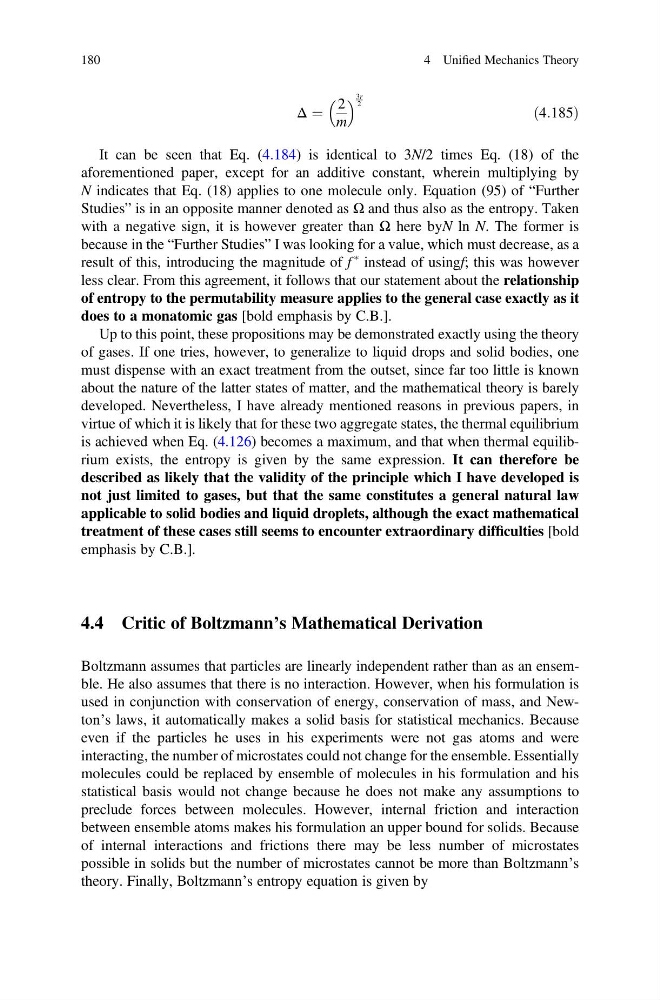
Δ ¼
2
m
3r
2
ð4:185Þ
It can be seen that Eq. (4.184) is identical to 3N/2 times Eq. (18) of the
aforementioned paper, except for an additive constant, wherein multiplying by
N indicates that Eq. (18) applies to one molecule only. Equation (95) of “Further
Studies” is in an opposite manner denoted as Ω and thus also as the entropy. Taken
with a negative sign, it is however greater than Ω here byN ln N. The former is
because in the “Further Studies” I was looking for a value, which must decrease, as a
result of this, introducing the magnitude of f
à instead of usingf; this was however
less clear. From this agreement, it follows that our statement about the relationship
of entropy to the permutability measure applies to the general case exactly as it
does to a monatomic gas [bold emphasis by C.B.].
Up to this point, these propositions may be demonstrated exactly using the theory
of gases. If one tries, however, to generalize to liquid drops and solid bodies, one
must dispense with an exact treatment from the outset, since far too little is known
about the nature of the latter states of matter, and the mathematical theory is barely
developed. Nevertheless, I have already mentioned reasons in previous papers, in
virtue of which it is likely that for these two aggregate states, the thermal equilibrium
is achieved when Eq. (4.126) becomes a maximum, and that when thermal equilibrium exists, the entropy is given by the same expression. It can therefore be
described as likely that the validity of the principle which I have developed is
not just limited to gases, but that the same constitutes a general natural law
applicable to solid bodies and liquid droplets, although the exact mathematical
treatment of these cases still seems to encounter extraordinary difficulties [bold
emphasis by C.B.].
4.4 Critic of Boltzmann’s Mathematical Derivation
Boltzmann assumes that particles are linearly independent rather than as an ensemble. He also assumes that there is no interaction. However, when his formulation is
used in conjunction with conservation of energy, conservation of mass, and Newton’s laws, it automatically makes a solid basis for statistical mechanics. Because
even if the particles he uses in his experiments were not gas atoms and were
interacting, the number of microstates could not change for the ensemble. Essentially
molecules could be replaced by ensemble of molecules in his formulation and his
statistical basis would not change because he does not make any assumptions to
preclude forces between molecules. However, internal friction and interaction
between ensemble atoms makes his formulation an upper bound for solids. Because
of internal interactions and frictions there may be less number of microstates
possible in solids but the number of microstates cannot be more than Boltzmann’s
theory. Finally, Boltzmann’s entropy equation is given by
180
4 Unified Mechanics Theory
2
m
3r
2
ð4:185Þ
It can be seen that Eq. (4.184) is identical to 3N/2 times Eq. (18) of the
aforementioned paper, except for an additive constant, wherein multiplying by
N indicates that Eq. (18) applies to one molecule only. Equation (95) of “Further
Studies” is in an opposite manner denoted as Ω and thus also as the entropy. Taken
with a negative sign, it is however greater than Ω here byN ln N. The former is
because in the “Further Studies” I was looking for a value, which must decrease, as a
result of this, introducing the magnitude of f
à instead of usingf; this was however
less clear. From this agreement, it follows that our statement about the relationship
of entropy to the permutability measure applies to the general case exactly as it
does to a monatomic gas [bold emphasis by C.B.].
Up to this point, these propositions may be demonstrated exactly using the theory
of gases. If one tries, however, to generalize to liquid drops and solid bodies, one
must dispense with an exact treatment from the outset, since far too little is known
about the nature of the latter states of matter, and the mathematical theory is barely
developed. Nevertheless, I have already mentioned reasons in previous papers, in
virtue of which it is likely that for these two aggregate states, the thermal equilibrium
is achieved when Eq. (4.126) becomes a maximum, and that when thermal equilibrium exists, the entropy is given by the same expression. It can therefore be
described as likely that the validity of the principle which I have developed is
not just limited to gases, but that the same constitutes a general natural law
applicable to solid bodies and liquid droplets, although the exact mathematical
treatment of these cases still seems to encounter extraordinary difficulties [bold
emphasis by C.B.].
4.4 Critic of Boltzmann’s Mathematical Derivation
Boltzmann assumes that particles are linearly independent rather than as an ensemble. He also assumes that there is no interaction. However, when his formulation is
used in conjunction with conservation of energy, conservation of mass, and Newton’s laws, it automatically makes a solid basis for statistical mechanics. Because
even if the particles he uses in his experiments were not gas atoms and were
interacting, the number of microstates could not change for the ensemble. Essentially
molecules could be replaced by ensemble of molecules in his formulation and his
statistical basis would not change because he does not make any assumptions to
preclude forces between molecules. However, internal friction and interaction
between ensemble atoms makes his formulation an upper bound for solids. Because
of internal interactions and frictions there may be less number of microstates
possible in solids but the number of microstates cannot be more than Boltzmann’s
theory. Finally, Boltzmann’s entropy equation is given by
180
4 Unified Mechanics Theory