

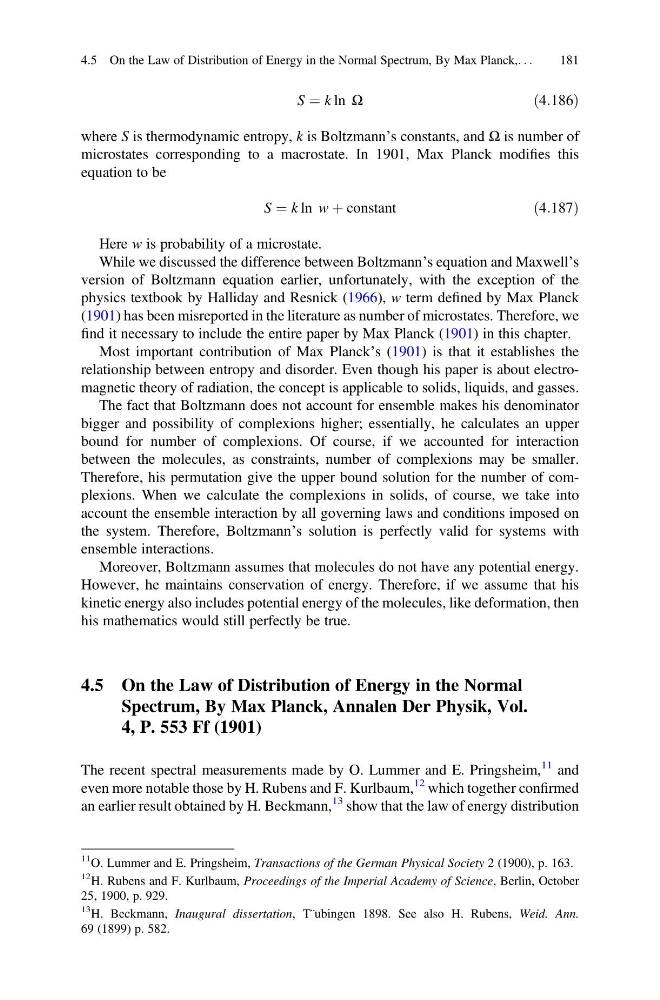
S ¼ k ln Ω
ð4:186Þ
where S is thermodynamic entropy, k is Boltzmann’s constants, and Ω is number of
microstates corresponding to a macrostate. In 1901, Max Planck modifies this
equation to be
S ¼ k ln w þ constant
ð4:187Þ
Here w is probability of a microstate.
While we discussed the difference between Boltzmann’s equation and Maxwell’s
version of Boltzmann equation earlier, unfortunately, with the exception of the
physics textbook by Halliday and Resnick (1966), w term defined by Max Planck
(1901) has been misreported in the literature as number of microstates. Therefore, we
find it necessary to include the entire paper by Max Planck (1901) in this chapter.
Most important contribution of Max Planck’s (1901) is that it establishes the
relationship between entropy and disorder. Even though his paper is about electromagnetic theory of radiation, the concept is applicable to solids, liquids, and gasses.
The fact that Boltzmann does not account for ensemble makes his denominator
bigger and possibility of complexions higher; essentially, he calculates an upper
bound for number of complexions. Of course, if we accounted for interaction
between the molecules, as constraints, number of complexions may be smaller.
Therefore, his permutation give the upper bound solution for the number of complexions. When we calculate the complexions in solids, of course, we take into
account the ensemble interaction by all governing laws and conditions imposed on
the system. Therefore, Boltzmann’s solution is perfectly valid for systems with
ensemble interactions.
Moreover, Boltzmann assumes that molecules do not have any potential energy.
However, he maintains conservation of energy. Therefore, if we assume that his
kinetic energy also includes potential energy of the molecules, like deformation, then
his mathematics would still perfectly be true.
4.5 On the Law of Distribution of Energy in the Normal
Spectrum, By Max Planck, Annalen Der Physik, Vol.
4, P. 553 Ff (1901)
The recent spectral measurements made by O. Lummer and E. Pringsheim,
11 and
even more notable those by H. Rubens and F. Kurlbaum,
12 which together confirmed
an earlier result obtained by H. Beckmann,
13 show that the law of energy distribution
11 O. Lummer and E. Pringsheim, Transactions of the German Physical Society 2 (1900), p. 163.
12 H. Rubens and F. Kurlbaum, Proceedings of the Imperial Academy of Science, Berlin, October
25, 1900, p. 929.
13 H. Beckmann, Inaugural dissertation, T¨ubingen 1898. See also H. Rubens, Weid. Ann.
69 (1899) p. 582.
4.5 On the Law of Distribution of Energy in the Normal Spectrum, By Max Planck,. . .
181
ð4:186Þ
where S is thermodynamic entropy, k is Boltzmann’s constants, and Ω is number of
microstates corresponding to a macrostate. In 1901, Max Planck modifies this
equation to be
S ¼ k ln w þ constant
ð4:187Þ
Here w is probability of a microstate.
While we discussed the difference between Boltzmann’s equation and Maxwell’s
version of Boltzmann equation earlier, unfortunately, with the exception of the
physics textbook by Halliday and Resnick (1966), w term defined by Max Planck
(1901) has been misreported in the literature as number of microstates. Therefore, we
find it necessary to include the entire paper by Max Planck (1901) in this chapter.
Most important contribution of Max Planck’s (1901) is that it establishes the
relationship between entropy and disorder. Even though his paper is about electromagnetic theory of radiation, the concept is applicable to solids, liquids, and gasses.
The fact that Boltzmann does not account for ensemble makes his denominator
bigger and possibility of complexions higher; essentially, he calculates an upper
bound for number of complexions. Of course, if we accounted for interaction
between the molecules, as constraints, number of complexions may be smaller.
Therefore, his permutation give the upper bound solution for the number of complexions. When we calculate the complexions in solids, of course, we take into
account the ensemble interaction by all governing laws and conditions imposed on
the system. Therefore, Boltzmann’s solution is perfectly valid for systems with
ensemble interactions.
Moreover, Boltzmann assumes that molecules do not have any potential energy.
However, he maintains conservation of energy. Therefore, if we assume that his
kinetic energy also includes potential energy of the molecules, like deformation, then
his mathematics would still perfectly be true.
4.5 On the Law of Distribution of Energy in the Normal
Spectrum, By Max Planck, Annalen Der Physik, Vol.
4, P. 553 Ff (1901)
The recent spectral measurements made by O. Lummer and E. Pringsheim,
11 and
even more notable those by H. Rubens and F. Kurlbaum,
12 which together confirmed
an earlier result obtained by H. Beckmann,
13 show that the law of energy distribution
11 O. Lummer and E. Pringsheim, Transactions of the German Physical Society 2 (1900), p. 163.
12 H. Rubens and F. Kurlbaum, Proceedings of the Imperial Academy of Science, Berlin, October
25, 1900, p. 929.
13 H. Beckmann, Inaugural dissertation, T¨ubingen 1898. See also H. Rubens, Weid. Ann.
69 (1899) p. 582.
4.5 On the Law of Distribution of Energy in the Normal Spectrum, By Max Planck,. . .
181