

Ω ¼ À
Z Z
f ln fdodw
¼ ÀN ln N þ N ln
Z Z
e
Àh χþL
ð
Þ dodw þ hN χ þ
rN
2
:
ð4:180Þ
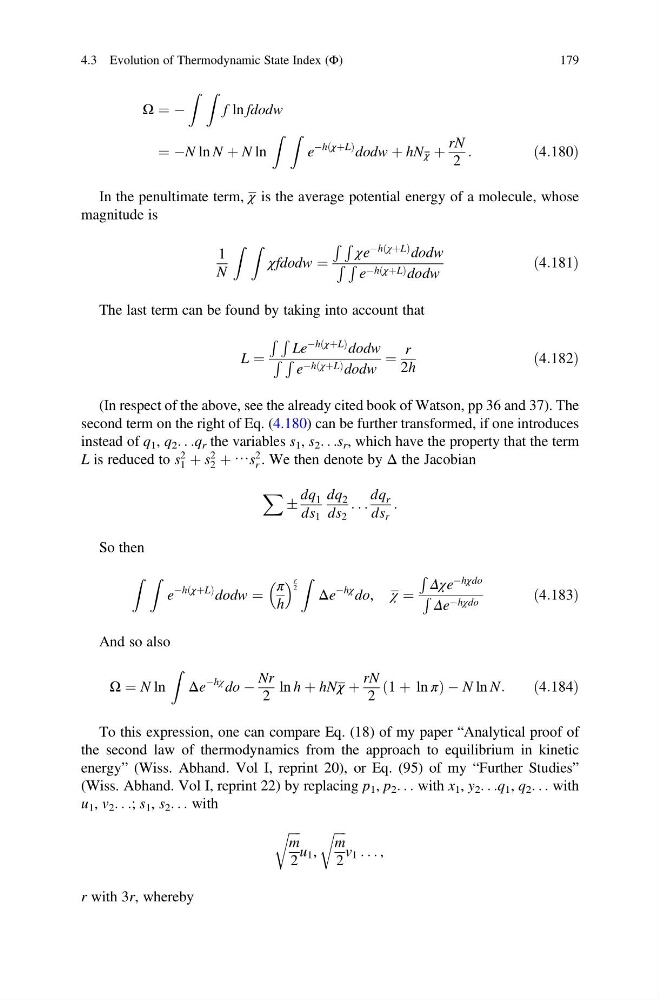
In the penultimate term, χ is the average potential energy of a molecule, whose
magnitude is
1
N
Z Z
χfdodw ¼
R R χe
Àh χþL
ð
Þ dodw
R R
e Àh χþL
ð
Þ dodw
ð4:181Þ
The last term can be found by taking into account that
L ¼
R R
Le
Àh χþL
ð
Þ dodw
R R
e Àh χþL
ð
Þ dodw
¼
r
2h
ð4:182Þ
(In respect of the above, see the already cited book of Watson, pp 36 and 37). The
second term on the right of Eq. (4.180) can be further transformed, if one introduces
instead of q 1 , q 2 . . .q r the variables s 1 , s 2 . . .s r , which have the property that the term
L is reduced to s
2
1 þ s
2
2 þ ⋯s
2
r . We then denote by Δ the Jacobian
X
Æ
dq 1
ds 1
dq 2
ds 2
. . .
dq r
ds r
:
So then
Z Z
e
Àh χþL
ð
Þ dodw ¼
π
h
r
2
Z
Δe
Àhχ do, χ ¼
R Δχe
Àhχdo
R Δe Àhχdo
ð4:183Þ
And so also
Ω ¼ N ln
Z
Δe
Àhχ do À
Nr
2
ln h þ hNχ þ
rN
2
1 þ ln π
ð
ÞÀN ln N:
ð4:184Þ
To this expression, one can compare Eq. (18) of my paper “Analytical proof of
the second law of thermodynamics from the approach to equilibrium in kinetic
energy” (Wiss. Abhand. Vol I, reprint 20), or Eq. (95) of my “Further Studies”
(Wiss. Abhand. Vol I, reprint 22) by replacing p 1 , p 2 . . . with x 1 , y 2 . . .q 1 , q 2 . . . with
u 1 , v 2 . . .; s 1 , s 2 . . . with
ffiffiffi ffi
m
2
r
u 1 ,
ffiffiffi ffi
m
2
r
v 1 . . . ,
r with 3r, whereby
4.3 Evolution of Thermodynamic State Index (Φ)
179
Z Z
f ln fdodw
¼ ÀN ln N þ N ln
Z Z
e
Àh χþL
ð
Þ dodw þ hN χ þ
rN
2
:
ð4:180Þ
In the penultimate term, χ is the average potential energy of a molecule, whose
magnitude is
1
N
Z Z
χfdodw ¼
R R χe
Àh χþL
ð
Þ dodw
R R
e Àh χþL
ð
Þ dodw
ð4:181Þ
The last term can be found by taking into account that
L ¼
R R
Le
Àh χþL
ð
Þ dodw
R R
e Àh χþL
ð
Þ dodw
¼
r
2h
ð4:182Þ
(In respect of the above, see the already cited book of Watson, pp 36 and 37). The
second term on the right of Eq. (4.180) can be further transformed, if one introduces
instead of q 1 , q 2 . . .q r the variables s 1 , s 2 . . .s r , which have the property that the term
L is reduced to s
2
1 þ s
2
2 þ ⋯s
2
r . We then denote by Δ the Jacobian
X
Æ
dq 1
ds 1
dq 2
ds 2
. . .
dq r
ds r
:
So then
Z Z
e
Àh χþL
ð
Þ dodw ¼
π
h
r
2
Z
Δe
Àhχ do, χ ¼
R Δχe
Àhχdo
R Δe Àhχdo
ð4:183Þ
And so also
Ω ¼ N ln
Z
Δe
Àhχ do À
Nr
2
ln h þ hNχ þ
rN
2
1 þ ln π
ð
ÞÀN ln N:
ð4:184Þ
To this expression, one can compare Eq. (18) of my paper “Analytical proof of
the second law of thermodynamics from the approach to equilibrium in kinetic
energy” (Wiss. Abhand. Vol I, reprint 20), or Eq. (95) of my “Further Studies”
(Wiss. Abhand. Vol I, reprint 22) by replacing p 1 , p 2 . . . with x 1 , y 2 . . .q 1 , q 2 . . . with
u 1 , v 2 . . .; s 1 , s 2 . . . with
ffiffiffi ffi
m
2
r
u 1 ,
ffiffiffi ffi
m
2
r
v 1 . . . ,
r with 3r, whereby
4.3 Evolution of Thermodynamic State Index (Φ)
179