

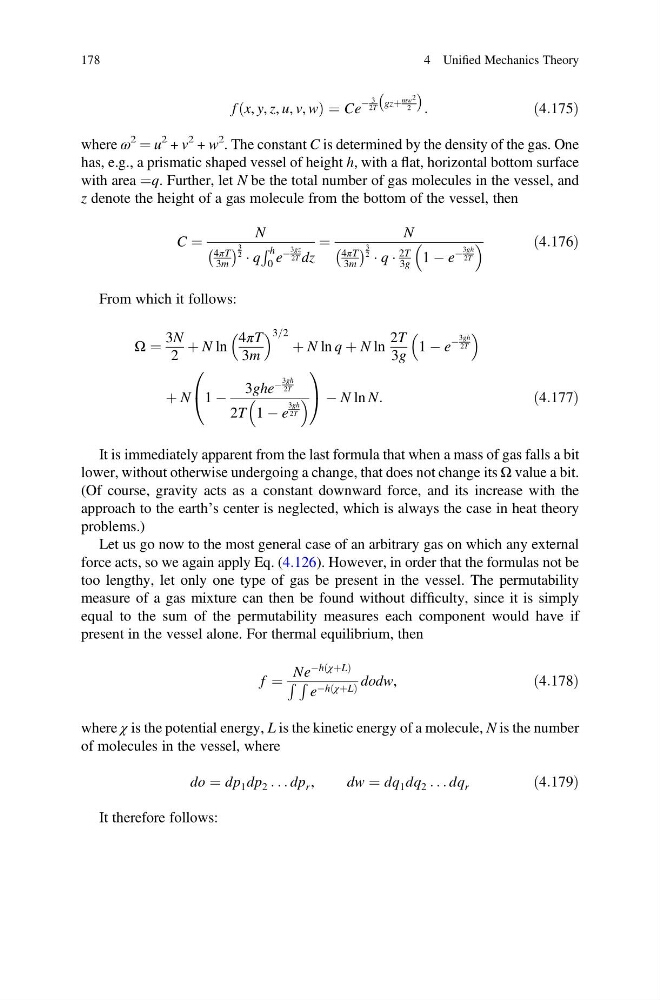
f x, y, z, u, v, w
ð
Þ¼Ce
À
3
2T gzþ
mw 2
2
À
Á
:
ð4:175Þ
where ω
2
¼ u
2 + v
2 + w
2 . The constant C is determined by the density of the gas. One
has, e.g., a prismatic shaped vessel of height h, with a flat, horizontal bottom surface
with area ¼q. Further, let N be the total number of gas molecules in the vessel, and
z denote the height of a gas molecule from the bottom of the vessel, then
C ¼
N
4πT
3m
À Á3
2
Á q
R h
0 e À
3gz
2T dz
¼
N
4πT
3m
À Á3
2
Á q Á
2T
3g 1 À e À
3gh
2T
ð4:176Þ
From which it follows:
Ω ¼
3N
2
þ N ln
4πT
3m
3=2
þ N ln q þ N ln
2T
3g
1 À e
À
3gh
2T
þ N 1 À
3ghe
À
3gh
2T
2T 1 À e
3gh
2T
0
@
1
A À N ln N:
ð4:177Þ
It is immediately apparent from the last formula that when a mass of gas falls a bit
lower, without otherwise undergoing a change, that does not change its Ω value a bit.
(Of course, gravity acts as a constant downward force, and its increase with the
approach to the earth’s center is neglected, which is always the case in heat theory
problems.)
Let us go now to the most general case of an arbitrary gas on which any external
force acts, so we again apply Eq. (4.126). However, in order that the formulas not be
too lengthy, let only one type of gas be present in the vessel. The permutability
measure of a gas mixture can then be found without difficulty, since it is simply
equal to the sum of the permutability measures each component would have if
present in the vessel alone. For thermal equilibrium, then
f ¼
Ne
Àh χþL
ð
Þ
R R
e Àh χþL
ð
Þ
dodw,
ð4:178Þ
where χ is the potential energy, L is the kinetic energy of a molecule, N is the number
of molecules in the vessel, where
do ¼ dp 1 dp 2 . . . dp r ,
dw ¼ dq 1 dq 2 . . . dq r
ð4:179Þ
It therefore follows:
178
4 Unified Mechanics Theory
ð
Þ¼Ce
À
3
2T gzþ
mw 2
2
À
Á
:
ð4:175Þ
where ω
2
¼ u
2 + v
2 + w
2 . The constant C is determined by the density of the gas. One
has, e.g., a prismatic shaped vessel of height h, with a flat, horizontal bottom surface
with area ¼q. Further, let N be the total number of gas molecules in the vessel, and
z denote the height of a gas molecule from the bottom of the vessel, then
C ¼
N
4πT
3m
À Á3
2
Á q
R h
0 e À
3gz
2T dz
¼
N
4πT
3m
À Á3
2
Á q Á
2T
3g 1 À e À
3gh
2T
ð4:176Þ
From which it follows:
Ω ¼
3N
2
þ N ln
4πT
3m
3=2
þ N ln q þ N ln
2T
3g
1 À e
À
3gh
2T
þ N 1 À
3ghe
À
3gh
2T
2T 1 À e
3gh
2T
0
@
1
A À N ln N:
ð4:177Þ
It is immediately apparent from the last formula that when a mass of gas falls a bit
lower, without otherwise undergoing a change, that does not change its Ω value a bit.
(Of course, gravity acts as a constant downward force, and its increase with the
approach to the earth’s center is neglected, which is always the case in heat theory
problems.)
Let us go now to the most general case of an arbitrary gas on which any external
force acts, so we again apply Eq. (4.126). However, in order that the formulas not be
too lengthy, let only one type of gas be present in the vessel. The permutability
measure of a gas mixture can then be found without difficulty, since it is simply
equal to the sum of the permutability measures each component would have if
present in the vessel alone. For thermal equilibrium, then
f ¼
Ne
Àh χþL
ð
Þ
R R
e Àh χþL
ð
Þ
dodw,
ð4:178Þ
where χ is the potential energy, L is the kinetic energy of a molecule, N is the number
of molecules in the vessel, where
do ¼ dp 1 dp 2 . . . dp r ,
dw ¼ dq 1 dq 2 . . . dq r
ð4:179Þ
It therefore follows:
178
4 Unified Mechanics Theory