

manner to its old volume by a piston. To achieve this manipulation, we can if we
want assume that the piston is created by a surrounding dense gas enclosed in
infinitely thin walls. This gas is unchanged except that it moves down in space.
Since the permutability measure does not depend on the absolute position in
space, the permutability measure of the gas driving the piston does not change. That
of the gas inside the vessel decreases to the initial value, since this gas has gone
through a cyclic process. However, since this was not reversible,
R
dQ/T integrated
over this cycle is not equal to the difference between the initial and final values of the
entropy, but it is smaller due to the uncompensated transformation in the expansion.
In contrast, heat is transferred to the surrounding gas. Therefore, for this process the
permutability measure of the surrounding gas is increased by as much as that of the
enclosed gas in the vessel during the first process. Since the latter mass of gas went
through a cyclic process, its entropy decreased by as much during the second process
as it increased during the first, but not by
R
dQ/T; and because the second process was
reversible, the entropy of the surrounding gas increased as much as the enclosed
gas’s decreased. The result is, as it has to be, that the sum of the permutability
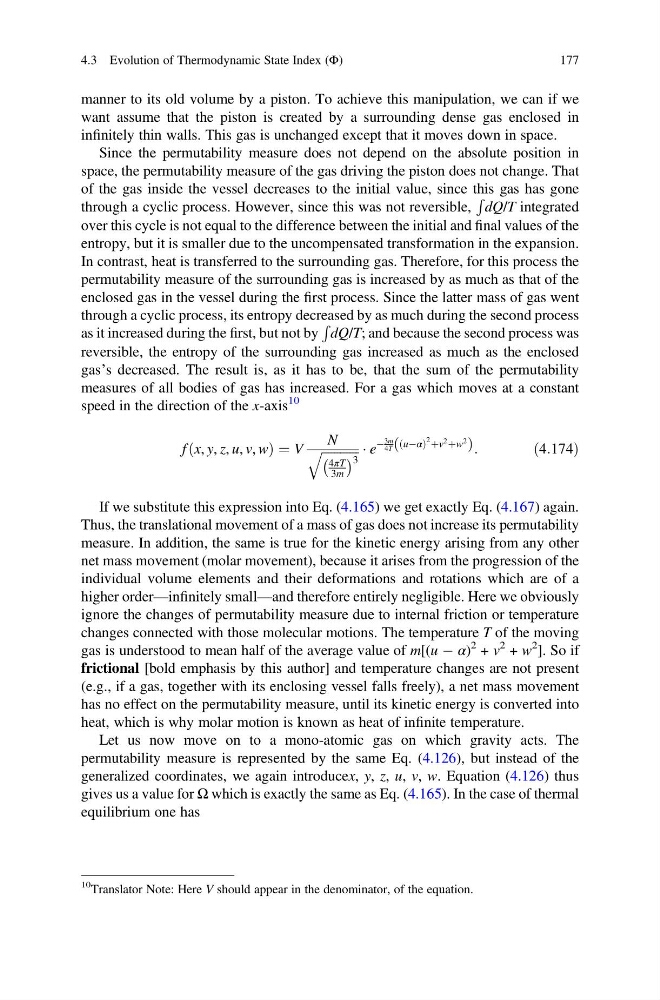
measures of all bodies of gas has increased. For a gas which moves at a constant
speed in the direction of the x-axis
10
f x, y, z, u, v, w
ð
Þ¼V
N
ffiffiffiffiffiffiffiffiffiffiffiffi
4πT
3m
À Á 3
q
Á e
À
3m
4T uÀα
ð
Þ
2 þv
2 þw
2
ð
Þ :
ð4:174Þ
If we substitute this expression into Eq. (4.165) we get exactly Eq. (4.167) again.
Thus, the translational movement of a mass of gas does not increase its permutability
measure. In addition, the same is true for the kinetic energy arising from any other
net mass movement (molar movement), because it arises from the progression of the
individual volume elements and their deformations and rotations which are of a
higher order—infinitely small—and therefore entirely negligible. Here we obviously
ignore the changes of permutability measure due to internal friction or temperature
changes connected with those molecular motions. The temperature T of the moving
gas is understood to mean half of the average value of m[(u À α)
2 + v
2 + w
2 ]. So if
frictional [bold emphasis by this author] and temperature changes are not present
(e.g., if a gas, together with its enclosing vessel falls freely), a net mass movement
has no effect on the permutability measure, until its kinetic energy is converted into
heat, which is why molar motion is known as heat of infinite temperature.
Let us now move on to a mono-atomic gas on which gravity acts. The
permutability measure is represented by the same Eq. (4.126), but instead of the
generalized coordinates, we again introducex, y, z, u, v, w. Equation (4.126) thus
gives us a value for Ω which is exactly the same as Eq. (4.165). In the case of thermal
equilibrium one has
10 Translator Note: Here V should appear in the denominator, of the equation.
4.3 Evolution of Thermodynamic State Index (Φ)
177
want assume that the piston is created by a surrounding dense gas enclosed in
infinitely thin walls. This gas is unchanged except that it moves down in space.
Since the permutability measure does not depend on the absolute position in
space, the permutability measure of the gas driving the piston does not change. That
of the gas inside the vessel decreases to the initial value, since this gas has gone
through a cyclic process. However, since this was not reversible,
R
dQ/T integrated
over this cycle is not equal to the difference between the initial and final values of the
entropy, but it is smaller due to the uncompensated transformation in the expansion.
In contrast, heat is transferred to the surrounding gas. Therefore, for this process the
permutability measure of the surrounding gas is increased by as much as that of the
enclosed gas in the vessel during the first process. Since the latter mass of gas went
through a cyclic process, its entropy decreased by as much during the second process
as it increased during the first, but not by
R
dQ/T; and because the second process was
reversible, the entropy of the surrounding gas increased as much as the enclosed
gas’s decreased. The result is, as it has to be, that the sum of the permutability
measures of all bodies of gas has increased. For a gas which moves at a constant
speed in the direction of the x-axis
10
f x, y, z, u, v, w
ð
Þ¼V
N
ffiffiffiffiffiffiffiffiffiffiffiffi
4πT
3m
À Á 3
q
Á e
À
3m
4T uÀα
ð
Þ
2 þv
2 þw
2
ð
Þ :
ð4:174Þ
If we substitute this expression into Eq. (4.165) we get exactly Eq. (4.167) again.
Thus, the translational movement of a mass of gas does not increase its permutability
measure. In addition, the same is true for the kinetic energy arising from any other
net mass movement (molar movement), because it arises from the progression of the
individual volume elements and their deformations and rotations which are of a
higher order—infinitely small—and therefore entirely negligible. Here we obviously
ignore the changes of permutability measure due to internal friction or temperature
changes connected with those molecular motions. The temperature T of the moving
gas is understood to mean half of the average value of m[(u À α)
2 + v
2 + w
2 ]. So if
frictional [bold emphasis by this author] and temperature changes are not present
(e.g., if a gas, together with its enclosing vessel falls freely), a net mass movement
has no effect on the permutability measure, until its kinetic energy is converted into
heat, which is why molar motion is known as heat of infinite temperature.
Let us now move on to a mono-atomic gas on which gravity acts. The
permutability measure is represented by the same Eq. (4.126), but instead of the
generalized coordinates, we again introducex, y, z, u, v, w. Equation (4.126) thus
gives us a value for Ω which is exactly the same as Eq. (4.165). In the case of thermal
equilibrium one has
10 Translator Note: Here V should appear in the denominator, of the equation.
4.3 Evolution of Thermodynamic State Index (Φ)
177