

that the ratios of these numbers should provide the probabilities that a molecule has
kinetic energy0, E, 2E, etc. at thermal equilibrium. Second, for each complexion we
form the corresponding state distribution. If some state distribution is composed of P
complexions, we then denote the quotient P =J as the probability of the state
distribution. At first glance, this definition of a state distribution seems very plausible. However, we shall presently see that this should not be used, because under
these conditions, the distribution whose probability is the greatest would not correspond to thermal equilibrium. [Boltzmann does not justify this statement. However,
later Planck does show that actually highest probability is equilibrium.] It is easy to
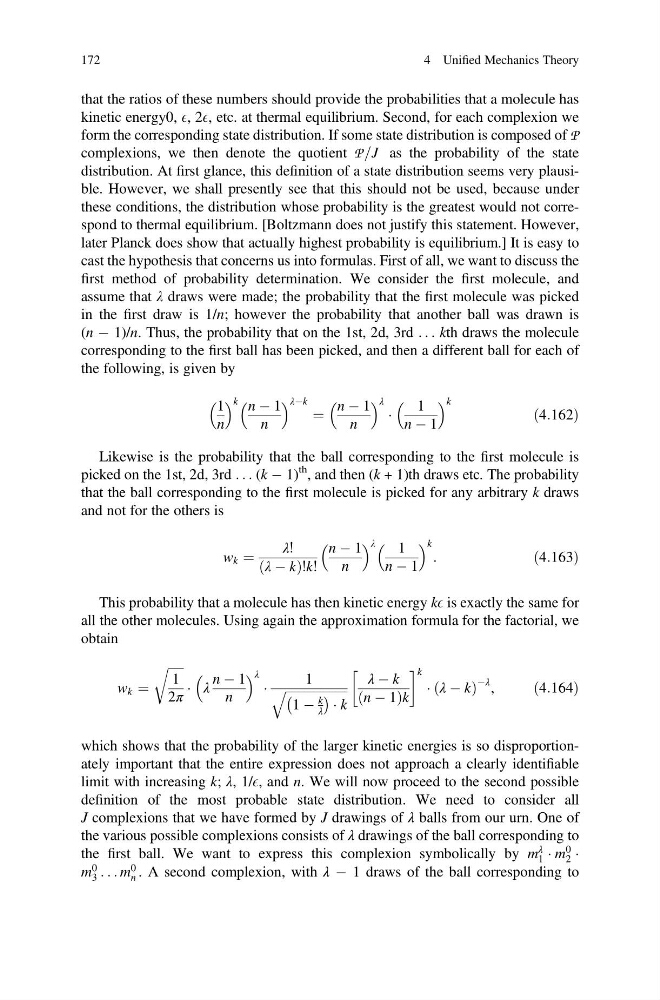
cast the hypothesis that concerns us into formulas. First of all, we want to discuss the
first method of probability determination. We consider the first molecule, and
assume that λ draws were made; the probability that the first molecule was picked
in the first draw is 1/n; however the probability that another ball was drawn is
(n À 1)/n. Thus, the probability that on the 1st, 2d, 3rd . . . kth draws the molecule
corresponding to the first ball has been picked, and then a different ball for each of
the following, is given by
1
n
k n À 1
n
λÀk
¼
n À 1
n
λ
Á
1
n À 1
k
ð4:162Þ
Likewise is the probability that the ball corresponding to the first molecule is
picked on the 1st, 2d, 3rd . . . (k À 1)
th , and then (k + 1)th draws etc. The probability
that the ball corresponding to the first molecule is picked for any arbitrary k draws
and not for the others is
w k ¼
λ!
λ À k
ð
Þ!k!
n À 1
n
λ
1
n À 1
k
:
ð4:163Þ
This probability that a molecule has then kinetic energy kE is exactly the same for
all the other molecules. Using again the approximation formula for the factorial, we
obtain
w k ¼
ffiffiffiffiffi
1
2π
r
Á λ
n À 1
n
λ
Á
1
ffiffiffiffiffiffiffiffiffiffiffiffiffiffiffiffiffiffiffiffi
1 À
k
λ
À
Á Á k
q
λ À k
n À 1
ð
Þk
! k
Á λ À k
ð
Þ
Àλ ,
ð4:164Þ
which shows that the probability of the larger kinetic energies is so disproportionately important that the entire expression does not approach a clearly identifiable
limit with increasing k; λ, 1/E, and n. We will now proceed to the second possible
definition of the most probable state distribution. We need to consider all
J complexions that we have formed by J drawings of λ balls from our urn. One of
the various possible complexions consists of λ drawings of the ball corresponding to
the first ball. We want to express this complexion symbolically by m
λ
1 Á m
0
2 Á
m
0
3 . . . m
0
n . A second complexion, with λ À 1 draws of the ball corresponding to
172
4 Unified Mechanics Theory
kinetic energy0, E, 2E, etc. at thermal equilibrium. Second, for each complexion we
form the corresponding state distribution. If some state distribution is composed of P
complexions, we then denote the quotient P =J as the probability of the state
distribution. At first glance, this definition of a state distribution seems very plausible. However, we shall presently see that this should not be used, because under
these conditions, the distribution whose probability is the greatest would not correspond to thermal equilibrium. [Boltzmann does not justify this statement. However,
later Planck does show that actually highest probability is equilibrium.] It is easy to
cast the hypothesis that concerns us into formulas. First of all, we want to discuss the
first method of probability determination. We consider the first molecule, and
assume that λ draws were made; the probability that the first molecule was picked
in the first draw is 1/n; however the probability that another ball was drawn is
(n À 1)/n. Thus, the probability that on the 1st, 2d, 3rd . . . kth draws the molecule
corresponding to the first ball has been picked, and then a different ball for each of
the following, is given by
1
n
k n À 1
n
λÀk
¼
n À 1
n
λ
Á
1
n À 1
k
ð4:162Þ
Likewise is the probability that the ball corresponding to the first molecule is
picked on the 1st, 2d, 3rd . . . (k À 1)
th , and then (k + 1)th draws etc. The probability
that the ball corresponding to the first molecule is picked for any arbitrary k draws
and not for the others is
w k ¼
λ!
λ À k
ð
Þ!k!
n À 1
n
λ
1
n À 1
k
:
ð4:163Þ
This probability that a molecule has then kinetic energy kE is exactly the same for
all the other molecules. Using again the approximation formula for the factorial, we
obtain
w k ¼
ffiffiffiffiffi
1
2π
r
Á λ
n À 1
n
λ
Á
1
ffiffiffiffiffiffiffiffiffiffiffiffiffiffiffiffiffiffiffiffi
1 À
k
λ
À
Á Á k
q
λ À k
n À 1
ð
Þk
! k
Á λ À k
ð
Þ
Àλ ,
ð4:164Þ
which shows that the probability of the larger kinetic energies is so disproportionately important that the entire expression does not approach a clearly identifiable
limit with increasing k; λ, 1/E, and n. We will now proceed to the second possible
definition of the most probable state distribution. We need to consider all
J complexions that we have formed by J drawings of λ balls from our urn. One of
the various possible complexions consists of λ drawings of the ball corresponding to
the first ball. We want to express this complexion symbolically by m
λ
1 Á m
0
2 Á
m
0
3 . . . m
0
n . A second complexion, with λ À 1 draws of the ball corresponding to
172
4 Unified Mechanics Theory