

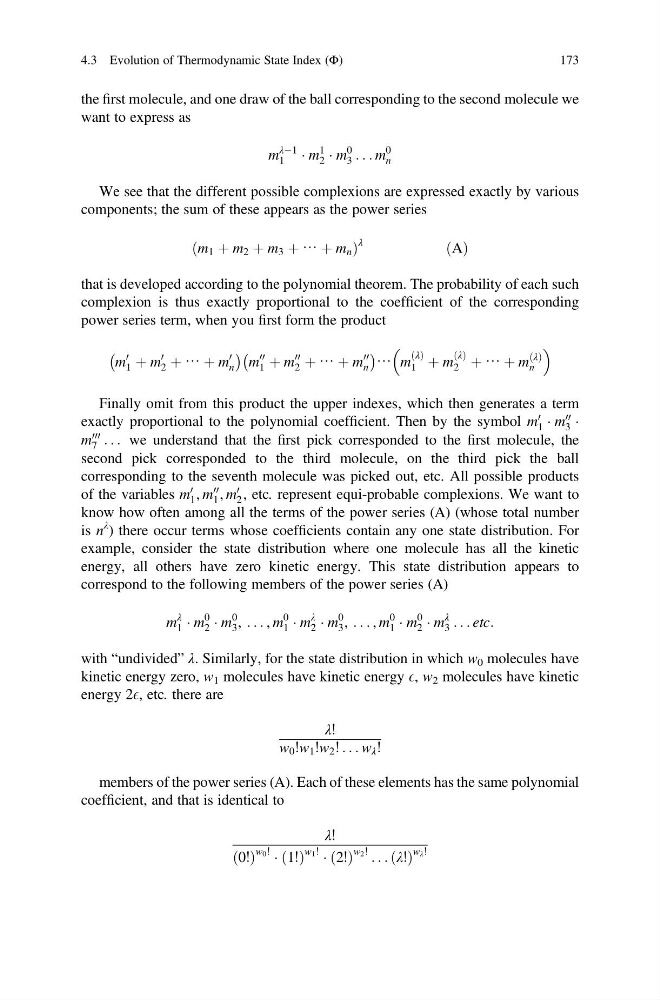
the first molecule, and one draw of the ball corresponding to the second molecule we
want to express as
m
λÀ1
1
Á m
1
2 Á m
0
3 . . . m
0
n
We see that the different possible complexions are expressed exactly by various
components; the sum of these appears as the power series
m 1 þ m 2 þ m 3 þ ⋯ þ m n
ð
Þ
λ
A
ð Þ
that is developed according to the polynomial theorem. The probability of each such
complexion is thus exactly proportional to the coefficient of the corresponding
power series term, when you first form the product
m
0
1 þ m
0
2 þ ⋯ þ m
0
n
À
Á
m
00
1 þ m
00
2 þ ⋯ þ m
00
n
À
Á ⋯ m
λ
ð Þ
1 þ m
λ
ð Þ
2 þ ⋯ þ m
λ
ð Þ
n
Finally omit from this product the upper indexes, which then generates a term
exactly proportional to the polynomial coefficient. Then by the symbol m
0
1 Á m
00
3 Á
m
000
7 . . . we understand that the first pick corresponded to the first molecule, the
second pick corresponded to the third molecule, on the third pick the ball
corresponding to the seventh molecule was picked out, etc. All possible products
of the variables m
0
1 , m
00
1 , m
0
2 , etc. represent equi-probable complexions. We want to
know how often among all the terms of the power series (A) (whose total number
is n
λ ) there occur terms whose coefficients contain any one state distribution. For
example, consider the state distribution where one molecule has all the kinetic
energy, all others have zero kinetic energy. This state distribution appears to
correspond to the following members of the power series (A)
m
λ
1 Á m
0
2 Á m
0
3 , . . . , m
0
1 Á m
λ
2 Á m
0
3 , . . . , m
0
1 Á m
0
2 Á m
λ
3 . . . etc:
with “undivided” λ. Similarly, for the state distribution in which w 0 molecules have
kinetic energy zero, w 1 molecules have kinetic energy E, w 2 molecules have kinetic
energy 2E, etc. there are
λ!
w 0 !w 1 !w 2 ! . . . w λ !
members of the power series (A). Each of these elements has the same polynomial
coefficient, and that is identical to
λ!
0!
ð Þ
w 0 ! Á 1!
ð Þ
w 1 ! Á 2!
ð Þ
w 2 ! . . . λ!
ð Þ
w λ !
4.3 Evolution of Thermodynamic State Index (Φ)
173
want to express as
m
λÀ1
1
Á m
1
2 Á m
0
3 . . . m
0
n
We see that the different possible complexions are expressed exactly by various
components; the sum of these appears as the power series
m 1 þ m 2 þ m 3 þ ⋯ þ m n
ð
Þ
λ
A
ð Þ
that is developed according to the polynomial theorem. The probability of each such
complexion is thus exactly proportional to the coefficient of the corresponding
power series term, when you first form the product
m
0
1 þ m
0
2 þ ⋯ þ m
0
n
À
Á
m
00
1 þ m
00
2 þ ⋯ þ m
00
n
À
Á ⋯ m
λ
ð Þ
1 þ m
λ
ð Þ
2 þ ⋯ þ m
λ
ð Þ
n
Finally omit from this product the upper indexes, which then generates a term
exactly proportional to the polynomial coefficient. Then by the symbol m
0
1 Á m
00
3 Á
m
000
7 . . . we understand that the first pick corresponded to the first molecule, the
second pick corresponded to the third molecule, on the third pick the ball
corresponding to the seventh molecule was picked out, etc. All possible products
of the variables m
0
1 , m
00
1 , m
0
2 , etc. represent equi-probable complexions. We want to
know how often among all the terms of the power series (A) (whose total number
is n
λ ) there occur terms whose coefficients contain any one state distribution. For
example, consider the state distribution where one molecule has all the kinetic
energy, all others have zero kinetic energy. This state distribution appears to
correspond to the following members of the power series (A)
m
λ
1 Á m
0
2 Á m
0
3 , . . . , m
0
1 Á m
λ
2 Á m
0
3 , . . . , m
0
1 Á m
0
2 Á m
λ
3 . . . etc:
with “undivided” λ. Similarly, for the state distribution in which w 0 molecules have
kinetic energy zero, w 1 molecules have kinetic energy E, w 2 molecules have kinetic
energy 2E, etc. there are
λ!
w 0 !w 1 !w 2 ! . . . w λ !
members of the power series (A). Each of these elements has the same polynomial
coefficient, and that is identical to
λ!
0!
ð Þ
w 0 ! Á 1!
ð Þ
w 1 ! Á 2!
ð Þ
w 2 ! . . . λ!
ð Þ
w λ !
4.3 Evolution of Thermodynamic State Index (Φ)
173