

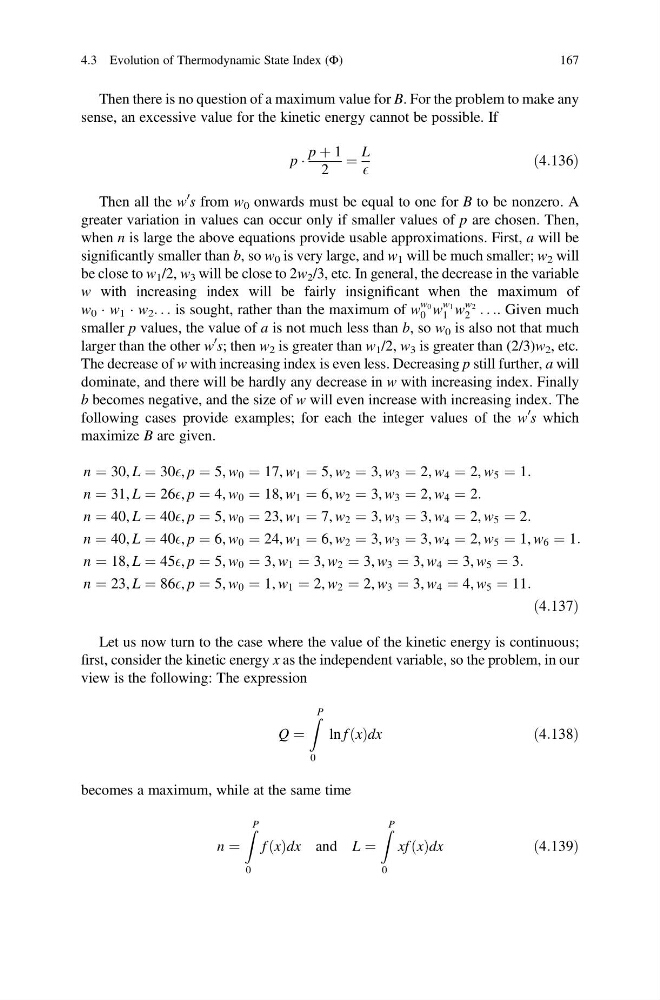
Then there is no question of a maximum value for B. For the problem to make any
sense, an excessive value for the kinetic energy cannot be possible. If
p Á
p þ 1
2
¼
L
E
ð4:136Þ
Then all the w
0 s from w 0 onwards must be equal to one for B to be nonzero. A
greater variation in values can occur only if smaller values of p are chosen. Then,
when n is large the above equations provide usable approximations. First, a will be
significantly smaller than b, so w 0 is very large, and w 1 will be much smaller; w 2 will
be close to w 1 /2, w 3 will be close to 2w 2 /3, etc. In general, the decrease in the variable
w with increasing index will be fairly insignificant when the maximum of
w 0 Á w 1 Á w 2 . . . is sought, rather than the maximum of w
w 0
0 w
w 1
1 w
w 2
2 . . .. Given much
smaller p values, the value of a is not much less than b, so w 0 is also not that much
larger than the other w
0 s; then w 2 is greater than w 1 /2, w 3 is greater than (2/3)w 2 , etc.
The decrease of w with increasing index is even less. Decreasing p still further, a will
dominate, and there will be hardly any decrease in w with increasing index. Finally
b becomes negative, and the size of w will even increase with increasing index. The
following cases provide examples; for each the integer values of the w
0 s which
maximize B are given.
n ¼ 30, L ¼ 30E, p ¼ 5, w 0 ¼ 17, w 1 ¼ 5, w 2 ¼ 3, w 3 ¼ 2, w 4 ¼ 2, w 5 ¼ 1:
n ¼ 31, L ¼ 26E, p ¼ 4, w 0 ¼ 18, w 1 ¼ 6, w 2 ¼ 3, w 3 ¼ 2, w 4 ¼ 2:
n ¼ 40, L ¼ 40E, p ¼ 5, w 0 ¼ 23, w 1 ¼ 7, w 2 ¼ 3, w 3 ¼ 3, w 4 ¼ 2, w 5 ¼ 2:
n ¼ 40, L ¼ 40E, p ¼ 6, w 0 ¼ 24, w 1 ¼ 6, w 2 ¼ 3, w 3 ¼ 3, w 4 ¼ 2, w 5 ¼ 1, w 6 ¼ 1:
n ¼ 18, L ¼ 45E, p ¼ 5, w 0 ¼ 3, w 1 ¼ 3, w 2 ¼ 3, w 3 ¼ 3, w 4 ¼ 3, w 5 ¼ 3:
n ¼ 23, L ¼ 86E, p ¼ 5, w 0 ¼ 1, w 1 ¼ 2, w 2 ¼ 2, w 3 ¼ 3, w 4 ¼ 4, w 5 ¼ 11:
ð4:137Þ
Let us now turn to the case where the value of the kinetic energy is continuous;
first, consider the kinetic energy x as the independent variable, so the problem, in our
view is the following: The expression
Q ¼
Z P
0
ln f x
ð Þdx
ð4:138Þ
becomes a maximum, while at the same time
n ¼
Z P
0
f x
ð Þdx and L ¼
Z P
0
xf x
ð Þdx
ð4:139Þ
4.3 Evolution of Thermodynamic State Index (Φ)
167
sense, an excessive value for the kinetic energy cannot be possible. If
p Á
p þ 1
2
¼
L
E
ð4:136Þ
Then all the w
0 s from w 0 onwards must be equal to one for B to be nonzero. A
greater variation in values can occur only if smaller values of p are chosen. Then,
when n is large the above equations provide usable approximations. First, a will be
significantly smaller than b, so w 0 is very large, and w 1 will be much smaller; w 2 will
be close to w 1 /2, w 3 will be close to 2w 2 /3, etc. In general, the decrease in the variable
w with increasing index will be fairly insignificant when the maximum of
w 0 Á w 1 Á w 2 . . . is sought, rather than the maximum of w
w 0
0 w
w 1
1 w
w 2
2 . . .. Given much
smaller p values, the value of a is not much less than b, so w 0 is also not that much
larger than the other w
0 s; then w 2 is greater than w 1 /2, w 3 is greater than (2/3)w 2 , etc.
The decrease of w with increasing index is even less. Decreasing p still further, a will
dominate, and there will be hardly any decrease in w with increasing index. Finally
b becomes negative, and the size of w will even increase with increasing index. The
following cases provide examples; for each the integer values of the w
0 s which
maximize B are given.
n ¼ 30, L ¼ 30E, p ¼ 5, w 0 ¼ 17, w 1 ¼ 5, w 2 ¼ 3, w 3 ¼ 2, w 4 ¼ 2, w 5 ¼ 1:
n ¼ 31, L ¼ 26E, p ¼ 4, w 0 ¼ 18, w 1 ¼ 6, w 2 ¼ 3, w 3 ¼ 2, w 4 ¼ 2:
n ¼ 40, L ¼ 40E, p ¼ 5, w 0 ¼ 23, w 1 ¼ 7, w 2 ¼ 3, w 3 ¼ 3, w 4 ¼ 2, w 5 ¼ 2:
n ¼ 40, L ¼ 40E, p ¼ 6, w 0 ¼ 24, w 1 ¼ 6, w 2 ¼ 3, w 3 ¼ 3, w 4 ¼ 2, w 5 ¼ 1, w 6 ¼ 1:
n ¼ 18, L ¼ 45E, p ¼ 5, w 0 ¼ 3, w 1 ¼ 3, w 2 ¼ 3, w 3 ¼ 3, w 4 ¼ 3, w 5 ¼ 3:
n ¼ 23, L ¼ 86E, p ¼ 5, w 0 ¼ 1, w 1 ¼ 2, w 2 ¼ 2, w 3 ¼ 3, w 4 ¼ 4, w 5 ¼ 11:
ð4:137Þ
Let us now turn to the case where the value of the kinetic energy is continuous;
first, consider the kinetic energy x as the independent variable, so the problem, in our
view is the following: The expression
Q ¼
Z P
0
ln f x
ð Þdx
ð4:138Þ
becomes a maximum, while at the same time
n ¼
Z P
0
f x
ð Þdx and L ¼
Z P
0
xf x
ð Þdx
ð4:139Þ
4.3 Evolution of Thermodynamic State Index (Φ)
167