

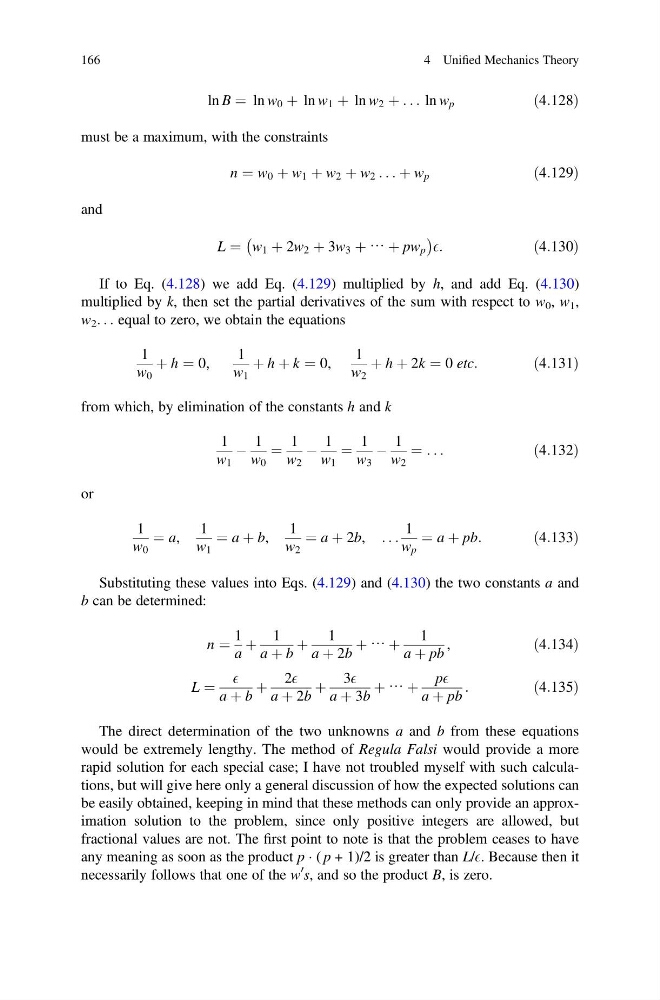
ln B ¼ ln w 0 þ ln w 1 þ ln w 2 þ . . . ln w p
ð4:128Þ
must be a maximum, with the constraints
n ¼ w 0 þ w 1 þ w 2 þ w 2 . . . þ w p
ð4:129Þ
and
L ¼ w 1 þ 2w 2 þ 3w 3 þ ⋯ þ pw p
À
Á E:
ð4:130Þ
If to Eq. (4.128) we add Eq. (4.129) multiplied by h, and add Eq. (4.130)
multiplied by k, then set the partial derivatives of the sum with respect to w 0 , w 1 ,
w 2 . . . equal to zero, we obtain the equations
1
w 0
þ h ¼ 0,
1
w 1
þ h þ k ¼ 0,
1
w 2
þ h þ 2k ¼ 0 etc:
ð4:131Þ
from which, by elimination of the constants h and k
1
w 1
À
1
w 0
¼
1
w 2
À
1
w 1
¼
1
w 3
À
1
w 2
¼ . . .
ð4:132Þ
or
1
w 0
¼ a,
1
w 1
¼ a þ b,
1
w 2
¼ a þ 2b, . . .
1
w p
¼ a þ pb:
ð4:133Þ
Substituting these values into Eqs. (4.129) and (4.130) the two constants a and
b can be determined:
n ¼
1
a
þ
1
a þ b
þ
1
a þ 2b
þ ⋯ þ
1
a þ pb
,
ð4:134Þ
L ¼
E
a þ b
þ
2E
a þ 2b
þ
3E
a þ 3b
þ ⋯ þ
pE
a þ pb
:
ð4:135Þ
The direct determination of the two unknowns a and b from these equations
would be extremely lengthy. The method of Regula Falsi would provide a more
rapid solution for each special case; I have not troubled myself with such calculations, but will give here only a general discussion of how the expected solutions can
be easily obtained, keeping in mind that these methods can only provide an approximation solution to the problem, since only positive integers are allowed, but
fractional values are not. The first point to note is that the problem ceases to have
any meaning as soon as the product p Á ( p + 1)/2 is greater than L/E. Because then it
necessarily follows that one of the w
0
s, and so the product B, is zero.
166
4 Unified Mechanics Theory
ð4:128Þ
must be a maximum, with the constraints
n ¼ w 0 þ w 1 þ w 2 þ w 2 . . . þ w p
ð4:129Þ
and
L ¼ w 1 þ 2w 2 þ 3w 3 þ ⋯ þ pw p
À
Á E:
ð4:130Þ
If to Eq. (4.128) we add Eq. (4.129) multiplied by h, and add Eq. (4.130)
multiplied by k, then set the partial derivatives of the sum with respect to w 0 , w 1 ,
w 2 . . . equal to zero, we obtain the equations
1
w 0
þ h ¼ 0,
1
w 1
þ h þ k ¼ 0,
1
w 2
þ h þ 2k ¼ 0 etc:
ð4:131Þ
from which, by elimination of the constants h and k
1
w 1
À
1
w 0
¼
1
w 2
À
1
w 1
¼
1
w 3
À
1
w 2
¼ . . .
ð4:132Þ
or
1
w 0
¼ a,
1
w 1
¼ a þ b,
1
w 2
¼ a þ 2b, . . .
1
w p
¼ a þ pb:
ð4:133Þ
Substituting these values into Eqs. (4.129) and (4.130) the two constants a and
b can be determined:
n ¼
1
a
þ
1
a þ b
þ
1
a þ 2b
þ ⋯ þ
1
a þ pb
,
ð4:134Þ
L ¼
E
a þ b
þ
2E
a þ 2b
þ
3E
a þ 3b
þ ⋯ þ
pE
a þ pb
:
ð4:135Þ
The direct determination of the two unknowns a and b from these equations
would be extremely lengthy. The method of Regula Falsi would provide a more
rapid solution for each special case; I have not troubled myself with such calculations, but will give here only a general discussion of how the expected solutions can
be easily obtained, keeping in mind that these methods can only provide an approximation solution to the problem, since only positive integers are allowed, but
fractional values are not. The first point to note is that the problem ceases to have
any meaning as soon as the product p Á ( p + 1)/2 is greater than L/E. Because then it
necessarily follows that one of the w
0
s, and so the product B, is zero.
166
4 Unified Mechanics Theory