

ln P ¼ N À C ln 2π
À
X
w ab... Á ln w ab... þ
X
w
0
a 0 b
0 ... Á ln w
0
a 0 b
0 ... þ . . .
h
i
:
ð4:125Þ
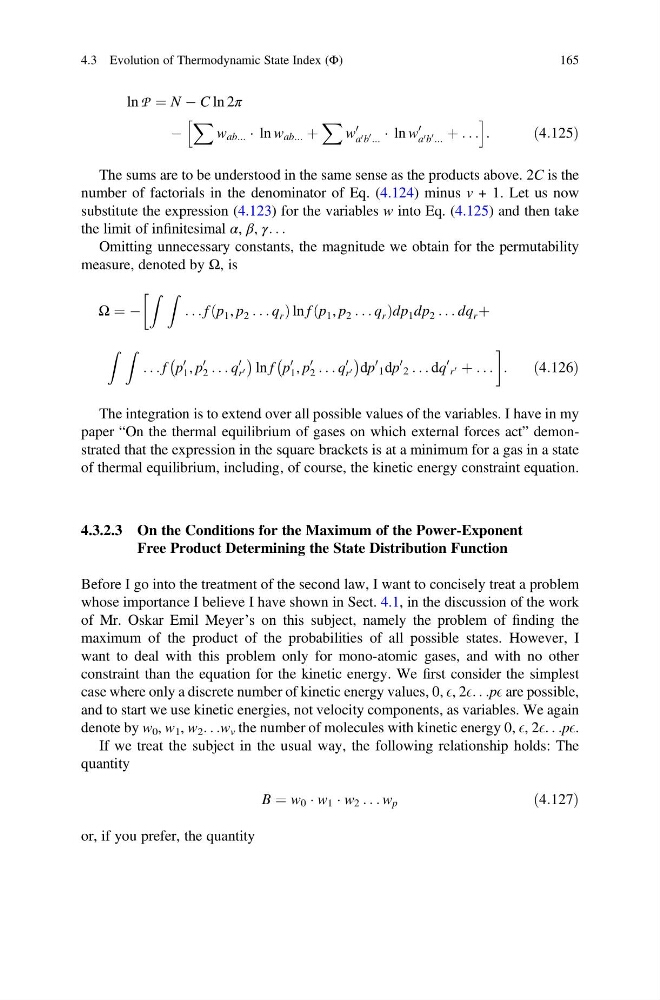
The sums are to be understood in the same sense as the products above. 2C is the
number of factorials in the denominator of Eq. (4.124) minus v + 1. Let us now
substitute the expression (4.123) for the variables w into Eq. (4.125) and then take
the limit of infinitesimal α, β, γ. . .
Omitting unnecessary constants, the magnitude we obtain for the permutability
measure, denoted by Ω, is
Ω ¼ À
Z Z
. . . f p 1 , p 2 . . . q r
ð
Þln f p 1 , p 2 . . . q r
ð
Þ dp 1 dp 2 . . . dq r þ
Z Z
. . . f p
0
1 , p
0
2 . . . q
0
r 0
À
Á
ln f p
0
1 , p
0
2 . . . q
0
r 0
À
Á
dp
0
1 dp
0
2 . . . dq
0
r 0 þ . . .
!
:
ð4:126Þ
The integration is to extend over all possible values of the variables. I have in my
paper “On the thermal equilibrium of gases on which external forces act” demonstrated that the expression in the square brackets is at a minimum for a gas in a state
of thermal equilibrium, including, of course, the kinetic energy constraint equation.
4.3.2.3 On the Conditions for the Maximum of the Power-Exponent
Free Product Determining the State Distribution Function
Before I go into the treatment of the second law, I want to concisely treat a problem
whose importance I believe I have shown in Sect. 4.1, in the discussion of the work
of Mr. Oskar Emil Meyer’s on this subject, namely the problem of finding the
maximum of the product of the probabilities of all possible states. However, I
want to deal with this problem only for mono-atomic gases, and with no other
constraint than the equation for the kinetic energy. We first consider the simplest
case where only a discrete number of kinetic energy values, 0, E, 2E. . .pE are possible,
and to start we use kinetic energies, not velocity components, as variables. We again
denote by w 0 , w 1 , w 2 . . .w v the number of molecules with kinetic energy 0, E, 2E. . .pE.
If we treat the subject in the usual way, the following relationship holds: The
quantity
B ¼ w 0 Á w 1 Á w 2 . . . w p
ð4:127Þ
or, if you prefer, the quantity
4.3 Evolution of Thermodynamic State Index (Φ)
165
À
X
w ab... Á ln w ab... þ
X
w
0
a 0 b
0 ... Á ln w
0
a 0 b
0 ... þ . . .
h
i
:
ð4:125Þ
The sums are to be understood in the same sense as the products above. 2C is the
number of factorials in the denominator of Eq. (4.124) minus v + 1. Let us now
substitute the expression (4.123) for the variables w into Eq. (4.125) and then take
the limit of infinitesimal α, β, γ. . .
Omitting unnecessary constants, the magnitude we obtain for the permutability
measure, denoted by Ω, is
Ω ¼ À
Z Z
. . . f p 1 , p 2 . . . q r
ð
Þln f p 1 , p 2 . . . q r
ð
Þ dp 1 dp 2 . . . dq r þ
Z Z
. . . f p
0
1 , p
0
2 . . . q
0
r 0
À
Á
ln f p
0
1 , p
0
2 . . . q
0
r 0
À
Á
dp
0
1 dp
0
2 . . . dq
0
r 0 þ . . .
!
:
ð4:126Þ
The integration is to extend over all possible values of the variables. I have in my
paper “On the thermal equilibrium of gases on which external forces act” demonstrated that the expression in the square brackets is at a minimum for a gas in a state
of thermal equilibrium, including, of course, the kinetic energy constraint equation.
4.3.2.3 On the Conditions for the Maximum of the Power-Exponent
Free Product Determining the State Distribution Function
Before I go into the treatment of the second law, I want to concisely treat a problem
whose importance I believe I have shown in Sect. 4.1, in the discussion of the work
of Mr. Oskar Emil Meyer’s on this subject, namely the problem of finding the
maximum of the product of the probabilities of all possible states. However, I
want to deal with this problem only for mono-atomic gases, and with no other
constraint than the equation for the kinetic energy. We first consider the simplest
case where only a discrete number of kinetic energy values, 0, E, 2E. . .pE are possible,
and to start we use kinetic energies, not velocity components, as variables. We again
denote by w 0 , w 1 , w 2 . . .w v the number of molecules with kinetic energy 0, E, 2E. . .pE.
If we treat the subject in the usual way, the following relationship holds: The
quantity
B ¼ w 0 Á w 1 Á w 2 . . . w p
ð4:127Þ
or, if you prefer, the quantity
4.3 Evolution of Thermodynamic State Index (Φ)
165