

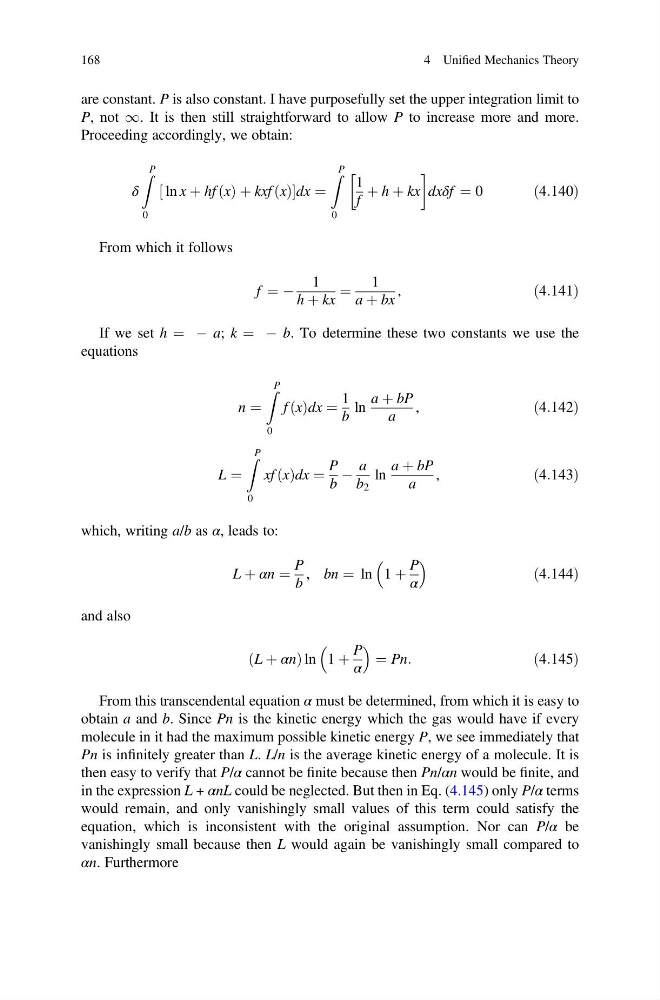
are constant. P is also constant. I have purposefully set the upper integration limit to
P, not 1. It is then still straightforward to allow P to increase more and more.
Proceeding accordingly, we obtain:
δ
Z P
0
ln x þ hf x
ð Þ þ kxf x
ð Þ
½
dx ¼
Z P
0
1
f
þ h þ kx
!
dxδf ¼ 0
ð4:140Þ
From which it follows
f ¼ À
1
h þ kx
¼
1
a þ bx
,
ð4:141Þ
If we set h ¼ À a; k ¼ À b. To determine these two constants we use the
equations
n ¼
Z P
0
f x
ð Þdx ¼
1
b
ln
a þ bP
a
,
ð4:142Þ
L ¼
Z P
0
xf x
ð Þdx ¼
P
b
À
a
b 2
ln
a þ bP
a
,
ð4:143Þ
which, writing a/b as α, leads to:
L þ αn ¼
P
b
, bn ¼ ln 1 þ
P
α
ð4:144Þ
and also
L þ αn
ð
Þln 1 þ
P
α
¼ Pn:
ð4:145Þ
From this transcendental equation α must be determined, from which it is easy to
obtain a and b. Since Pn is the kinetic energy which the gas would have if every
molecule in it had the maximum possible kinetic energy P, we see immediately that
Pn is infinitely greater than L. L/n is the average kinetic energy of a molecule. It is
then easy to verify that P/α cannot be finite because then Pn/αn would be finite, and
in the expression L + αnL could be neglected. But then in Eq. (4.145) only P/α terms
would remain, and only vanishingly small values of this term could satisfy the
equation, which is inconsistent with the original assumption. Nor can P/α be
vanishingly small because then L would again be vanishingly small compared to
αn. Furthermore
168
4 Unified Mechanics Theory
P, not 1. It is then still straightforward to allow P to increase more and more.
Proceeding accordingly, we obtain:
δ
Z P
0
ln x þ hf x
ð Þ þ kxf x
ð Þ
½
dx ¼
Z P
0
1
f
þ h þ kx
!
dxδf ¼ 0
ð4:140Þ
From which it follows
f ¼ À
1
h þ kx
¼
1
a þ bx
,
ð4:141Þ
If we set h ¼ À a; k ¼ À b. To determine these two constants we use the
equations
n ¼
Z P
0
f x
ð Þdx ¼
1
b
ln
a þ bP
a
,
ð4:142Þ
L ¼
Z P
0
xf x
ð Þdx ¼
P
b
À
a
b 2
ln
a þ bP
a
,
ð4:143Þ
which, writing a/b as α, leads to:
L þ αn ¼
P
b
, bn ¼ ln 1 þ
P
α
ð4:144Þ
and also
L þ αn
ð
Þln 1 þ
P
α
¼ Pn:
ð4:145Þ
From this transcendental equation α must be determined, from which it is easy to
obtain a and b. Since Pn is the kinetic energy which the gas would have if every
molecule in it had the maximum possible kinetic energy P, we see immediately that
Pn is infinitely greater than L. L/n is the average kinetic energy of a molecule. It is
then easy to verify that P/α cannot be finite because then Pn/αn would be finite, and
in the expression L + αnL could be neglected. But then in Eq. (4.145) only P/α terms
would remain, and only vanishingly small values of this term could satisfy the
equation, which is inconsistent with the original assumption. Nor can P/α be
vanishingly small because then L would again be vanishingly small compared to
αn. Furthermore
168
4 Unified Mechanics Theory