

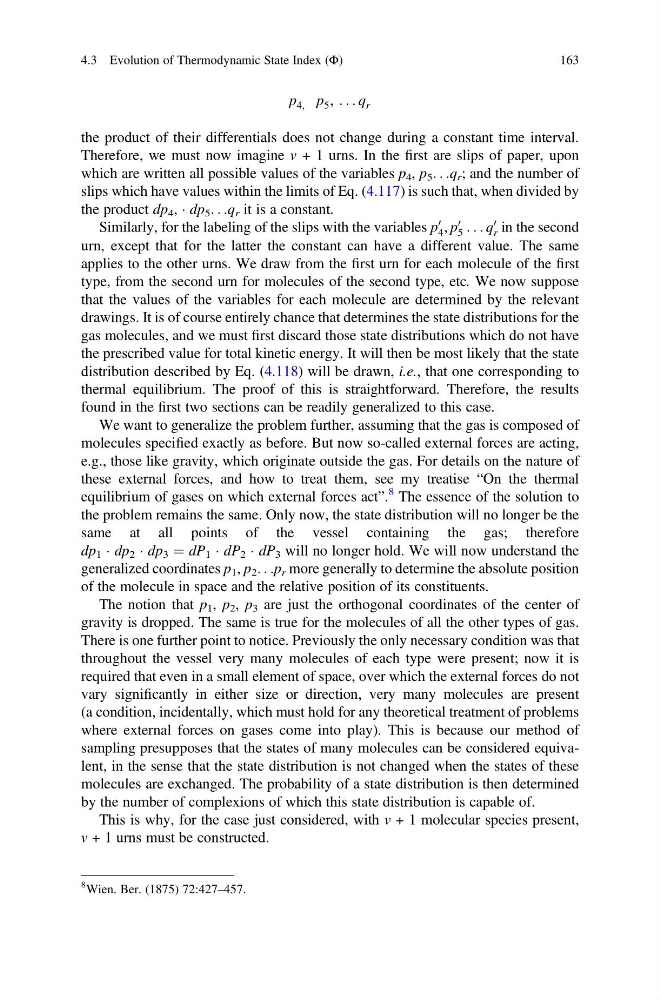
p 4, p 5 , . . . q r
the product of their differentials does not change during a constant time interval.
Therefore, we must now imagine v + 1 urns. In the first are slips of paper, upon
which are written all possible values of the variables p 4 , p 5 . . .q r ; and the number of
slips which have values within the limits of Eq. (4.117) is such that, when divided by
the product dp 4 , Á dp 5 . . .q r it is a constant.
Similarly, for the labeling of the slips with the variables p
0
4 , p
0
5 . . . q
0
r in the second
urn, except that for the latter the constant can have a different value. The same
applies to the other urns. We draw from the first urn for each molecule of the first
type, from the second urn for molecules of the second type, etc. We now suppose
that the values of the variables for each molecule are determined by the relevant
drawings. It is of course entirely chance that determines the state distributions for the
gas molecules, and we must first discard those state distributions which do not have
the prescribed value for total kinetic energy. It will then be most likely that the state
distribution described by Eq. (4.118) will be drawn, i.e., that one corresponding to
thermal equilibrium. The proof of this is straightforward. Therefore, the results
found in the first two sections can be readily generalized to this case.
We want to generalize the problem further, assuming that the gas is composed of
molecules specified exactly as before. But now so-called external forces are acting,
e.g., those like gravity, which originate outside the gas. For details on the nature of
these external forces, and how to treat them, see my treatise “On the thermal
equilibrium of gases on which external forces act”.
8 The essence of the solution to
the problem remains the same. Only now, the state distribution will no longer be the
same at all points of the vessel containing the gas; therefore
dp 1 Á dp 2 Á dp 3 ¼ dP 1 Á dP 2 Á dP 3 will no longer hold. We will now understand the
generalized coordinates p 1 , p 2 . . .p r more generally to determine the absolute position
of the molecule in space and the relative position of its constituents.
The notion that p 1 , p 2 , p 3 are just the orthogonal coordinates of the center of
gravity is dropped. The same is true for the molecules of all the other types of gas.
There is one further point to notice. Previously the only necessary condition was that
throughout the vessel very many molecules of each type were present; now it is
required that even in a small element of space, over which the external forces do not
vary significantly in either size or direction, very many molecules are present
(a condition, incidentally, which must hold for any theoretical treatment of problems
where external forces on gases come into play). This is because our method of
sampling presupposes that the states of many molecules can be considered equivalent, in the sense that the state distribution is not changed when the states of these
molecules are exchanged. The probability of a state distribution is then determined
by the number of complexions of which this state distribution is capable of.
This is why, for the case just considered, with v + 1 molecular species present,
v + 1 urns must be constructed.
8 Wien. Ber. (1875) 72:427–457.
4.3 Evolution of Thermodynamic State Index (Φ)
163
the product of their differentials does not change during a constant time interval.
Therefore, we must now imagine v + 1 urns. In the first are slips of paper, upon
which are written all possible values of the variables p 4 , p 5 . . .q r ; and the number of
slips which have values within the limits of Eq. (4.117) is such that, when divided by
the product dp 4 , Á dp 5 . . .q r it is a constant.
Similarly, for the labeling of the slips with the variables p
0
4 , p
0
5 . . . q
0
r in the second
urn, except that for the latter the constant can have a different value. The same
applies to the other urns. We draw from the first urn for each molecule of the first
type, from the second urn for molecules of the second type, etc. We now suppose
that the values of the variables for each molecule are determined by the relevant
drawings. It is of course entirely chance that determines the state distributions for the
gas molecules, and we must first discard those state distributions which do not have
the prescribed value for total kinetic energy. It will then be most likely that the state
distribution described by Eq. (4.118) will be drawn, i.e., that one corresponding to
thermal equilibrium. The proof of this is straightforward. Therefore, the results
found in the first two sections can be readily generalized to this case.
We want to generalize the problem further, assuming that the gas is composed of
molecules specified exactly as before. But now so-called external forces are acting,
e.g., those like gravity, which originate outside the gas. For details on the nature of
these external forces, and how to treat them, see my treatise “On the thermal
equilibrium of gases on which external forces act”.
8 The essence of the solution to
the problem remains the same. Only now, the state distribution will no longer be the
same at all points of the vessel containing the gas; therefore
dp 1 Á dp 2 Á dp 3 ¼ dP 1 Á dP 2 Á dP 3 will no longer hold. We will now understand the
generalized coordinates p 1 , p 2 . . .p r more generally to determine the absolute position
of the molecule in space and the relative position of its constituents.
The notion that p 1 , p 2 , p 3 are just the orthogonal coordinates of the center of
gravity is dropped. The same is true for the molecules of all the other types of gas.
There is one further point to notice. Previously the only necessary condition was that
throughout the vessel very many molecules of each type were present; now it is
required that even in a small element of space, over which the external forces do not
vary significantly in either size or direction, very many molecules are present
(a condition, incidentally, which must hold for any theoretical treatment of problems
where external forces on gases come into play). This is because our method of
sampling presupposes that the states of many molecules can be considered equivalent, in the sense that the state distribution is not changed when the states of these
molecules are exchanged. The probability of a state distribution is then determined
by the number of complexions of which this state distribution is capable of.
This is why, for the case just considered, with v + 1 molecular species present,
v + 1 urns must be constructed.
8 Wien. Ber. (1875) 72:427–457.
4.3 Evolution of Thermodynamic State Index (Φ)
163