

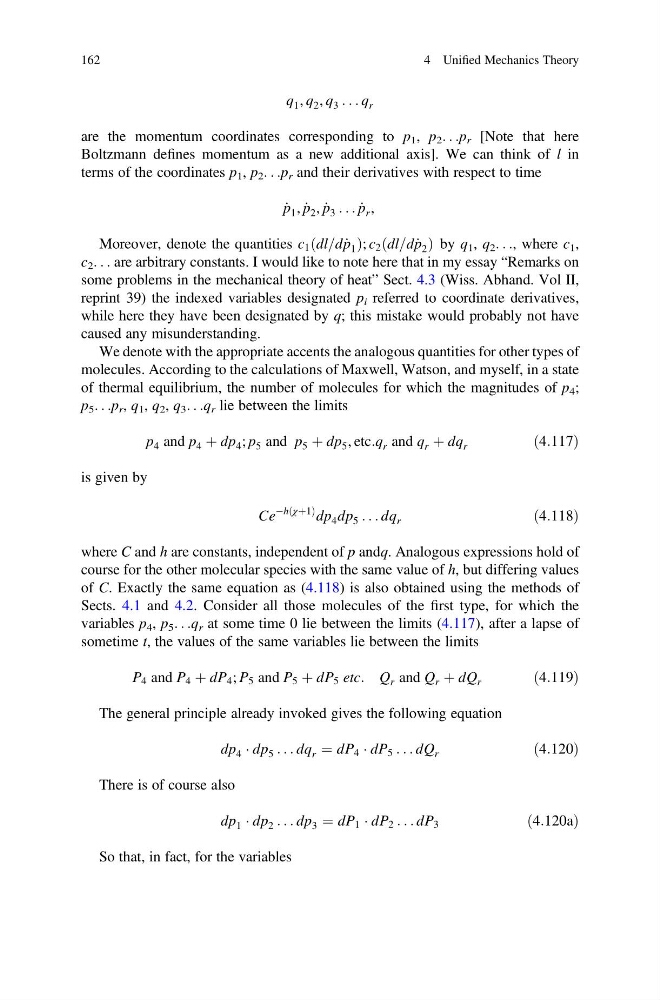
q 1 , q 2 , q 3 . . . q r
are the momentum coordinates corresponding to p 1 , p 2 . . .p r [Note that here
Boltzmann defines momentum as a new additional axis]. We can think of l in
terms of the coordinates p 1 , p 2 . . .p r and their derivatives with respect to time
_
p 1 , _
p 2 , _
p 3 . . . _
p r ,
Moreover, denote the quantities c 1 dl=d _
p 1
ð
Þ; c 2 dl=d _
p 2
ð
Þ by q 1 , q 2 . . ., where c 1 ,
c 2 . . . are arbitrary constants. I would like to note here that in my essay “Remarks on
some problems in the mechanical theory of heat” Sect. 4.3 (Wiss. Abhand. Vol II,
reprint 39) the indexed variables designated p i referred to coordinate derivatives,
while here they have been designated by q; this mistake would probably not have
caused any misunderstanding.
We denote with the appropriate accents the analogous quantities for other types of
molecules. According to the calculations of Maxwell, Watson, and myself, in a state
of thermal equilibrium, the number of molecules for which the magnitudes of p 4 ;
p 5 . . .p r , q 1 , q 2 , q 3 . . .q r lie between the limits
p 4 and p 4 þ dp 4 ; p 5 and p 5 þ dp 5 , etc:q r and q r þ dq r
ð4:117Þ
is given by
Ce
Àh χþ1
ð
Þ dp 4 dp 5 . . . dq r
ð4:118Þ
where C and h are constants, independent of p andq. Analogous expressions hold of
course for the other molecular species with the same value of h, but differing values
of C. Exactly the same equation as (4.118) is also obtained using the methods of
Sects. 4.1 and 4.2. Consider all those molecules of the first type, for which the
variables p 4 , p 5 . . .q r at some time 0 lie between the limits (4.117), after a lapse of
sometime t, the values of the same variables lie between the limits
P 4 and P 4 þ dP 4 ; P 5 and P 5 þ dP 5 etc: Q r and Q r þ dQ r
ð4:119Þ
The general principle already invoked gives the following equation
dp 4 Á dp 5 . . . dq r ¼ dP 4 Á dP 5 . . . dQ r
ð4:120Þ
There is of course also
dp 1 Á dp 2 . . . dp 3 ¼ dP 1 Á dP 2 . . . dP 3
ð4:120aÞ
So that, in fact, for the variables
162
4 Unified Mechanics Theory
are the momentum coordinates corresponding to p 1 , p 2 . . .p r [Note that here
Boltzmann defines momentum as a new additional axis]. We can think of l in
terms of the coordinates p 1 , p 2 . . .p r and their derivatives with respect to time
_
p 1 , _
p 2 , _
p 3 . . . _
p r ,
Moreover, denote the quantities c 1 dl=d _
p 1
ð
Þ; c 2 dl=d _
p 2
ð
Þ by q 1 , q 2 . . ., where c 1 ,
c 2 . . . are arbitrary constants. I would like to note here that in my essay “Remarks on
some problems in the mechanical theory of heat” Sect. 4.3 (Wiss. Abhand. Vol II,
reprint 39) the indexed variables designated p i referred to coordinate derivatives,
while here they have been designated by q; this mistake would probably not have
caused any misunderstanding.
We denote with the appropriate accents the analogous quantities for other types of
molecules. According to the calculations of Maxwell, Watson, and myself, in a state
of thermal equilibrium, the number of molecules for which the magnitudes of p 4 ;
p 5 . . .p r , q 1 , q 2 , q 3 . . .q r lie between the limits
p 4 and p 4 þ dp 4 ; p 5 and p 5 þ dp 5 , etc:q r and q r þ dq r
ð4:117Þ
is given by
Ce
Àh χþ1
ð
Þ dp 4 dp 5 . . . dq r
ð4:118Þ
where C and h are constants, independent of p andq. Analogous expressions hold of
course for the other molecular species with the same value of h, but differing values
of C. Exactly the same equation as (4.118) is also obtained using the methods of
Sects. 4.1 and 4.2. Consider all those molecules of the first type, for which the
variables p 4 , p 5 . . .q r at some time 0 lie between the limits (4.117), after a lapse of
sometime t, the values of the same variables lie between the limits
P 4 and P 4 þ dP 4 ; P 5 and P 5 þ dP 5 etc: Q r and Q r þ dQ r
ð4:119Þ
The general principle already invoked gives the following equation
dp 4 Á dp 5 . . . dq r ¼ dP 4 Á dP 5 . . . dQ r
ð4:120Þ
There is of course also
dp 1 Á dp 2 . . . dp 3 ¼ dP 1 Á dP 2 . . . dP 3
ð4:120aÞ
So that, in fact, for the variables
162
4 Unified Mechanics Theory