

product dudvdw and independent of u, v, and w. The earlier distribution of slips in
the urn is characterized by the fact that although E could be replaced by dx, kinetic
energies between zero and dx, dx and 2dx, 2dx and 3dx, etc. occurred on the same
number of slips.)
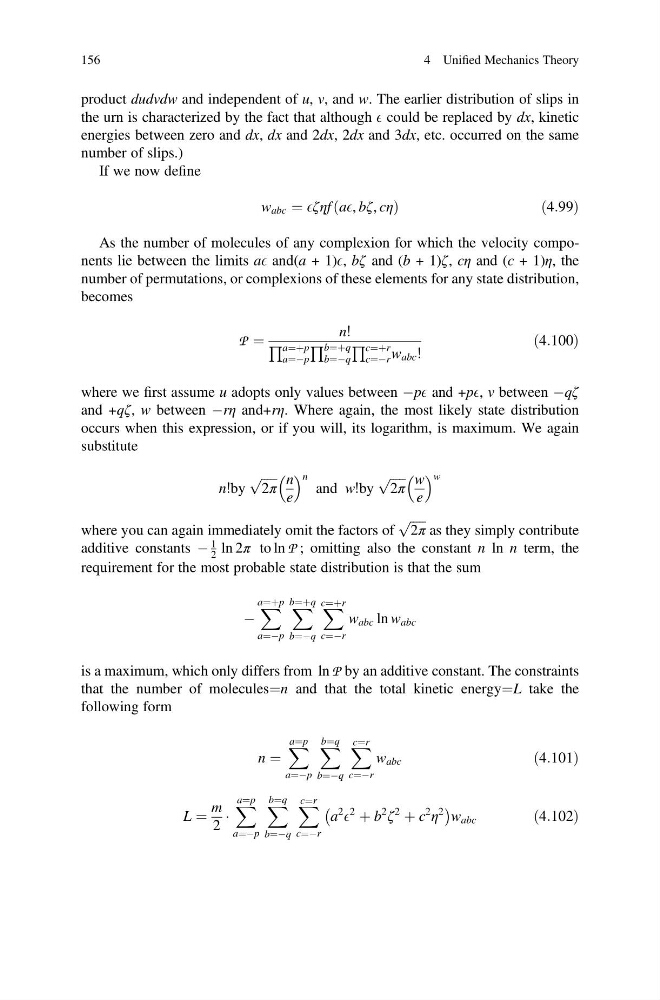
If we now define
w abc ¼ Eζηf aE, bζ, cη
ð
Þ
ð 4:99Þ
As the number of molecules of any complexion for which the velocity components lie between the limits aE and(a + 1)E, bζ and (b + 1)ζ, cη and (c + 1)η, the
number of permutations, or complexions of these elements for any state distribution,
becomes
P ¼
n!
Q a¼þp
a¼Àp
Q b¼þq
b¼Àq
Q c¼þr
c¼Àr w abc !
ð4:100Þ
where we first assume u adopts only values between ÀpE and +pE, v between Àqζ
and +qζ, w between Àrη and+rη. Where again, the most likely state distribution
occurs when this expression, or if you will, its logarithm, is maximum. We again
substitute
n!by
ffiffiffiffiffi
2π
p
n
e
n
and w!by
ffiffiffiffiffi
2π
p
w
e
w
where you can again immediately omit the factors of
ffiffiffiffiffi
2π
p
as they simply contribute
additive constants À
1
2 ln 2π to ln P ; omitting also the constant n ln n term, the
requirement for the most probable state distribution is that the sum
À
X
a¼þp
a¼Àp
X
b¼þq
b¼Àq
X
c¼þr
c¼Àr
w abc ln w abc
is a maximum, which only differs from ln P by an additive constant. The constraints
that the number of molecules¼n and that the total kinetic energy¼L take the
following form
n ¼
X a¼p
a¼Àp
X b¼q
b¼Àq
X c¼r
c¼Àr
w abc
ð4:101Þ
L ¼
m
2
Á
X a¼p
a¼Àp
X b¼q
b¼Àq
X c¼r
c¼Àr
a
2
E
2
þ b
2
ζ
2
þ c
2
η
2
À
Á
w abc
ð4:102Þ
156
4 Unified Mechanics Theory
the urn is characterized by the fact that although E could be replaced by dx, kinetic
energies between zero and dx, dx and 2dx, 2dx and 3dx, etc. occurred on the same
number of slips.)
If we now define
w abc ¼ Eζηf aE, bζ, cη
ð
Þ
ð 4:99Þ
As the number of molecules of any complexion for which the velocity components lie between the limits aE and(a + 1)E, bζ and (b + 1)ζ, cη and (c + 1)η, the
number of permutations, or complexions of these elements for any state distribution,
becomes
P ¼
n!
Q a¼þp
a¼Àp
Q b¼þq
b¼Àq
Q c¼þr
c¼Àr w abc !
ð4:100Þ
where we first assume u adopts only values between ÀpE and +pE, v between Àqζ
and +qζ, w between Àrη and+rη. Where again, the most likely state distribution
occurs when this expression, or if you will, its logarithm, is maximum. We again
substitute
n!by
ffiffiffiffiffi
2π
p
n
e
n
and w!by
ffiffiffiffiffi
2π
p
w
e
w
where you can again immediately omit the factors of
ffiffiffiffiffi
2π
p
as they simply contribute
additive constants À
1
2 ln 2π to ln P ; omitting also the constant n ln n term, the
requirement for the most probable state distribution is that the sum
À
X
a¼þp
a¼Àp
X
b¼þq
b¼Àq
X
c¼þr
c¼Àr
w abc ln w abc
is a maximum, which only differs from ln P by an additive constant. The constraints
that the number of molecules¼n and that the total kinetic energy¼L take the
following form
n ¼
X a¼p
a¼Àp
X b¼q
b¼Àq
X c¼r
c¼Àr
w abc
ð4:101Þ
L ¼
m
2
Á
X a¼p
a¼Àp
X b¼q
b¼Àq
X c¼r
c¼Àr
a
2
E
2
þ b
2
ζ
2
þ c
2
η
2
À
Á
w abc
ð4:102Þ
156
4 Unified Mechanics Theory