

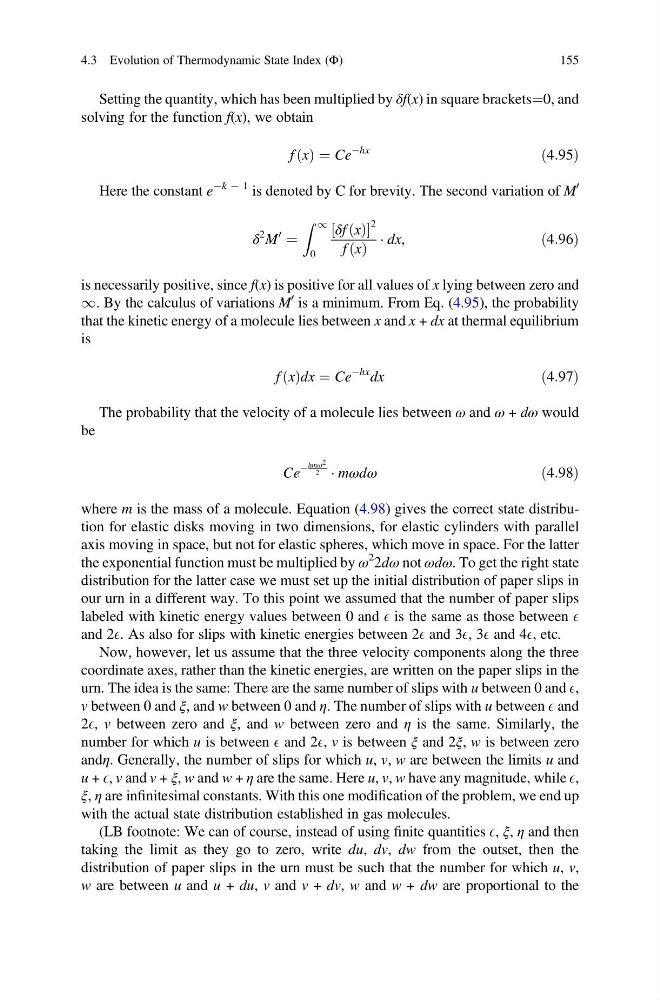
Setting the quantity, which has been multiplied by δf(x) in square brackets¼0, and
solving for the function f(x), we obtain
f x
ð Þ ¼ Ce
Àhx
ð4:95Þ
Here the constant e
Àk À 1 is denoted by C for brevity. The second variation of M
0
δ
2 M
0
¼
Z 1
0
δf x
ð Þ
½
2
f x
ð Þ
Á dx,
ð4:96Þ
is necessarily positive, since f(x) is positive for all values of x lying between zero and
1. By the calculus of variations M
0 is a minimum. From Eq. (4.95), the probability
that the kinetic energy of a molecule lies between x and x + dx at thermal equilibrium
is
f x
ð Þdx ¼ Ce
Àhx dx
ð4:97Þ
The probability that the velocity of a molecule lies between ω and ω + dω would
be
Ce
À
hmω 2
2
Á mωdω
ð4:98Þ
where m is the mass of a molecule. Equation (4.98) gives the correct state distribution for elastic disks moving in two dimensions, for elastic cylinders with parallel
axis moving in space, but not for elastic spheres, which move in space. For the latter
the exponential function must be multiplied by ω
2 2dω not ωdω. To get the right state
distribution for the latter case we must set up the initial distribution of paper slips in
our urn in a different way. To this point we assumed that the number of paper slips
labeled with kinetic energy values between 0 and E is the same as those between E
and 2E. As also for slips with kinetic energies between 2E and 3E, 3E and 4E, etc.
Now, however, let us assume that the three velocity components along the three
coordinate axes, rather than the kinetic energies, are written on the paper slips in the
urn. The idea is the same: There are the same number of slips with u between 0 and E,
v between 0 and ξ, and w between 0 and η. The number of slips with u between E and
2E, v between zero and ξ, and w between zero and η is the same. Similarly, the
number for which u is between E and 2E, v is between ξ and 2ξ, w is between zero
andη. Generally, the number of slips for which u, v, w are between the limits u and
u + E, v and v + ξ, w and w + η are the same. Here u, v, w have any magnitude, while E,
ξ, η are infinitesimal constants. With this one modification of the problem, we end up
with the actual state distribution established in gas molecules.
(LB footnote: We can of course, instead of using finite quantities E, ξ, η and then
taking the limit as they go to zero, write du, dv, dw from the outset, then the
distribution of paper slips in the urn must be such that the number for which u, v,
w are between u and u + du, v and v + dv, w and w + dw are proportional to the
4.3 Evolution of Thermodynamic State Index (Φ)
155
solving for the function f(x), we obtain
f x
ð Þ ¼ Ce
Àhx
ð4:95Þ
Here the constant e
Àk À 1 is denoted by C for brevity. The second variation of M
0
δ
2 M
0
¼
Z 1
0
δf x
ð Þ
½
2
f x
ð Þ
Á dx,
ð4:96Þ
is necessarily positive, since f(x) is positive for all values of x lying between zero and
1. By the calculus of variations M
0 is a minimum. From Eq. (4.95), the probability
that the kinetic energy of a molecule lies between x and x + dx at thermal equilibrium
is
f x
ð Þdx ¼ Ce
Àhx dx
ð4:97Þ
The probability that the velocity of a molecule lies between ω and ω + dω would
be
Ce
À
hmω 2
2
Á mωdω
ð4:98Þ
where m is the mass of a molecule. Equation (4.98) gives the correct state distribution for elastic disks moving in two dimensions, for elastic cylinders with parallel
axis moving in space, but not for elastic spheres, which move in space. For the latter
the exponential function must be multiplied by ω
2 2dω not ωdω. To get the right state
distribution for the latter case we must set up the initial distribution of paper slips in
our urn in a different way. To this point we assumed that the number of paper slips
labeled with kinetic energy values between 0 and E is the same as those between E
and 2E. As also for slips with kinetic energies between 2E and 3E, 3E and 4E, etc.
Now, however, let us assume that the three velocity components along the three
coordinate axes, rather than the kinetic energies, are written on the paper slips in the
urn. The idea is the same: There are the same number of slips with u between 0 and E,
v between 0 and ξ, and w between 0 and η. The number of slips with u between E and
2E, v between zero and ξ, and w between zero and η is the same. Similarly, the
number for which u is between E and 2E, v is between ξ and 2ξ, w is between zero
andη. Generally, the number of slips for which u, v, w are between the limits u and
u + E, v and v + ξ, w and w + η are the same. Here u, v, w have any magnitude, while E,
ξ, η are infinitesimal constants. With this one modification of the problem, we end up
with the actual state distribution established in gas molecules.
(LB footnote: We can of course, instead of using finite quantities E, ξ, η and then
taking the limit as they go to zero, write du, dv, dw from the outset, then the
distribution of paper slips in the urn must be such that the number for which u, v,
w are between u and u + du, v and v + dv, w and w + dw are proportional to the
4.3 Evolution of Thermodynamic State Index (Φ)
155