

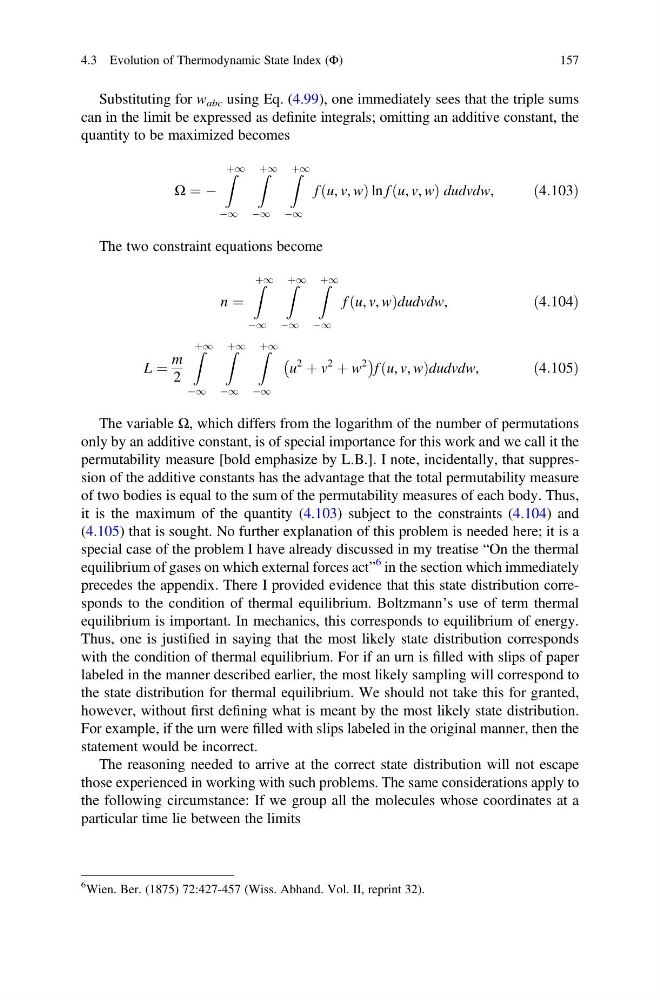
Substituting for w abc using Eq. (4.99), one immediately sees that the triple sums
can in the limit be expressed as definite integrals; omitting an additive constant, the
quantity to be maximized becomes
Ω ¼ À
Z þ1
À1
Z þ1
À1
Z þ1
À1
f u, v, w
ð
Þln f u, v, w
ð
Þdudvdw,
ð4:103Þ
The two constraint equations become
n ¼
Z þ1
À1
Z þ1
À1
Z þ1
À1
f u, v, w
ð
Þdudvdw,
ð4:104Þ
L ¼
m
2
Z þ1
À1
Z þ1
À1
Z þ1
À1
u
2
þ v
2
þ w
2
À
Á
f u, v, w
ð
Þdudvdw,
ð4:105Þ
The variable Ω, which differs from the logarithm of the number of permutations
only by an additive constant, is of special importance for this work and we call it the
permutability measure [bold emphasize by L.B.]. I note, incidentally, that suppression of the additive constants has the advantage that the total permutability measure
of two bodies is equal to the sum of the permutability measures of each body. Thus,
it is the maximum of the quantity (4.103) subject to the constraints (4.104) and
(4.105) that is sought. No further explanation of this problem is needed here; it is a
special case of the problem I have already discussed in my treatise “On the thermal
equilibrium of gases on which external forces act”
6 in the section which immediately
precedes the appendix. There I provided evidence that this state distribution corresponds to the condition of thermal equilibrium. Boltzmann’s use of term thermal
equilibrium is important. In mechanics, this corresponds to equilibrium of energy.
Thus, one is justified in saying that the most likely state distribution corresponds
with the condition of thermal equilibrium. For if an urn is filled with slips of paper
labeled in the manner described earlier, the most likely sampling will correspond to
the state distribution for thermal equilibrium. We should not take this for granted,
however, without first defining what is meant by the most likely state distribution.
For example, if the urn were filled with slips labeled in the original manner, then the
statement would be incorrect.
The reasoning needed to arrive at the correct state distribution will not escape
those experienced in working with such problems. The same considerations apply to
the following circumstance: If we group all the molecules whose coordinates at a
particular time lie between the limits
6 Wien. Ber. (1875) 72:427-457 (Wiss. Abhand. Vol. II, reprint 32).
4.3 Evolution of Thermodynamic State Index (Φ)
157
can in the limit be expressed as definite integrals; omitting an additive constant, the
quantity to be maximized becomes
Ω ¼ À
Z þ1
À1
Z þ1
À1
Z þ1
À1
f u, v, w
ð
Þln f u, v, w
ð
Þdudvdw,
ð4:103Þ
The two constraint equations become
n ¼
Z þ1
À1
Z þ1
À1
Z þ1
À1
f u, v, w
ð
Þdudvdw,
ð4:104Þ
L ¼
m
2
Z þ1
À1
Z þ1
À1
Z þ1
À1
u
2
þ v
2
þ w
2
À
Á
f u, v, w
ð
Þdudvdw,
ð4:105Þ
The variable Ω, which differs from the logarithm of the number of permutations
only by an additive constant, is of special importance for this work and we call it the
permutability measure [bold emphasize by L.B.]. I note, incidentally, that suppression of the additive constants has the advantage that the total permutability measure
of two bodies is equal to the sum of the permutability measures of each body. Thus,
it is the maximum of the quantity (4.103) subject to the constraints (4.104) and
(4.105) that is sought. No further explanation of this problem is needed here; it is a
special case of the problem I have already discussed in my treatise “On the thermal
equilibrium of gases on which external forces act”
6 in the section which immediately
precedes the appendix. There I provided evidence that this state distribution corresponds to the condition of thermal equilibrium. Boltzmann’s use of term thermal
equilibrium is important. In mechanics, this corresponds to equilibrium of energy.
Thus, one is justified in saying that the most likely state distribution corresponds
with the condition of thermal equilibrium. For if an urn is filled with slips of paper
labeled in the manner described earlier, the most likely sampling will correspond to
the state distribution for thermal equilibrium. We should not take this for granted,
however, without first defining what is meant by the most likely state distribution.
For example, if the urn were filled with slips labeled in the original manner, then the
statement would be incorrect.
The reasoning needed to arrive at the correct state distribution will not escape
those experienced in working with such problems. The same considerations apply to
the following circumstance: If we group all the molecules whose coordinates at a
particular time lie between the limits
6 Wien. Ber. (1875) 72:427-457 (Wiss. Abhand. Vol. II, reprint 32).
4.3 Evolution of Thermodynamic State Index (Φ)
157