

probable one. That state distribution which has the most complexions, we consider
as the most likely, or corresponding to thermal equilibrium. Proceeding to the
continuous kinetic energy case the most natural approach is as follows:
Taking E to be some very small value, we assume that in the urn are very many
slips of paper labeled with kinetic energy values between zero and E. In the urn are
also equal numbers of paper slips labeled with kinetic energy values between E and
2E, 2E and 3E up to infinity. Since E is very small, we can regard all molecules with
kinetic energy between x and x + E as having the same kinetic energy. The rest of the
calculation proceeds as in Sect. 4.1 above. We assume some complexion has been
drawn; w 0 molecules have kinetic energy between zero and E, w 1 molecules have
values between E and 2E, w 2 have values between 2E and 3E, etc.
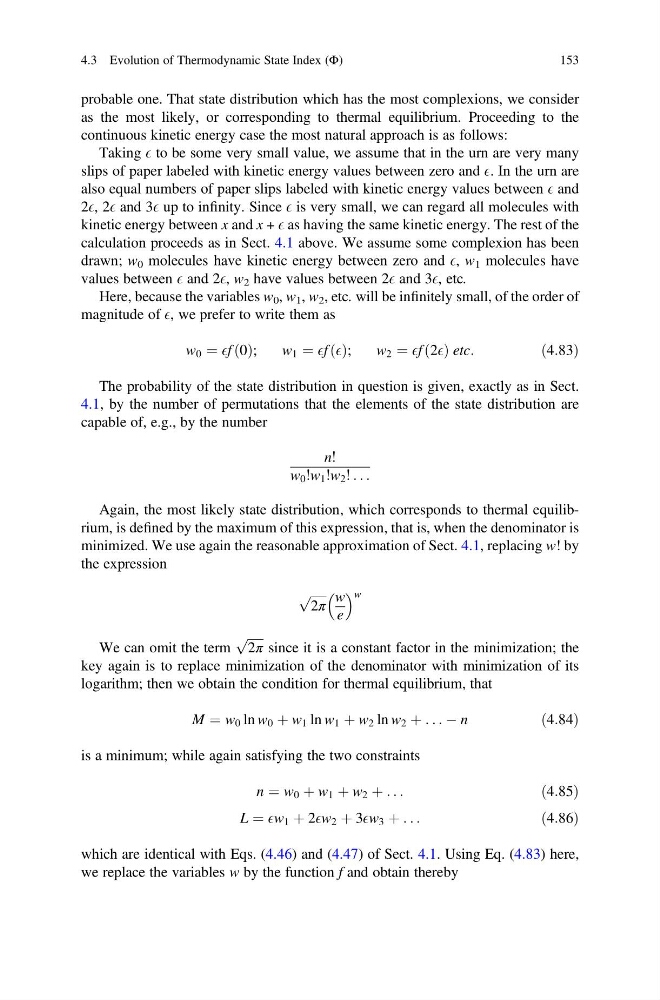
Here, because the variables w 0 , w 1 , w 2 , etc. will be infinitely small, of the order of
magnitude of E, we prefer to write them as
w 0 ¼ Ef 0
ð Þ;
w 1 ¼ Ef E
ð Þ;
w 2 ¼ Ef 2E
ð Þ etc:
ð4:83Þ
The probability of the state distribution in question is given, exactly as in Sect.
4.1, by the number of permutations that the elements of the state distribution are
capable of, e.g., by the number
n!
w 0 !w 1 !w 2 ! . . .
Again, the most likely state distribution, which corresponds to thermal equilibrium, is defined by the maximum of this expression, that is, when the denominator is
minimized. We use again the reasonable approximation of Sect. 4.1, replacing w! by
the expression
ffiffiffiffiffi
2π
p
w
e
w
We can omit the term
ffiffiffiffiffi
2π
p
since it is a constant factor in the minimization; the
key again is to replace minimization of the denominator with minimization of its
logarithm; then we obtain the condition for thermal equilibrium, that
M ¼ w 0 ln w 0 þ w 1 ln w 1 þ w 2 ln w 2 þ . . . À n
ð4:84Þ
is a minimum; while again satisfying the two constraints
n ¼ w 0 þ w 1 þ w 2 þ . . .
ð4:85Þ
L ¼ Ew 1 þ 2Ew 2 þ 3Ew 3 þ . . .
ð4:86Þ
which are identical with Eqs. (4.46) and (4.47) of Sect. 4.1. Using Eq. (4.83) here,
we replace the variables w by the function f and obtain thereby
4.3 Evolution of Thermodynamic State Index (Φ)
153
as the most likely, or corresponding to thermal equilibrium. Proceeding to the
continuous kinetic energy case the most natural approach is as follows:
Taking E to be some very small value, we assume that in the urn are very many
slips of paper labeled with kinetic energy values between zero and E. In the urn are
also equal numbers of paper slips labeled with kinetic energy values between E and
2E, 2E and 3E up to infinity. Since E is very small, we can regard all molecules with
kinetic energy between x and x + E as having the same kinetic energy. The rest of the
calculation proceeds as in Sect. 4.1 above. We assume some complexion has been
drawn; w 0 molecules have kinetic energy between zero and E, w 1 molecules have
values between E and 2E, w 2 have values between 2E and 3E, etc.
Here, because the variables w 0 , w 1 , w 2 , etc. will be infinitely small, of the order of
magnitude of E, we prefer to write them as
w 0 ¼ Ef 0
ð Þ;
w 1 ¼ Ef E
ð Þ;
w 2 ¼ Ef 2E
ð Þ etc:
ð4:83Þ
The probability of the state distribution in question is given, exactly as in Sect.
4.1, by the number of permutations that the elements of the state distribution are
capable of, e.g., by the number
n!
w 0 !w 1 !w 2 ! . . .
Again, the most likely state distribution, which corresponds to thermal equilibrium, is defined by the maximum of this expression, that is, when the denominator is
minimized. We use again the reasonable approximation of Sect. 4.1, replacing w! by
the expression
ffiffiffiffiffi
2π
p
w
e
w
We can omit the term
ffiffiffiffiffi
2π
p
since it is a constant factor in the minimization; the
key again is to replace minimization of the denominator with minimization of its
logarithm; then we obtain the condition for thermal equilibrium, that
M ¼ w 0 ln w 0 þ w 1 ln w 1 þ w 2 ln w 2 þ . . . À n
ð4:84Þ
is a minimum; while again satisfying the two constraints
n ¼ w 0 þ w 1 þ w 2 þ . . .
ð4:85Þ
L ¼ Ew 1 þ 2Ew 2 þ 3Ew 3 þ . . .
ð4:86Þ
which are identical with Eqs. (4.46) and (4.47) of Sect. 4.1. Using Eq. (4.83) here,
we replace the variables w by the function f and obtain thereby
4.3 Evolution of Thermodynamic State Index (Φ)
153