

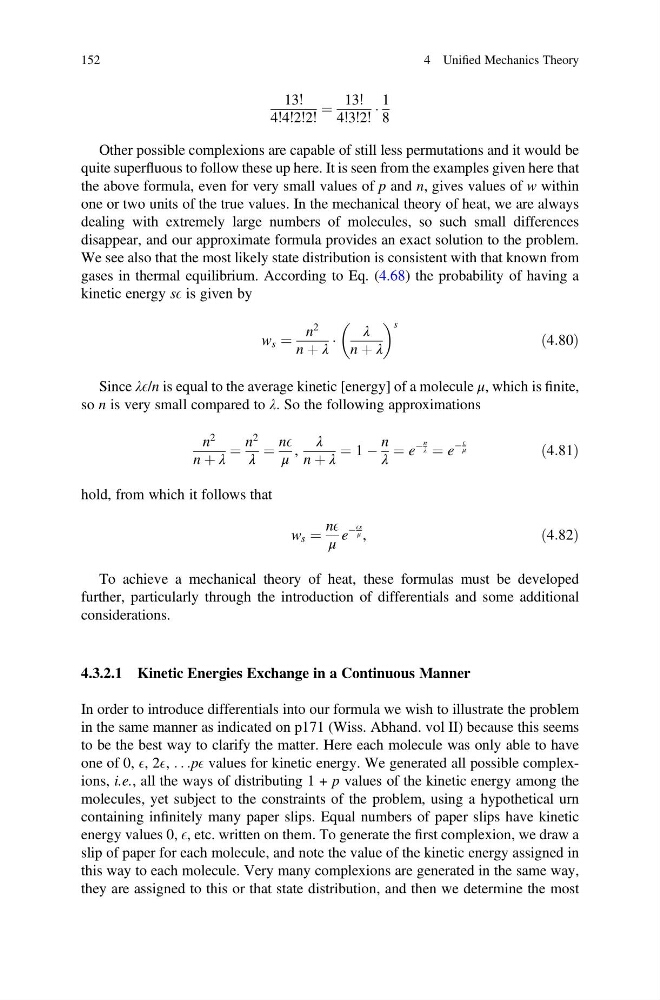
13!
4!4!2!2!
¼
13!
4!3!2!
Á
1
8
Other possible complexions are capable of still less permutations and it would be
quite superfluous to follow these up here. It is seen from the examples given here that
the above formula, even for very small values of p and n, gives values of w within
one or two units of the true values. In the mechanical theory of heat, we are always
dealing with extremely large numbers of molecules, so such small differences
disappear, and our approximate formula provides an exact solution to the problem.
We see also that the most likely state distribution is consistent with that known from
gases in thermal equilibrium. According to Eq. (4.68) the probability of having a
kinetic energy sE is given by
w s ¼
n
2
n þ λ
Á
λ
n þ λ
s
ð4:80Þ
Since λE/n is equal to the average kinetic [energy] of a molecule μ, which is finite,
so n is very small compared to λ. So the following approximations
n
2
n þ λ
¼
n
2
λ
¼
nE
μ
,
λ
n þ λ
¼ 1 À
n
λ
¼ e
À
n
λ ¼ e
À
E
μ
ð4:81Þ
hold, from which it follows that
w s ¼
nE
μ
e
À
Es
μ ,
ð4:82Þ
To achieve a mechanical theory of heat, these formulas must be developed
further, particularly through the introduction of differentials and some additional
considerations.
4.3.2.1 Kinetic Energies Exchange in a Continuous Manner
In order to introduce differentials into our formula we wish to illustrate the problem
in the same manner as indicated on p171 (Wiss. Abhand. vol II) because this seems
to be the best way to clarify the matter. Here each molecule was only able to have
one of 0, E, 2E, . . .pE values for kinetic energy. We generated all possible complexions, i.e., all the ways of distributing 1 + p values of the kinetic energy among the
molecules, yet subject to the constraints of the problem, using a hypothetical urn
containing infinitely many paper slips. Equal numbers of paper slips have kinetic
energy values 0, E, etc. written on them. To generate the first complexion, we draw a
slip of paper for each molecule, and note the value of the kinetic energy assigned in
this way to each molecule. Very many complexions are generated in the same way,
they are assigned to this or that state distribution, and then we determine the most
152
4 Unified Mechanics Theory
4!4!2!2!
¼
13!
4!3!2!
Á
1
8
Other possible complexions are capable of still less permutations and it would be
quite superfluous to follow these up here. It is seen from the examples given here that
the above formula, even for very small values of p and n, gives values of w within
one or two units of the true values. In the mechanical theory of heat, we are always
dealing with extremely large numbers of molecules, so such small differences
disappear, and our approximate formula provides an exact solution to the problem.
We see also that the most likely state distribution is consistent with that known from
gases in thermal equilibrium. According to Eq. (4.68) the probability of having a
kinetic energy sE is given by
w s ¼
n
2
n þ λ
Á
λ
n þ λ
s
ð4:80Þ
Since λE/n is equal to the average kinetic [energy] of a molecule μ, which is finite,
so n is very small compared to λ. So the following approximations
n
2
n þ λ
¼
n
2
λ
¼
nE
μ
,
λ
n þ λ
¼ 1 À
n
λ
¼ e
À
n
λ ¼ e
À
E
μ
ð4:81Þ
hold, from which it follows that
w s ¼
nE
μ
e
À
Es
μ ,
ð4:82Þ
To achieve a mechanical theory of heat, these formulas must be developed
further, particularly through the introduction of differentials and some additional
considerations.
4.3.2.1 Kinetic Energies Exchange in a Continuous Manner
In order to introduce differentials into our formula we wish to illustrate the problem
in the same manner as indicated on p171 (Wiss. Abhand. vol II) because this seems
to be the best way to clarify the matter. Here each molecule was only able to have
one of 0, E, 2E, . . .pE values for kinetic energy. We generated all possible complexions, i.e., all the ways of distributing 1 + p values of the kinetic energy among the
molecules, yet subject to the constraints of the problem, using a hypothetical urn
containing infinitely many paper slips. Equal numbers of paper slips have kinetic
energy values 0, E, etc. written on them. To generate the first complexion, we draw a
slip of paper for each molecule, and note the value of the kinetic energy assigned in
this way to each molecule. Very many complexions are generated in the same way,
they are assigned to this or that state distribution, and then we determine the most
152
4 Unified Mechanics Theory