

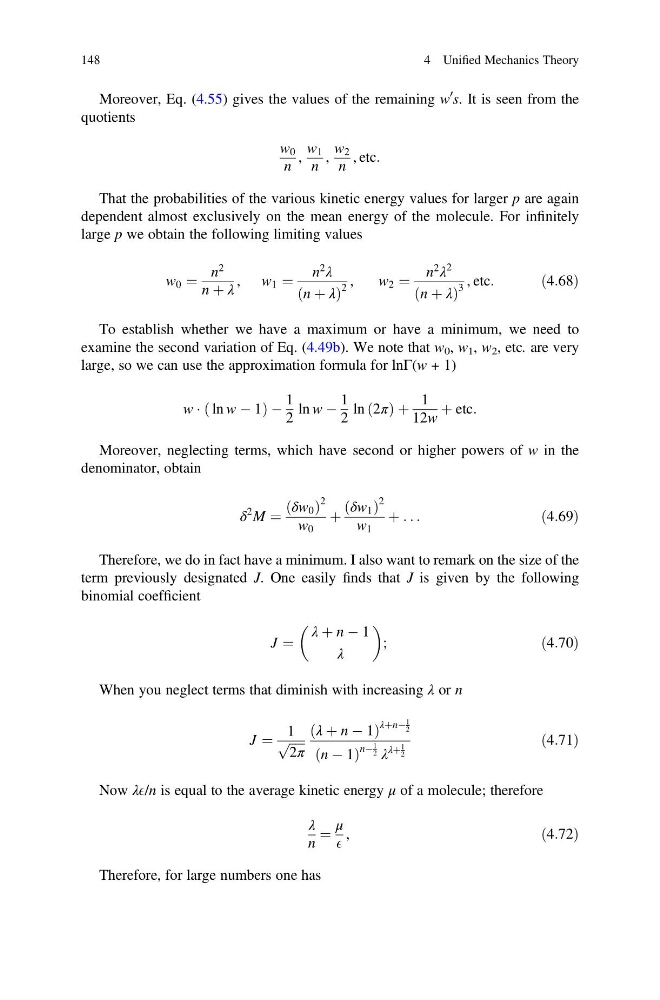
Moreover, Eq. (4.55) gives the values of the remaining w
0 s. It is seen from the
quotients
w 0
n
,
w 1
n
,
w 2
n
, etc:
That the probabilities of the various kinetic energy values for larger p are again
dependent almost exclusively on the mean energy of the molecule. For infinitely
large p we obtain the following limiting values
w 0 ¼
n
2
n þ λ
, w 1 ¼
n
2
λ
n þ λ
ð
Þ
2
,
w 2 ¼
n
2
λ
2
n þ λ
ð
Þ
3
, etc:
ð4:68Þ
To establish whether we have a maximum or have a minimum, we need to
examine the second variation of Eq. (4.49b). We note that w 0 , w 1 , w 2 , etc. are very
large, so we can use the approximation formula for lnΓ(w + 1)
w Á ln w À 1
ð
ÞÀ
1
2
ln w À
1
2
ln 2π
ð Þ þ
1
12w
þ etc:
Moreover, neglecting terms, which have second or higher powers of w in the
denominator, obtain
δ
2 M ¼
δw 0
ð
Þ
2
w 0
þ
δw 1
ð
Þ
2
w 1
þ . . .
ð4:69Þ
Therefore, we do in fact have a minimum. I also want to remark on the size of the
term previously designated J. One easily finds that J is given by the following
binomial coefficient
J ¼
λ þ n À 1
λ
;
ð4:70Þ
When you neglect terms that diminish with increasing λ or n
J ¼
1
ffiffiffiffiffi
2π
p
λ þ n À 1
ð
Þ
λþnÀ
1
2
n À 1
ð
Þ
nÀ
1
2 λ
λþ
1
2
ð4:71Þ
Now λE/n is equal to the average kinetic energy μ of a molecule; therefore
λ
n
¼
μ
E
,
ð4:72Þ
Therefore, for large numbers one has
148
4 Unified Mechanics Theory
0 s. It is seen from the
quotients
w 0
n
,
w 1
n
,
w 2
n
, etc:
That the probabilities of the various kinetic energy values for larger p are again
dependent almost exclusively on the mean energy of the molecule. For infinitely
large p we obtain the following limiting values
w 0 ¼
n
2
n þ λ
, w 1 ¼
n
2
λ
n þ λ
ð
Þ
2
,
w 2 ¼
n
2
λ
2
n þ λ
ð
Þ
3
, etc:
ð4:68Þ
To establish whether we have a maximum or have a minimum, we need to
examine the second variation of Eq. (4.49b). We note that w 0 , w 1 , w 2 , etc. are very
large, so we can use the approximation formula for lnΓ(w + 1)
w Á ln w À 1
ð
ÞÀ
1
2
ln w À
1
2
ln 2π
ð Þ þ
1
12w
þ etc:
Moreover, neglecting terms, which have second or higher powers of w in the
denominator, obtain
δ
2 M ¼
δw 0
ð
Þ
2
w 0
þ
δw 1
ð
Þ
2
w 1
þ . . .
ð4:69Þ
Therefore, we do in fact have a minimum. I also want to remark on the size of the
term previously designated J. One easily finds that J is given by the following
binomial coefficient
J ¼
λ þ n À 1
λ
;
ð4:70Þ
When you neglect terms that diminish with increasing λ or n
J ¼
1
ffiffiffiffiffi
2π
p
λ þ n À 1
ð
Þ
λþnÀ
1
2
n À 1
ð
Þ
nÀ
1
2 λ
λþ
1
2
ð4:71Þ
Now λE/n is equal to the average kinetic energy μ of a molecule; therefore
λ
n
¼
μ
E
,
ð4:72Þ
Therefore, for large numbers one has
148
4 Unified Mechanics Theory