

multiplying by the factor(x À 1)
2 .
5 To be convinced of this, one need only derive the
final equation directly by dividing the Eqs. (4.56) and (4.57). Following this division
and having removed the variable x from the denominator and collecting powers of
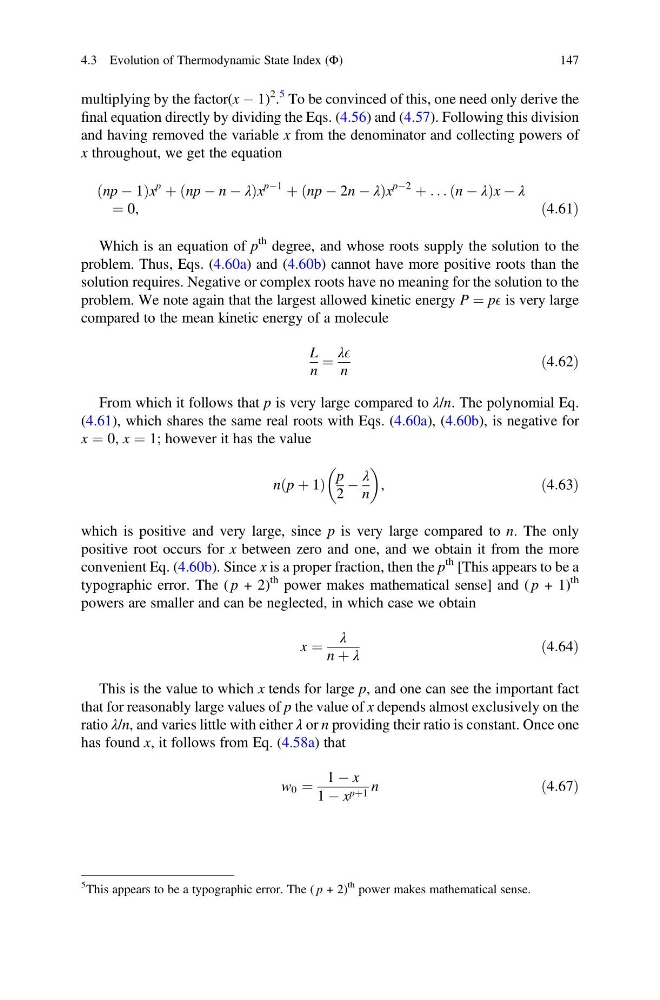
x throughout, we get the equation
np À 1
ð
Þx
p
þ np À n À λ
ð
Þ x
pÀ1
þ np À 2n À λ
ð
Þ x
pÀ2
þ . . . n À λ
ð
Þx À λ
¼ 0,
ð4:61Þ
Which is an equation of p
th degree, and whose roots supply the solution to the
problem. Thus, Eqs. (4.60a) and (4.60b) cannot have more positive roots than the
solution requires. Negative or complex roots have no meaning for the solution to the
problem. We note again that the largest allowed kinetic energy P ¼ pE is very large
compared to the mean kinetic energy of a molecule
L
n
¼
λE
n
ð4:62Þ
From which it follows that p is very large compared to λ/n. The polynomial Eq.
(4.61), which shares the same real roots with Eqs. (4.60a), (4.60b), is negative for
x ¼ 0, x ¼ 1; however it has the value
n p þ 1
ð
Þ
p
2
À
λ
n
,
ð4:63Þ
which is positive and very large, since p is very large compared to n. The only
positive root occurs for x between zero and one, and we obtain it from the more
convenient Eq. (4.60b). Since x is a proper fraction, then the p
th [This appears to be a
typographic error. The ( p + 2)
th power makes mathematical sense] and ( p + 1)
th
powers are smaller and can be neglected, in which case we obtain
x ¼
λ
n þ λ
ð4:64Þ
This is the value to which x tends for large p, and one can see the important fact
that for reasonably large values of p the value of x depends almost exclusively on the
ratio λ/n, and varies little with either λ or n providing their ratio is constant. Once one
has found x, it follows from Eq. (4.58a) that
w 0 ¼
1 À x
1 À x pþ1 n
ð4:67Þ
5 This appears to be a typographic error. The ( p + 2)
th power makes mathematical sense.
4.3 Evolution of Thermodynamic State Index (Φ)
147
2 .
5 To be convinced of this, one need only derive the
final equation directly by dividing the Eqs. (4.56) and (4.57). Following this division
and having removed the variable x from the denominator and collecting powers of
x throughout, we get the equation
np À 1
ð
Þx
p
þ np À n À λ
ð
Þ x
pÀ1
þ np À 2n À λ
ð
Þ x
pÀ2
þ . . . n À λ
ð
Þx À λ
¼ 0,
ð4:61Þ
Which is an equation of p
th degree, and whose roots supply the solution to the
problem. Thus, Eqs. (4.60a) and (4.60b) cannot have more positive roots than the
solution requires. Negative or complex roots have no meaning for the solution to the
problem. We note again that the largest allowed kinetic energy P ¼ pE is very large
compared to the mean kinetic energy of a molecule
L
n
¼
λE
n
ð4:62Þ
From which it follows that p is very large compared to λ/n. The polynomial Eq.
(4.61), which shares the same real roots with Eqs. (4.60a), (4.60b), is negative for
x ¼ 0, x ¼ 1; however it has the value
n p þ 1
ð
Þ
p
2
À
λ
n
,
ð4:63Þ
which is positive and very large, since p is very large compared to n. The only
positive root occurs for x between zero and one, and we obtain it from the more
convenient Eq. (4.60b). Since x is a proper fraction, then the p
th [This appears to be a
typographic error. The ( p + 2)
th power makes mathematical sense] and ( p + 1)
th
powers are smaller and can be neglected, in which case we obtain
x ¼
λ
n þ λ
ð4:64Þ
This is the value to which x tends for large p, and one can see the important fact
that for reasonably large values of p the value of x depends almost exclusively on the
ratio λ/n, and varies little with either λ or n providing their ratio is constant. Once one
has found x, it follows from Eq. (4.58a) that
w 0 ¼
1 À x
1 À x pþ1 n
ð4:67Þ
5 This appears to be a typographic error. The ( p + 2)
th power makes mathematical sense.
4.3 Evolution of Thermodynamic State Index (Φ)
147