

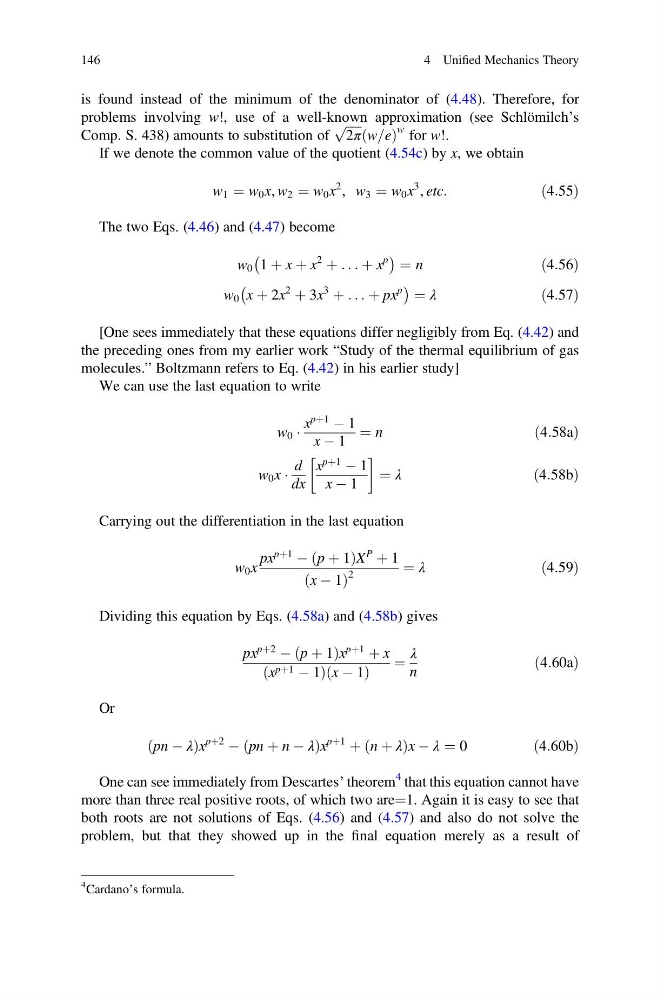
is found instead of the minimum of the denominator of (4.48). Therefore, for
problems involving w!, use of a well-known approximation (see Schlömilch’s
Comp. S. 438) amounts to substitution of
ffiffiffiffiffi
2π
p
w=e
ð
Þ
w for w!.
If we denote the common value of the quotient (4.54c) by x, we obtain
w 1 ¼ w 0 x, w 2 ¼ w 0 x
2 , w 3 ¼ w 0 x
3 , etc:
ð4:55Þ
The two Eqs. (4.46) and (4.47) become
w 0 1 þ x þ x
2
þ . . . þ x
p
À
Á ¼ n
ð4:56Þ
w 0 x þ 2x
2
þ 3x
3
þ . . . þ px
p
À
Á ¼ λ
ð4:57Þ
[One sees immediately that these equations differ negligibly from Eq. (4.42) and
the preceding ones from my earlier work “Study of the thermal equilibrium of gas
molecules.” Boltzmann refers to Eq. (4.42) in his earlier study]
We can use the last equation to write
w 0 Á
x
pþ1
À 1
x À 1
¼ n
ð4:58aÞ
w 0 x Á
d
dx
x
pþ1
À 1
x À 1
!
¼ λ
ð4:58bÞ
Carrying out the differentiation in the last equation
w 0 x
px
pþ1
À p þ 1
ð
ÞX
P
þ 1
x À 1
ð
Þ
2
¼ λ
ð4:59Þ
Dividing this equation by Eqs. (4.58a) and (4.58b) gives
px
pþ2
À p þ 1
ð
Þx
pþ1
þ x
x pþ1 À 1
ð
Þx À 1
ð
Þ
¼
λ
n
ð4:60aÞ
Or
pn À λ
ð
Þx
pþ2
À pn þ n À λ
ð
Þ x
pþ1
þ n þ λ
ð
Þx À λ ¼ 0
ð4:60bÞ
One can see immediately from Descartes’ theorem
4 that this equation cannot have
more than three real positive roots, of which two are¼1. Again it is easy to see that
both roots are not solutions of Eqs. (4.56) and (4.57) and also do not solve the
problem, but that they showed up in the final equation merely as a result of
4 Cardano’s formula.
146
4 Unified Mechanics Theory
problems involving w!, use of a well-known approximation (see Schlömilch’s
Comp. S. 438) amounts to substitution of
ffiffiffiffiffi
2π
p
w=e
ð
Þ
w for w!.
If we denote the common value of the quotient (4.54c) by x, we obtain
w 1 ¼ w 0 x, w 2 ¼ w 0 x
2 , w 3 ¼ w 0 x
3 , etc:
ð4:55Þ
The two Eqs. (4.46) and (4.47) become
w 0 1 þ x þ x
2
þ . . . þ x
p
À
Á ¼ n
ð4:56Þ
w 0 x þ 2x
2
þ 3x
3
þ . . . þ px
p
À
Á ¼ λ
ð4:57Þ
[One sees immediately that these equations differ negligibly from Eq. (4.42) and
the preceding ones from my earlier work “Study of the thermal equilibrium of gas
molecules.” Boltzmann refers to Eq. (4.42) in his earlier study]
We can use the last equation to write
w 0 Á
x
pþ1
À 1
x À 1
¼ n
ð4:58aÞ
w 0 x Á
d
dx
x
pþ1
À 1
x À 1
!
¼ λ
ð4:58bÞ
Carrying out the differentiation in the last equation
w 0 x
px
pþ1
À p þ 1
ð
ÞX
P
þ 1
x À 1
ð
Þ
2
¼ λ
ð4:59Þ
Dividing this equation by Eqs. (4.58a) and (4.58b) gives
px
pþ2
À p þ 1
ð
Þx
pþ1
þ x
x pþ1 À 1
ð
Þx À 1
ð
Þ
¼
λ
n
ð4:60aÞ
Or
pn À λ
ð
Þx
pþ2
À pn þ n À λ
ð
Þ x
pþ1
þ n þ λ
ð
Þx À λ ¼ 0
ð4:60bÞ
One can see immediately from Descartes’ theorem
4 that this equation cannot have
more than three real positive roots, of which two are¼1. Again it is easy to see that
both roots are not solutions of Eqs. (4.56) and (4.57) and also do not solve the
problem, but that they showed up in the final equation merely as a result of
4 Cardano’s formula.
146
4 Unified Mechanics Theory