

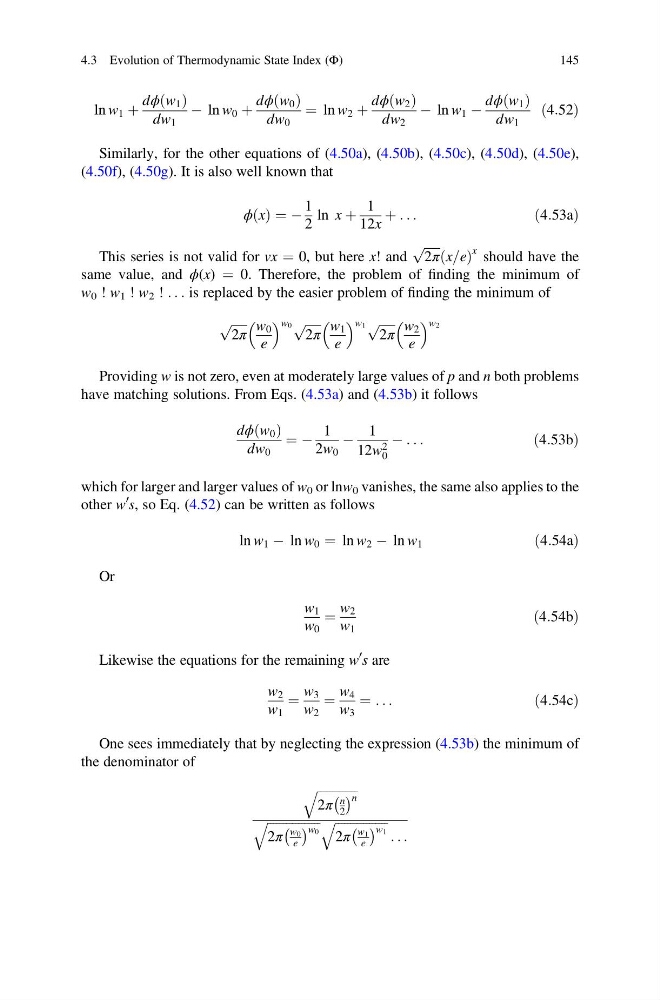
ln w 1 þ
dϕ w 1
ð Þ
dw 1
À ln w 0 þ
dϕ w 0
ð Þ
dw 0
¼ ln w 2 þ
dϕ w 2
ð Þ
dw 2
À ln w 1 À
dϕ w 1
ð Þ
dw 1
ð4:52Þ
Similarly, for the other equations of (4.50a), (4.50b), (4.50c), (4.50d), (4.50e),
(4.50f), (4.50g). It is also well known that
ϕ x
ð Þ ¼ À
1
2
ln x þ
1
12x
þ . . .
ð4:53aÞ
This series is not valid for vx ¼ 0, but here x! and
ffiffiffiffiffi
2π
p
x=e
ð Þ
x should have the
same value, and ϕ(x) ¼ 0. Therefore, the problem of finding the minimum of
w 0 ! w 1 ! w 2 ! . . . is replaced by the easier problem of finding the minimum of
ffiffiffiffiffi
2π
p
w 0
e
w 0 ffiffiffiffiffi
2π
p
w 1
e
w 1 ffiffiffiffiffi
2π
p
w 2
e
w 2
Providing w is not zero, even at moderately large values of p and n both problems
have matching solutions. From Eqs. (4.53a) and (4.53b) it follows
dϕ w 0
ð Þ
dw 0
¼ À
1
2w 0
À
1
12w 2
0
À . . .
ð4:53bÞ
which for larger and larger values of w 0 or lnw 0 vanishes, the same also applies to the
other w
0 s, so Eq. (4.52) can be written as follows
ln w 1 À ln w 0 ¼ ln w 2 À ln w 1
ð4:54aÞ
Or
w 1
w 0
¼
w 2
w 1
ð4:54bÞ
Likewise the equations for the remaining w
0 s are
w 2
w 1
¼
w 3
w 2
¼
w 4
w 3
¼ . . .
ð4:54cÞ
One sees immediately that by neglecting the expression (4.53b) the minimum of
the denominator of
ffiffiffiffiffiffiffiffiffiffiffiffiffi
2π
n
2
À Á n
q
ffiffiffiffiffiffiffiffiffiffiffiffiffiffiffiffiffi
2π
w 0
e
À Á w 0
q
ffiffiffiffiffiffiffiffiffiffiffiffiffiffiffiffiffi
2π
w 1
e
À Á w 1
q
. . .
4.3 Evolution of Thermodynamic State Index (Φ)
145
dϕ w 1
ð Þ
dw 1
À ln w 0 þ
dϕ w 0
ð Þ
dw 0
¼ ln w 2 þ
dϕ w 2
ð Þ
dw 2
À ln w 1 À
dϕ w 1
ð Þ
dw 1
ð4:52Þ
Similarly, for the other equations of (4.50a), (4.50b), (4.50c), (4.50d), (4.50e),
(4.50f), (4.50g). It is also well known that
ϕ x
ð Þ ¼ À
1
2
ln x þ
1
12x
þ . . .
ð4:53aÞ
This series is not valid for vx ¼ 0, but here x! and
ffiffiffiffiffi
2π
p
x=e
ð Þ
x should have the
same value, and ϕ(x) ¼ 0. Therefore, the problem of finding the minimum of
w 0 ! w 1 ! w 2 ! . . . is replaced by the easier problem of finding the minimum of
ffiffiffiffiffi
2π
p
w 0
e
w 0 ffiffiffiffiffi
2π
p
w 1
e
w 1 ffiffiffiffiffi
2π
p
w 2
e
w 2
Providing w is not zero, even at moderately large values of p and n both problems
have matching solutions. From Eqs. (4.53a) and (4.53b) it follows
dϕ w 0
ð Þ
dw 0
¼ À
1
2w 0
À
1
12w 2
0
À . . .
ð4:53bÞ
which for larger and larger values of w 0 or lnw 0 vanishes, the same also applies to the
other w
0 s, so Eq. (4.52) can be written as follows
ln w 1 À ln w 0 ¼ ln w 2 À ln w 1
ð4:54aÞ
Or
w 1
w 0
¼
w 2
w 1
ð4:54bÞ
Likewise the equations for the remaining w
0 s are
w 2
w 1
¼
w 3
w 2
¼
w 4
w 3
¼ . . .
ð4:54cÞ
One sees immediately that by neglecting the expression (4.53b) the minimum of
the denominator of
ffiffiffiffiffiffiffiffiffiffiffiffiffi
2π
n
2
À Á n
q
ffiffiffiffiffiffiffiffiffiffiffiffiffiffiffiffiffi
2π
w 0
e
À Á w 0
q
ffiffiffiffiffiffiffiffiffiffiffiffiffiffiffiffiffi
2π
w 1
e
À Á w 1
q
. . .
4.3 Evolution of Thermodynamic State Index (Φ)
145