

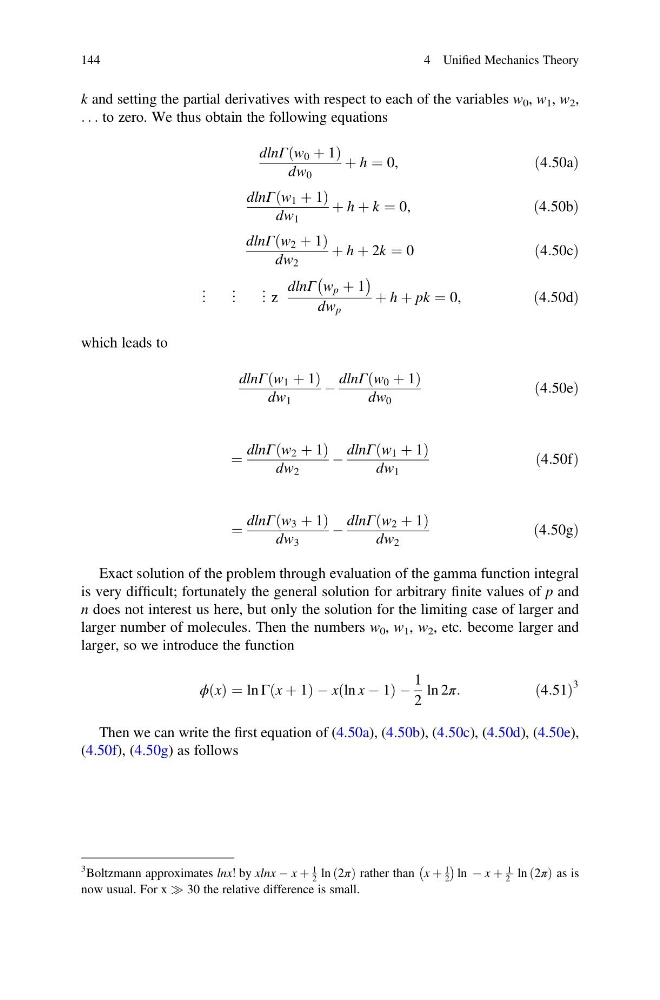
k and setting the partial derivatives with respect to each of the variables w 0 , w 1 , w 2 ,
. . . to zero. We thus obtain the following equations
dlnΓ w 0 þ 1
ð
Þ
dw 0
þ h ¼ 0,
ð4:50aÞ
dlnΓ w 1 þ 1
ð
Þ
dw 1
þ h þ k ¼ 0,
ð4:50bÞ
dlnΓ w 2 þ 1
ð
Þ
dw 2
þ h þ 2k ¼ 0
ð4:50cÞ
⋮ ⋮ ⋮z
dlnΓ w p þ 1
À
Á
dw p
þ h þ pk ¼ 0,
ð4:50dÞ
which leads to
dlnΓ w 1 þ 1
ð
Þ
dw 1
À
dlnΓ w 0 þ 1
ð
Þ
dw 0
ð4:50eÞ
¼
dlnΓ w 2 þ 1
ð
Þ
dw 2
À
dlnΓ w 1 þ 1
ð
Þ
dw 1
ð4:50fÞ
¼
dlnΓ w 3 þ 1
ð
Þ
dw 3
À
dlnΓ w 2 þ 1
ð
Þ
dw 2
ð4:50gÞ
Exact solution of the problem through evaluation of the gamma function integral
is very difficult; fortunately the general solution for arbitrary finite values of p and
n does not interest us here, but only the solution for the limiting case of larger and
larger number of molecules. Then the numbers w 0 , w 1 , w 2 , etc. become larger and
larger, so we introduce the function
ϕ x
ð Þ ¼ ln Γ x þ 1
ð
ÞÀx ln x À 1
ð
ÞÀ
1
2
ln 2π:
ð4:51Þ
3
Then we can write the first equation of (4.50a), (4.50b), (4.50c), (4.50d), (4.50e),
(4.50f), (4.50g) as follows
3 Boltzmann approximates lnx! by xlnx À x þ
1
2 ln 2π
ð Þ rather than x þ
1
2
À
Á
ln À x þ
1
2 ln 2π
ð Þ as is
now usual. For x ) 30 the relative difference is small.
144
4 Unified Mechanics Theory
. . . to zero. We thus obtain the following equations
dlnΓ w 0 þ 1
ð
Þ
dw 0
þ h ¼ 0,
ð4:50aÞ
dlnΓ w 1 þ 1
ð
Þ
dw 1
þ h þ k ¼ 0,
ð4:50bÞ
dlnΓ w 2 þ 1
ð
Þ
dw 2
þ h þ 2k ¼ 0
ð4:50cÞ
⋮ ⋮ ⋮z
dlnΓ w p þ 1
À
Á
dw p
þ h þ pk ¼ 0,
ð4:50dÞ
which leads to
dlnΓ w 1 þ 1
ð
Þ
dw 1
À
dlnΓ w 0 þ 1
ð
Þ
dw 0
ð4:50eÞ
¼
dlnΓ w 2 þ 1
ð
Þ
dw 2
À
dlnΓ w 1 þ 1
ð
Þ
dw 1
ð4:50fÞ
¼
dlnΓ w 3 þ 1
ð
Þ
dw 3
À
dlnΓ w 2 þ 1
ð
Þ
dw 2
ð4:50gÞ
Exact solution of the problem through evaluation of the gamma function integral
is very difficult; fortunately the general solution for arbitrary finite values of p and
n does not interest us here, but only the solution for the limiting case of larger and
larger number of molecules. Then the numbers w 0 , w 1 , w 2 , etc. become larger and
larger, so we introduce the function
ϕ x
ð Þ ¼ ln Γ x þ 1
ð
ÞÀx ln x À 1
ð
ÞÀ
1
2
ln 2π:
ð4:51Þ
3
Then we can write the first equation of (4.50a), (4.50b), (4.50c), (4.50d), (4.50e),
(4.50f), (4.50g) as follows
3 Boltzmann approximates lnx! by xlnx À x þ
1
2 ln 2π
ð Þ rather than x þ
1
2
À
Á
ln À x þ
1
2 ln 2π
ð Þ as is
now usual. For x ) 30 the relative difference is small.
144
4 Unified Mechanics Theory