

henceforth denoted by w. Boltzmann uses W for the initial of German word,
Wahrscheinlichkeit. We would first like to calculate the permutations P for the
state distribution characterized by w 0 molecules with kinetic energy 0, w 1 molecules
with the kinetic energy E, etc. It must be understood that
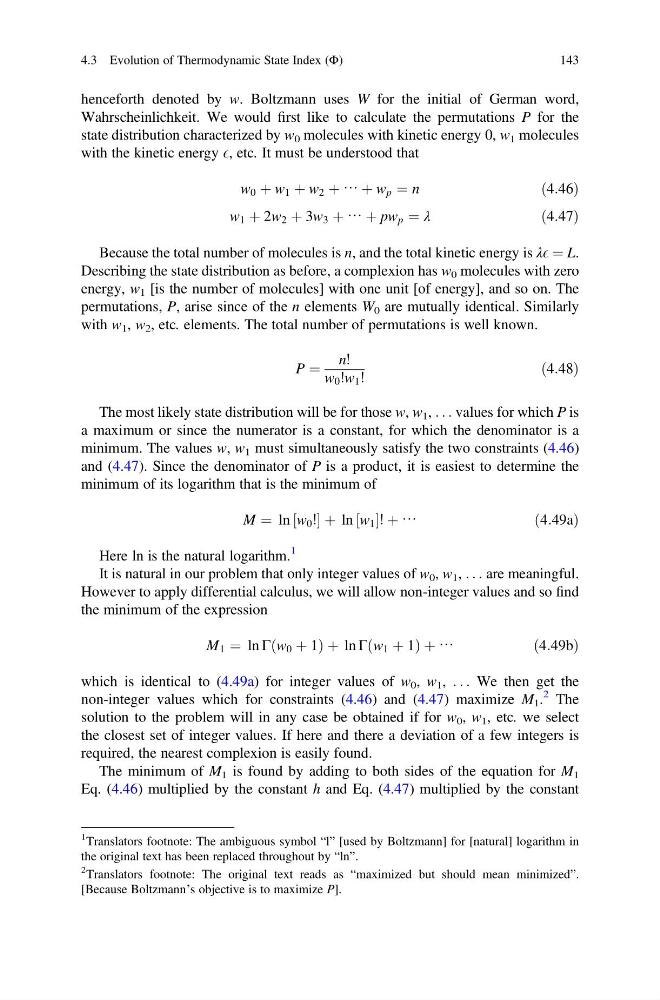
w 0 þ w 1 þ w 2 þ ⋯ þ w p ¼ n
ð4:46Þ
w 1 þ 2w 2 þ 3w 3 þ ⋯ þ pw p ¼ λ
ð4:47Þ
Because the total number of molecules is n, and the total kinetic energy is λE ¼ L.
Describing the state distribution as before, a complexion has w 0 molecules with zero
energy, w 1 [is the number of molecules] with one unit [of energy], and so on. The
permutations, P, arise since of the n elements W 0 are mutually identical. Similarly
with w 1 , w 2 , etc. elements. The total number of permutations is well known.
P ¼
n!
w 0 !w 1 !
ð4:48Þ
The most likely state distribution will be for those w, w 1 , . . . values for which P is
a maximum or since the numerator is a constant, for which the denominator is a
minimum. The values w, w 1 must simultaneously satisfy the two constraints (4.46)
and (4.47). Since the denominator of P is a product, it is easiest to determine the
minimum of its logarithm that is the minimum of
M ¼ ln w 0 !
½ þ ln w 1
½ ! þ ⋯
ð4:49aÞ
Here ln is the natural logarithm.
1
It is natural in our problem that only integer values of w 0 , w 1 , . . . are meaningful.
However to apply differential calculus, we will allow non-integer values and so find
the minimum of the expression
M 1 ¼ ln Γ w 0 þ 1
ð
Þþ ln Γ w 1 þ 1
ð
Þþ⋯
ð4:49bÞ
which is identical to (4.49a) for integer values of w 0 , w 1 , . . . We then get the
non-integer values which for constraints (4.46) and (4.47) maximize M 1 .
2 The
solution to the problem will in any case be obtained if for w 0 , w 1 , etc. we select
the closest set of integer values. If here and there a deviation of a few integers is
required, the nearest complexion is easily found.
The minimum of M 1 is found by adding to both sides of the equation for M 1
Eq. (4.46) multiplied by the constant h and Eq. (4.47) multiplied by the constant
1 Translators footnote: The ambiguous symbol “l” [used by Boltzmann] for [natural] logarithm in
the original text has been replaced throughout by “ln”.
2 Translators footnote: The original text reads as “maximized but should mean minimized”.
[Because Boltzmann’s objective is to maximize P].
4.3 Evolution of Thermodynamic State Index (Φ)
143
Wahrscheinlichkeit. We would first like to calculate the permutations P for the
state distribution characterized by w 0 molecules with kinetic energy 0, w 1 molecules
with the kinetic energy E, etc. It must be understood that
w 0 þ w 1 þ w 2 þ ⋯ þ w p ¼ n
ð4:46Þ
w 1 þ 2w 2 þ 3w 3 þ ⋯ þ pw p ¼ λ
ð4:47Þ
Because the total number of molecules is n, and the total kinetic energy is λE ¼ L.
Describing the state distribution as before, a complexion has w 0 molecules with zero
energy, w 1 [is the number of molecules] with one unit [of energy], and so on. The
permutations, P, arise since of the n elements W 0 are mutually identical. Similarly
with w 1 , w 2 , etc. elements. The total number of permutations is well known.
P ¼
n!
w 0 !w 1 !
ð4:48Þ
The most likely state distribution will be for those w, w 1 , . . . values for which P is
a maximum or since the numerator is a constant, for which the denominator is a
minimum. The values w, w 1 must simultaneously satisfy the two constraints (4.46)
and (4.47). Since the denominator of P is a product, it is easiest to determine the
minimum of its logarithm that is the minimum of
M ¼ ln w 0 !
½ þ ln w 1
½ ! þ ⋯
ð4:49aÞ
Here ln is the natural logarithm.
1
It is natural in our problem that only integer values of w 0 , w 1 , . . . are meaningful.
However to apply differential calculus, we will allow non-integer values and so find
the minimum of the expression
M 1 ¼ ln Γ w 0 þ 1
ð
Þþ ln Γ w 1 þ 1
ð
Þþ⋯
ð4:49bÞ
which is identical to (4.49a) for integer values of w 0 , w 1 , . . . We then get the
non-integer values which for constraints (4.46) and (4.47) maximize M 1 .
2 The
solution to the problem will in any case be obtained if for w 0 , w 1 , etc. we select
the closest set of integer values. If here and there a deviation of a few integers is
required, the nearest complexion is easily found.
The minimum of M 1 is found by adding to both sides of the equation for M 1
Eq. (4.46) multiplied by the constant h and Eq. (4.47) multiplied by the constant
1 Translators footnote: The ambiguous symbol “l” [used by Boltzmann] for [natural] logarithm in
the original text has been replaced throughout by “ln”.
2 Translators footnote: The original text reads as “maximized but should mean minimized”.
[Because Boltzmann’s objective is to maximize P].
4.3 Evolution of Thermodynamic State Index (Φ)
143