

λ þ n À 1
ð
Þ
λþnÀ
1
2 ¼¼ λ
λþnÀ
1
2
1 þ
n À 1
λ
λ ! 1þ
2nÀ1
2λ
¼ λ
λþnÀ
1
2 Á e
nÀ1
ð4:73Þ
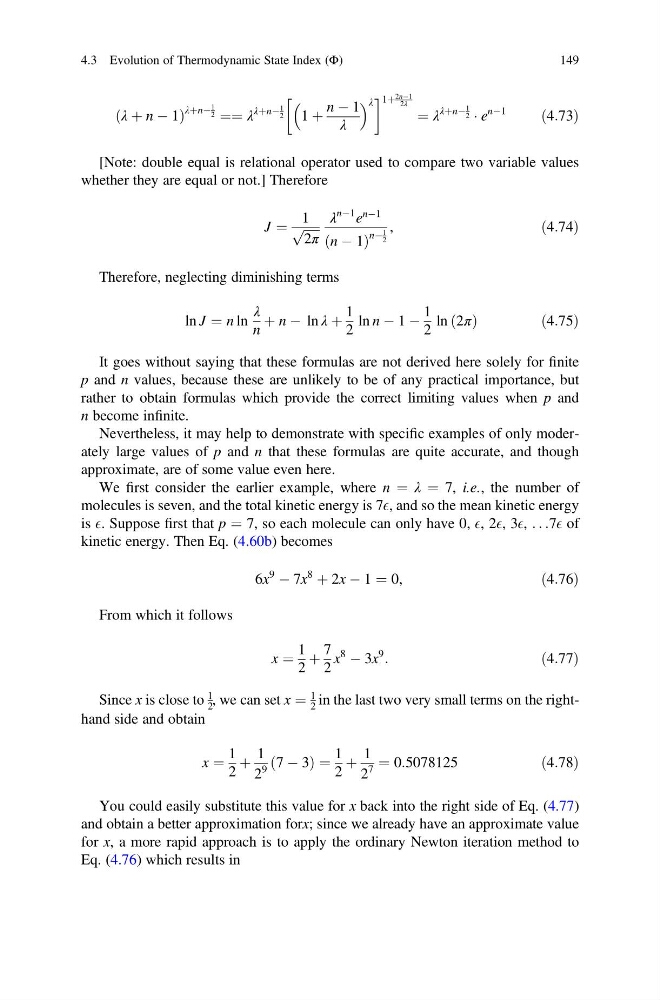
[Note: double equal is relational operator used to compare two variable values
whether they are equal or not.] Therefore
J ¼
1
ffiffiffiffiffi
2π
p
λ
nÀ1 e
nÀ1
n À 1
ð
Þ
nÀ
1
2
,
ð4:74Þ
Therefore, neglecting diminishing terms
ln J ¼ n ln
λ
n
þ n À ln λ þ
1
2
ln n À 1 À
1
2
ln 2π
ð Þ
ð4:75Þ
It goes without saying that these formulas are not derived here solely for finite
p and n values, because these are unlikely to be of any practical importance, but
rather to obtain formulas which provide the correct limiting values when p and
n become infinite.
Nevertheless, it may help to demonstrate with specific examples of only moderately large values of p and n that these formulas are quite accurate, and though
approximate, are of some value even here.
We first consider the earlier example, where n ¼ λ ¼ 7, i.e., the number of
molecules is seven, and the total kinetic energy is 7E, and so the mean kinetic energy
is E. Suppose first that p ¼ 7, so each molecule can only have 0, E, 2E, 3E, . . .7E of
kinetic energy. Then Eq. (4.60b) becomes
6x
9
À 7x
8
þ 2x À 1 ¼ 0,
ð4:76Þ
From which it follows
x ¼
1
2
þ
7
2
x
8
À 3x
9
:
ð4:77Þ
Since x is close to
1
2 , we can set x ¼
1
2 in the last two very small terms on the righthand side and obtain
x ¼
1
2
þ
1
2
9
7 À 3
ð
Þ¼
1
2
þ
1
2
7 ¼ 0:5078125
ð4:78Þ
You could easily substitute this value for x back into the right side of Eq. (4.77)
and obtain a better approximation forx; since we already have an approximate value
for x, a more rapid approach is to apply the ordinary Newton iteration method to
Eq. (4.76) which results in
4.3 Evolution of Thermodynamic State Index (Φ)
149
ð
Þ
λþnÀ
1
2 ¼¼ λ
λþnÀ
1
2
1 þ
n À 1
λ
λ ! 1þ
2nÀ1
2λ
¼ λ
λþnÀ
1
2 Á e
nÀ1
ð4:73Þ
[Note: double equal is relational operator used to compare two variable values
whether they are equal or not.] Therefore
J ¼
1
ffiffiffiffiffi
2π
p
λ
nÀ1 e
nÀ1
n À 1
ð
Þ
nÀ
1
2
,
ð4:74Þ
Therefore, neglecting diminishing terms
ln J ¼ n ln
λ
n
þ n À ln λ þ
1
2
ln n À 1 À
1
2
ln 2π
ð Þ
ð4:75Þ
It goes without saying that these formulas are not derived here solely for finite
p and n values, because these are unlikely to be of any practical importance, but
rather to obtain formulas which provide the correct limiting values when p and
n become infinite.
Nevertheless, it may help to demonstrate with specific examples of only moderately large values of p and n that these formulas are quite accurate, and though
approximate, are of some value even here.
We first consider the earlier example, where n ¼ λ ¼ 7, i.e., the number of
molecules is seven, and the total kinetic energy is 7E, and so the mean kinetic energy
is E. Suppose first that p ¼ 7, so each molecule can only have 0, E, 2E, 3E, . . .7E of
kinetic energy. Then Eq. (4.60b) becomes
6x
9
À 7x
8
þ 2x À 1 ¼ 0,
ð4:76Þ
From which it follows
x ¼
1
2
þ
7
2
x
8
À 3x
9
:
ð4:77Þ
Since x is close to
1
2 , we can set x ¼
1
2 in the last two very small terms on the righthand side and obtain
x ¼
1
2
þ
1
2
9
7 À 3
ð
Þ¼
1
2
þ
1
2
7 ¼ 0:5078125
ð4:78Þ
You could easily substitute this value for x back into the right side of Eq. (4.77)
and obtain a better approximation forx; since we already have an approximate value
for x, a more rapid approach is to apply the ordinary Newton iteration method to
Eq. (4.76) which results in
4.3 Evolution of Thermodynamic State Index (Φ)
149