

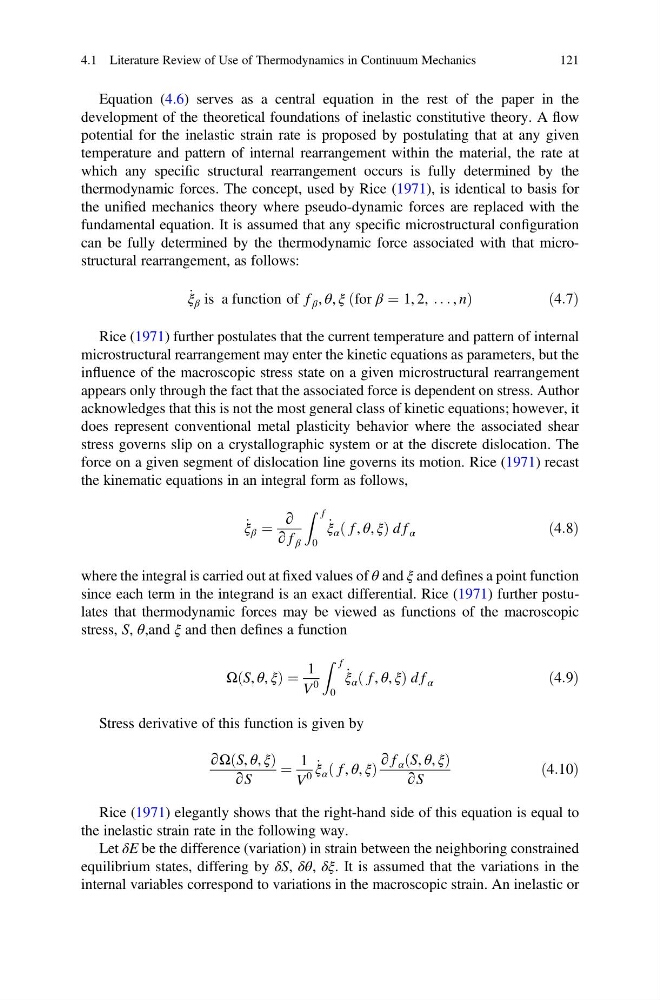
Equation (4.6) serves as a central equation in the rest of the paper in the
development of the theoretical foundations of inelastic constitutive theory. A flow
potential for the inelastic strain rate is proposed by postulating that at any given
temperature and pattern of internal rearrangement within the material, the rate at
which any specific structural rearrangement occurs is fully determined by the
thermodynamic forces. The concept, used by Rice (1971), is identical to basis for
the unified mechanics theory where pseudo-dynamic forces are replaced with the
fundamental equation. It is assumed that any specific microstructural configuration
can be fully determined by the thermodynamic force associated with that microstructural rearrangement, as follows:
_
ξ β is a function of f β , θ, ξ for β ¼ 1, 2, . . . , n
ð
Þ
ð 4:7Þ
Rice (1971) further postulates that the current temperature and pattern of internal
microstructural rearrangement may enter the kinetic equations as parameters, but the
influence of the macroscopic stress state on a given microstructural rearrangement
appears only through the fact that the associated force is dependent on stress. Author
acknowledges that this is not the most general class of kinetic equations; however, it
does represent conventional metal plasticity behavior where the associated shear
stress governs slip on a crystallographic system or at the discrete dislocation. The
force on a given segment of dislocation line governs its motion. Rice (1971) recast
the kinematic equations in an integral form as follows,
_
ξ β ¼
∂
∂ f β
Z f
0
_
ξ α f , θ, ξ
ð
Þd f α
ð4:8Þ
where the integral is carried out at fixed values of θ and ξ and defines a point function
since each term in the integrand is an exact differential. Rice (1971) further postulates that thermodynamic forces may be viewed as functions of the macroscopic
stress, S, θ,and ξ and then defines a function
Ω S, θ, ξ
ð
Þ¼
1
V
0
Z f
0
_
ξ α f , θ, ξ
ð
Þd f α
ð4:9Þ
Stress derivative of this function is given by
∂Ω S, θ, ξ
ð
Þ
∂S
¼
1
V
0
_
ξ α f , θ, ξ
ð
Þ
∂ f α S, θ, ξ
ð
Þ
∂S
ð4:10Þ
Rice (1971) elegantly shows that the right-hand side of this equation is equal to
the inelastic strain rate in the following way.
Let δE be the difference (variation) in strain between the neighboring constrained
equilibrium states, differing by δS, δθ, δξ. It is assumed that the variations in the
internal variables correspond to variations in the macroscopic strain. An inelastic or
4.1 Literature Review of Use of Thermodynamics in Continuum Mechanics
121
development of the theoretical foundations of inelastic constitutive theory. A flow
potential for the inelastic strain rate is proposed by postulating that at any given
temperature and pattern of internal rearrangement within the material, the rate at
which any specific structural rearrangement occurs is fully determined by the
thermodynamic forces. The concept, used by Rice (1971), is identical to basis for
the unified mechanics theory where pseudo-dynamic forces are replaced with the
fundamental equation. It is assumed that any specific microstructural configuration
can be fully determined by the thermodynamic force associated with that microstructural rearrangement, as follows:
_
ξ β is a function of f β , θ, ξ for β ¼ 1, 2, . . . , n
ð
Þ
ð 4:7Þ
Rice (1971) further postulates that the current temperature and pattern of internal
microstructural rearrangement may enter the kinetic equations as parameters, but the
influence of the macroscopic stress state on a given microstructural rearrangement
appears only through the fact that the associated force is dependent on stress. Author
acknowledges that this is not the most general class of kinetic equations; however, it
does represent conventional metal plasticity behavior where the associated shear
stress governs slip on a crystallographic system or at the discrete dislocation. The
force on a given segment of dislocation line governs its motion. Rice (1971) recast
the kinematic equations in an integral form as follows,
_
ξ β ¼
∂
∂ f β
Z f
0
_
ξ α f , θ, ξ
ð
Þd f α
ð4:8Þ
where the integral is carried out at fixed values of θ and ξ and defines a point function
since each term in the integrand is an exact differential. Rice (1971) further postulates that thermodynamic forces may be viewed as functions of the macroscopic
stress, S, θ,and ξ and then defines a function
Ω S, θ, ξ
ð
Þ¼
1
V
0
Z f
0
_
ξ α f , θ, ξ
ð
Þd f α
ð4:9Þ
Stress derivative of this function is given by
∂Ω S, θ, ξ
ð
Þ
∂S
¼
1
V
0
_
ξ α f , θ, ξ
ð
Þ
∂ f α S, θ, ξ
ð
Þ
∂S
ð4:10Þ
Rice (1971) elegantly shows that the right-hand side of this equation is equal to
the inelastic strain rate in the following way.
Let δE be the difference (variation) in strain between the neighboring constrained
equilibrium states, differing by δS, δθ, δξ. It is assumed that the variations in the
internal variables correspond to variations in the macroscopic strain. An inelastic or
4.1 Literature Review of Use of Thermodynamics in Continuum Mechanics
121