

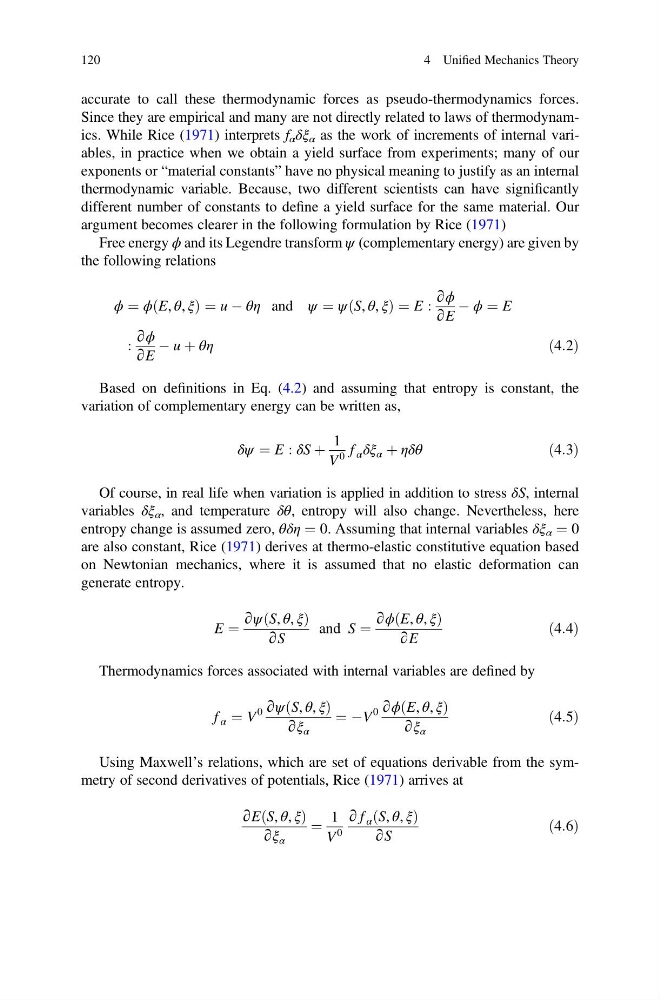
accurate to call these thermodynamic forces as pseudo-thermodynamics forces.
Since they are empirical and many are not directly related to laws of thermodynamics. While Rice (1971) interprets f α δξ α as the work of increments of internal variables, in practice when we obtain a yield surface from experiments; many of our
exponents or “material constants” have no physical meaning to justify as an internal
thermodynamic variable. Because, two different scientists can have significantly
different number of constants to define a yield surface for the same material. Our
argument becomes clearer in the following formulation by Rice (1971)
Free energy ϕ and its Legendre transform ψ (complementary energy) are given by
the following relations
ϕ ¼ ϕ E, θ, ξ
ð
Þ¼u À θη and ψ ¼ ψ S, θ, ξ
ð
Þ¼E :
∂ϕ
∂E
À ϕ ¼ E
:
∂ϕ
∂E
À u þ θη
ð4:2Þ
Based on definitions in Eq. (4.2) and assuming that entropy is constant, the
variation of complementary energy can be written as,
δψ ¼ E : δS þ
1
V
0
f α δξ α þ ηδθ
ð4:3Þ
Of course, in real life when variation is applied in addition to stress δS, internal
variables δξ α , and temperature δθ, entropy will also change. Nevertheless, here
entropy change is assumed zero, θδη ¼ 0. Assuming that internal variables δξ α ¼ 0
are also constant, Rice (1971) derives at thermo-elastic constitutive equation based
on Newtonian mechanics, where it is assumed that no elastic deformation can
generate entropy.
E ¼
∂ψ S, θ, ξ
ð
Þ
∂S
and S ¼
∂ϕ E, θ, ξ
ð
Þ
∂E
ð4:4Þ
Thermodynamics forces associated with internal variables are defined by
f α ¼ V
0 ∂ψ S, θ, ξ
ð
Þ
∂ξ α
¼ ÀV
0 ∂ϕ E, θ, ξ
ð
Þ
∂ξ α
ð4:5Þ
Using Maxwell’s relations, which are set of equations derivable from the symmetry of second derivatives of potentials, Rice (1971) arrives at
∂E S, θ, ξ
ð
Þ
∂ξ α
¼
1
V
0
∂ f α S, θ, ξ
ð
Þ
∂S
ð4:6Þ
120
4 Unified Mechanics Theory
Since they are empirical and many are not directly related to laws of thermodynamics. While Rice (1971) interprets f α δξ α as the work of increments of internal variables, in practice when we obtain a yield surface from experiments; many of our
exponents or “material constants” have no physical meaning to justify as an internal
thermodynamic variable. Because, two different scientists can have significantly
different number of constants to define a yield surface for the same material. Our
argument becomes clearer in the following formulation by Rice (1971)
Free energy ϕ and its Legendre transform ψ (complementary energy) are given by
the following relations
ϕ ¼ ϕ E, θ, ξ
ð
Þ¼u À θη and ψ ¼ ψ S, θ, ξ
ð
Þ¼E :
∂ϕ
∂E
À ϕ ¼ E
:
∂ϕ
∂E
À u þ θη
ð4:2Þ
Based on definitions in Eq. (4.2) and assuming that entropy is constant, the
variation of complementary energy can be written as,
δψ ¼ E : δS þ
1
V
0
f α δξ α þ ηδθ
ð4:3Þ
Of course, in real life when variation is applied in addition to stress δS, internal
variables δξ α , and temperature δθ, entropy will also change. Nevertheless, here
entropy change is assumed zero, θδη ¼ 0. Assuming that internal variables δξ α ¼ 0
are also constant, Rice (1971) derives at thermo-elastic constitutive equation based
on Newtonian mechanics, where it is assumed that no elastic deformation can
generate entropy.
E ¼
∂ψ S, θ, ξ
ð
Þ
∂S
and S ¼
∂ϕ E, θ, ξ
ð
Þ
∂E
ð4:4Þ
Thermodynamics forces associated with internal variables are defined by
f α ¼ V
0 ∂ψ S, θ, ξ
ð
Þ
∂ξ α
¼ ÀV
0 ∂ϕ E, θ, ξ
ð
Þ
∂ξ α
ð4:5Þ
Using Maxwell’s relations, which are set of equations derivable from the symmetry of second derivatives of potentials, Rice (1971) arrives at
∂E S, θ, ξ
ð
Þ
∂ξ α
¼
1
V
0
∂ f α S, θ, ξ
ð
Þ
∂S
ð4:6Þ
120
4 Unified Mechanics Theory