

strain states. However, Rice (1971) assumes that a discrete set of scalar internal
variables characterize the state of internal rearrangement. Each internal variable
characterizes a specific structural rearrangement. Unfortunately, this classification
does not satisfy the second law of thermodynamics. According to second law of
thermodynamics, not the individual internal variables like stress or strain, but only
the fundamental relation [entropy generation rate] determines the new structural
rearrangement. Rice (1971) also assumes that if various equilibrium states are
considered each corresponding to the same set of values for the thermodynamic
internal variables, then neighboring states are related by the usual laws of thermoelasticity. This later assumption also violates the second law of thermodynamics,
because according second law of thermodynamics even thermo-elastic deformation
leads to irreversible entropy generation. Easiest way to explain this is fatigue under
elastic loading or molecular dynamics simulations under elastic loading. According
to traditional thermo-elasticity assumption if there is no inelastic deformation,
thermodynamics internal state variables do not change. As a result, materials could
never fatigue under elastic loading. Of course, this violates the second law of
thermodynamics, because there is no reversible thermodynamic process in metals.
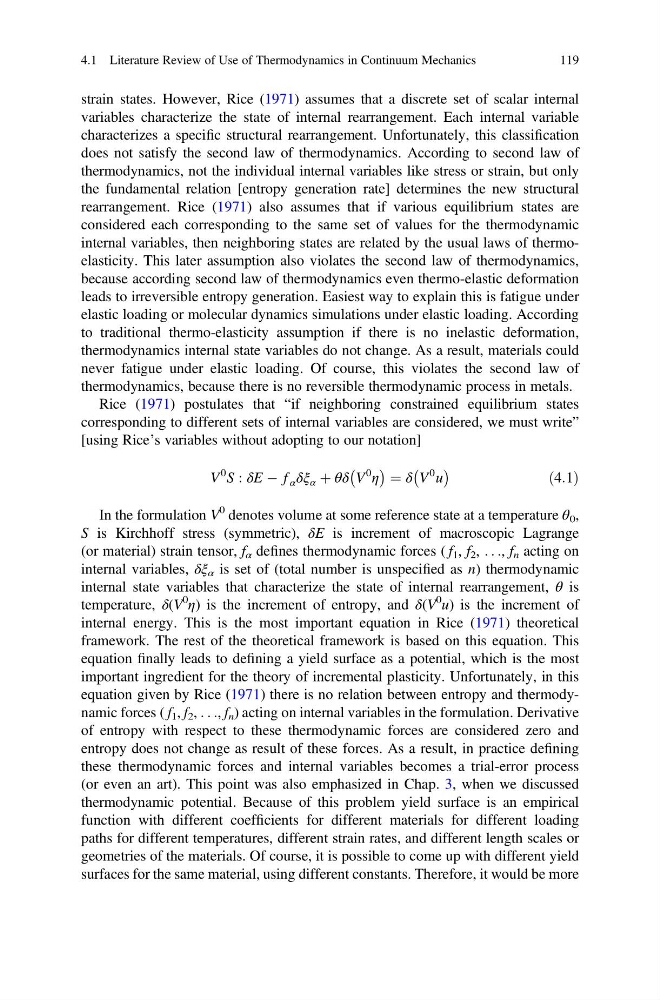
Rice (1971) postulates that “if neighboring constrained equilibrium states
corresponding to different sets of internal variables are considered, we must write”
[using Rice’s variables without adopting to our notation]
V
0 S : δE À f α δξ α þ θδ V
0
η
À
Á ¼ δ V
0 u
À
Á
ð4:1Þ
In the formulation V
0 denotes volume at some reference state at a temperature θ 0 ,
S is Kirchhoff stress (symmetric), δE is increment of macroscopic Lagrange
(or material) strain tensor, f α defines thermodynamic forces ( f 1 , f 2 , . . ., f n acting on
internal variables, δξ α is set of (total number is unspecified as n) thermodynamic
internal state variables that characterize the state of internal rearrangement, θ is
temperature, δ(V
0 η) is the increment of entropy, and δ(V
0 u) is the increment of
internal energy. This is the most important equation in Rice (1971) theoretical
framework. The rest of the theoretical framework is based on this equation. This
equation finally leads to defining a yield surface as a potential, which is the most
important ingredient for the theory of incremental plasticity. Unfortunately, in this
equation given by Rice (1971) there is no relation between entropy and thermodynamic forces ( f 1 , f 2 , . . ., f n ) acting on internal variables in the formulation. Derivative
of entropy with respect to these thermodynamic forces are considered zero and
entropy does not change as result of these forces. As a result, in practice defining
these thermodynamic forces and internal variables becomes a trial-error process
(or even an art). This point was also emphasized in Chap. 3, when we discussed
thermodynamic potential. Because of this problem yield surface is an empirical
function with different coefficients for different materials for different loading
paths for different temperatures, different strain rates, and different length scales or
geometries of the materials. Of course, it is possible to come up with different yield
surfaces for the same material, using different constants. Therefore, it would be more
4.1 Literature Review of Use of Thermodynamics in Continuum Mechanics
119
variables characterize the state of internal rearrangement. Each internal variable
characterizes a specific structural rearrangement. Unfortunately, this classification
does not satisfy the second law of thermodynamics. According to second law of
thermodynamics, not the individual internal variables like stress or strain, but only
the fundamental relation [entropy generation rate] determines the new structural
rearrangement. Rice (1971) also assumes that if various equilibrium states are
considered each corresponding to the same set of values for the thermodynamic
internal variables, then neighboring states are related by the usual laws of thermoelasticity. This later assumption also violates the second law of thermodynamics,
because according second law of thermodynamics even thermo-elastic deformation
leads to irreversible entropy generation. Easiest way to explain this is fatigue under
elastic loading or molecular dynamics simulations under elastic loading. According
to traditional thermo-elasticity assumption if there is no inelastic deformation,
thermodynamics internal state variables do not change. As a result, materials could
never fatigue under elastic loading. Of course, this violates the second law of
thermodynamics, because there is no reversible thermodynamic process in metals.
Rice (1971) postulates that “if neighboring constrained equilibrium states
corresponding to different sets of internal variables are considered, we must write”
[using Rice’s variables without adopting to our notation]
V
0 S : δE À f α δξ α þ θδ V
0
η
À
Á ¼ δ V
0 u
À
Á
ð4:1Þ
In the formulation V
0 denotes volume at some reference state at a temperature θ 0 ,
S is Kirchhoff stress (symmetric), δE is increment of macroscopic Lagrange
(or material) strain tensor, f α defines thermodynamic forces ( f 1 , f 2 , . . ., f n acting on
internal variables, δξ α is set of (total number is unspecified as n) thermodynamic
internal state variables that characterize the state of internal rearrangement, θ is
temperature, δ(V
0 η) is the increment of entropy, and δ(V
0 u) is the increment of
internal energy. This is the most important equation in Rice (1971) theoretical
framework. The rest of the theoretical framework is based on this equation. This
equation finally leads to defining a yield surface as a potential, which is the most
important ingredient for the theory of incremental plasticity. Unfortunately, in this
equation given by Rice (1971) there is no relation between entropy and thermodynamic forces ( f 1 , f 2 , . . ., f n ) acting on internal variables in the formulation. Derivative
of entropy with respect to these thermodynamic forces are considered zero and
entropy does not change as result of these forces. As a result, in practice defining
these thermodynamic forces and internal variables becomes a trial-error process
(or even an art). This point was also emphasized in Chap. 3, when we discussed
thermodynamic potential. Because of this problem yield surface is an empirical
function with different coefficients for different materials for different loading
paths for different temperatures, different strain rates, and different length scales or
geometries of the materials. Of course, it is possible to come up with different yield
surfaces for the same material, using different constants. Therefore, it would be more
4.1 Literature Review of Use of Thermodynamics in Continuum Mechanics
119