

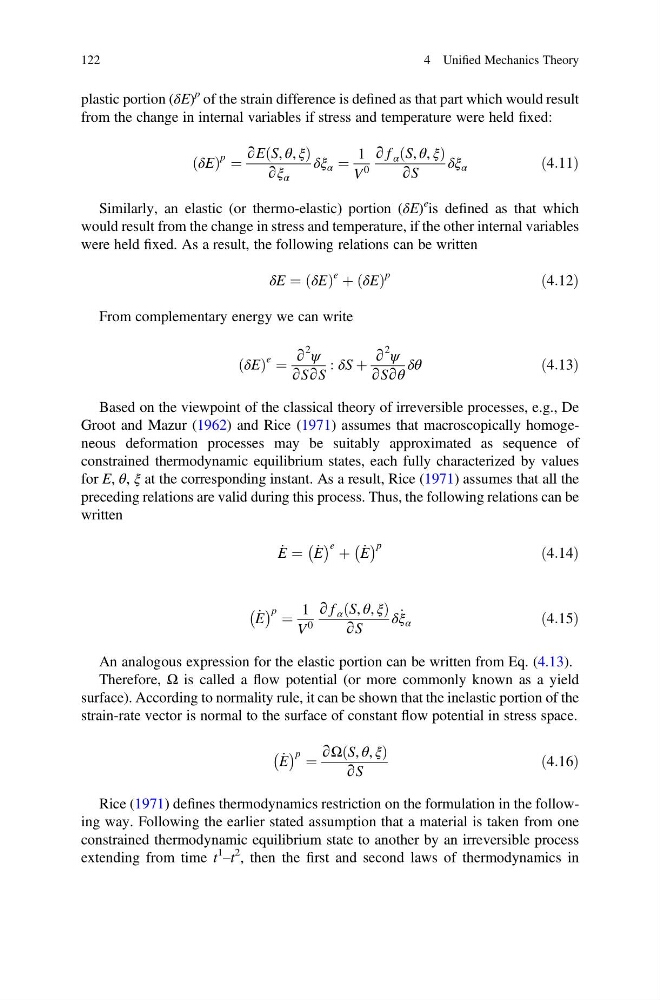
plastic portion (δE)
p of the strain difference is defined as that part which would result
from the change in internal variables if stress and temperature were held fixed:
δE
ð Þ
p ¼
∂E S, θ, ξ
ð
Þ
∂ξ α
δξ α ¼
1
V
0
∂ f α S, θ, ξ
ð
Þ
∂S
δξ α
ð4:11Þ
Similarly, an elastic (or thermo-elastic) portion (δE)
e
is defined as that which
would result from the change in stress and temperature, if the other internal variables
were held fixed. As a result, the following relations can be written
δE ¼ δE
ð Þ
e þ δE
ð Þ
p
ð4:12Þ
From complementary energy we can write
δE
ð Þ
e ¼
∂
2 ψ
∂S∂S
: δS þ
∂
2 ψ
∂S∂θ
δθ
ð4:13Þ
Based on the viewpoint of the classical theory of irreversible processes, e.g., De
Groot and Mazur (1962) and Rice (1971) assumes that macroscopically homogeneous deformation processes may be suitably approximated as sequence of
constrained thermodynamic equilibrium states, each fully characterized by values
for E, θ, ξ at the corresponding instant. As a result, Rice (1971) assumes that all the
preceding relations are valid during this process. Thus, the following relations can be
written
_
E ¼ _
E
À Á e þ _
E
À Á p
ð4:14Þ
_
E
À Á p ¼
1
V
0
∂ f α S, θ, ξ
ð
Þ
∂S
δ _
ξ α
ð4:15Þ
An analogous expression for the elastic portion can be written from Eq. (4.13).
Therefore, Ω is called a flow potential (or more commonly known as a yield
surface). According to normality rule, it can be shown that the inelastic portion of the
strain-rate vector is normal to the surface of constant flow potential in stress space.
_
E
À Á p ¼
∂Ω S, θ, ξ
ð
Þ
∂S
ð4:16Þ
Rice (1971) defines thermodynamics restriction on the formulation in the following way. Following the earlier stated assumption that a material is taken from one
constrained thermodynamic equilibrium state to another by an irreversible process
extending from time t
1
–t
2 , then the first and second laws of thermodynamics in
122
4 Unified Mechanics Theory
p of the strain difference is defined as that part which would result
from the change in internal variables if stress and temperature were held fixed:
δE
ð Þ
p ¼
∂E S, θ, ξ
ð
Þ
∂ξ α
δξ α ¼
1
V
0
∂ f α S, θ, ξ
ð
Þ
∂S
δξ α
ð4:11Þ
Similarly, an elastic (or thermo-elastic) portion (δE)
e
is defined as that which
would result from the change in stress and temperature, if the other internal variables
were held fixed. As a result, the following relations can be written
δE ¼ δE
ð Þ
e þ δE
ð Þ
p
ð4:12Þ
From complementary energy we can write
δE
ð Þ
e ¼
∂
2 ψ
∂S∂S
: δS þ
∂
2 ψ
∂S∂θ
δθ
ð4:13Þ
Based on the viewpoint of the classical theory of irreversible processes, e.g., De
Groot and Mazur (1962) and Rice (1971) assumes that macroscopically homogeneous deformation processes may be suitably approximated as sequence of
constrained thermodynamic equilibrium states, each fully characterized by values
for E, θ, ξ at the corresponding instant. As a result, Rice (1971) assumes that all the
preceding relations are valid during this process. Thus, the following relations can be
written
_
E ¼ _
E
À Á e þ _
E
À Á p
ð4:14Þ
_
E
À Á p ¼
1
V
0
∂ f α S, θ, ξ
ð
Þ
∂S
δ _
ξ α
ð4:15Þ
An analogous expression for the elastic portion can be written from Eq. (4.13).
Therefore, Ω is called a flow potential (or more commonly known as a yield
surface). According to normality rule, it can be shown that the inelastic portion of the
strain-rate vector is normal to the surface of constant flow potential in stress space.
_
E
À Á p ¼
∂Ω S, θ, ξ
ð
Þ
∂S
ð4:16Þ
Rice (1971) defines thermodynamics restriction on the formulation in the following way. Following the earlier stated assumption that a material is taken from one
constrained thermodynamic equilibrium state to another by an irreversible process
extending from time t
1
–t
2 , then the first and second laws of thermodynamics in
122
4 Unified Mechanics Theory