

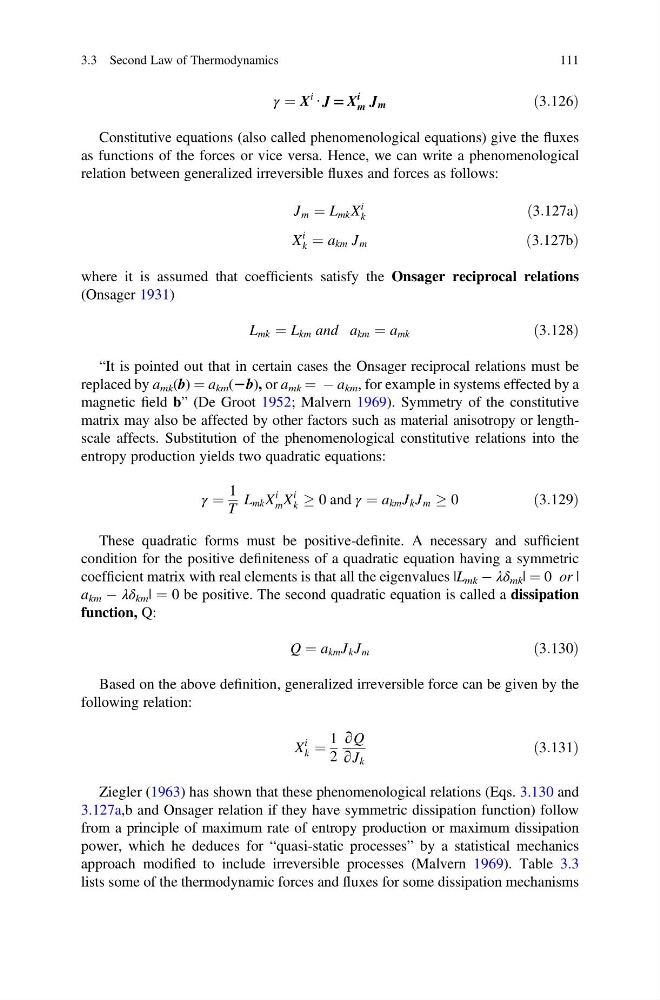
γ ¼ X
i
∙ J = X
i
m J m
ð3:126Þ
Constitutive equations (also called phenomenological equations) give the fluxes
as functions of the forces or vice versa. Hence, we can write a phenomenological
relation between generalized irreversible fluxes and forces as follows:
J m ¼ L mk X
i
k
ð3:127aÞ
X
i
k ¼ a km J m
ð3:127bÞ
where it is assumed that coefficients satisfy the Onsager reciprocal relations
(Onsager 1931)
L mk ¼ L km and a km ¼ a mk
ð3:128Þ
“It is pointed out that in certain cases the Onsager reciprocal relations must be
replaced by a mk (b) ¼ a km (2b), or a mk ¼ À a km , for example in systems effected by a
magnetic field b” (De Groot 1952; Malvern 1969). Symmetry of the constitutive
matrix may also be affected by other factors such as material anisotropy or lengthscale affects. Substitution of the phenomenological constitutive relations into the
entropy production yields two quadratic equations:
γ ¼
1
T
L mk X
i
m X
i
k ! 0 and γ ¼ a km J k J m ! 0
ð3:129Þ
These quadratic forms must be positive-definite. A necessary and sufficient
condition for the positive definiteness of a quadratic equation having a symmetric
coefficient matrix with real elements is that all the eigenvalues |L mk À λδ mk | ¼ 0 or |
a km À λδ km | ¼ 0 be positive. The second quadratic equation is called a dissipation
function, Q:
Q ¼ a km J k J m
ð3:130Þ
Based on the above definition, generalized irreversible force can be given by the
following relation:
X
i
k ¼
1
2
∂Q
∂J k
ð3:131Þ
Ziegler (1963) has shown that these phenomenological relations (Eqs. 3.130 and
3.127a,b and Onsager relation if they have symmetric dissipation function) follow
from a principle of maximum rate of entropy production or maximum dissipation
power, which he deduces for “quasi-static processes” by a statistical mechanics
approach modified to include irreversible processes (Malvern 1969). Table 3.3
lists some of the thermodynamic forces and fluxes for some dissipation mechanisms
3.3 Second Law of Thermodynamics
111
i
∙ J = X
i
m J m
ð3:126Þ
Constitutive equations (also called phenomenological equations) give the fluxes
as functions of the forces or vice versa. Hence, we can write a phenomenological
relation between generalized irreversible fluxes and forces as follows:
J m ¼ L mk X
i
k
ð3:127aÞ
X
i
k ¼ a km J m
ð3:127bÞ
where it is assumed that coefficients satisfy the Onsager reciprocal relations
(Onsager 1931)
L mk ¼ L km and a km ¼ a mk
ð3:128Þ
“It is pointed out that in certain cases the Onsager reciprocal relations must be
replaced by a mk (b) ¼ a km (2b), or a mk ¼ À a km , for example in systems effected by a
magnetic field b” (De Groot 1952; Malvern 1969). Symmetry of the constitutive
matrix may also be affected by other factors such as material anisotropy or lengthscale affects. Substitution of the phenomenological constitutive relations into the
entropy production yields two quadratic equations:
γ ¼
1
T
L mk X
i
m X
i
k ! 0 and γ ¼ a km J k J m ! 0
ð3:129Þ
These quadratic forms must be positive-definite. A necessary and sufficient
condition for the positive definiteness of a quadratic equation having a symmetric
coefficient matrix with real elements is that all the eigenvalues |L mk À λδ mk | ¼ 0 or |
a km À λδ km | ¼ 0 be positive. The second quadratic equation is called a dissipation
function, Q:
Q ¼ a km J k J m
ð3:130Þ
Based on the above definition, generalized irreversible force can be given by the
following relation:
X
i
k ¼
1
2
∂Q
∂J k
ð3:131Þ
Ziegler (1963) has shown that these phenomenological relations (Eqs. 3.130 and
3.127a,b and Onsager relation if they have symmetric dissipation function) follow
from a principle of maximum rate of entropy production or maximum dissipation
power, which he deduces for “quasi-static processes” by a statistical mechanics
approach modified to include irreversible processes (Malvern 1969). Table 3.3
lists some of the thermodynamic forces and fluxes for some dissipation mechanisms
3.3 Second Law of Thermodynamics
111