

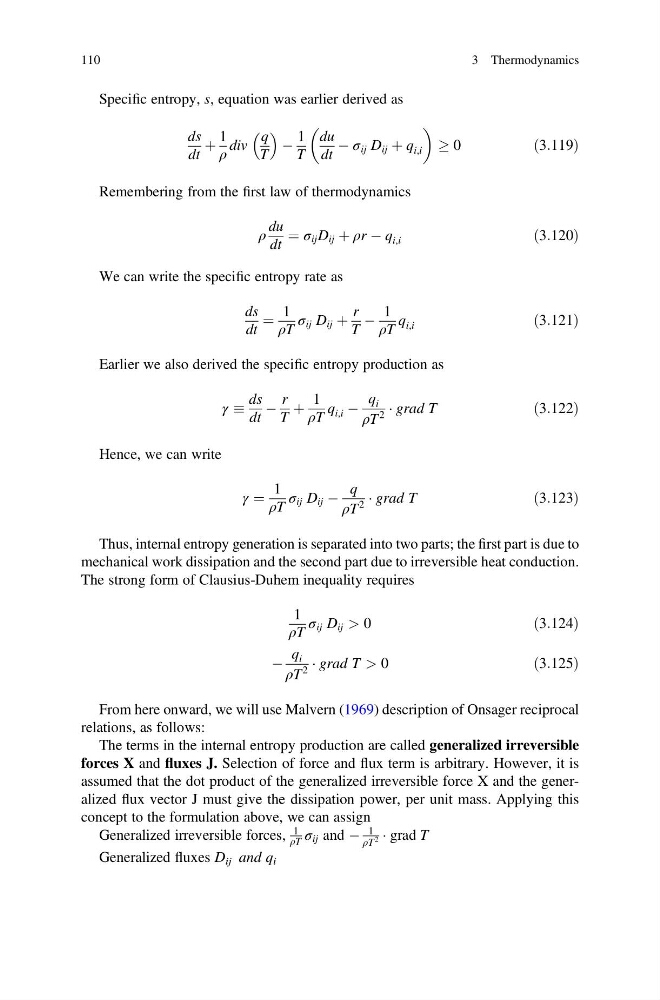
Specific entropy, s, equation was earlier derived as
ds
dt
þ
1
ρ
div
q
T
À
1
T
du
dt
À σ ij D ij þ q i,i
! 0
ð3:119Þ
Remembering from the first law of thermodynamics
ρ
du
dt
¼ σ ij D ij þ ρr À q i,i
ð3:120Þ
We can write the specific entropy rate as
ds
dt
¼
1
ρT
σ ij D ij þ
r
T
À
1
ρT
q i,i
ð3:121Þ
Earlier we also derived the specific entropy production as
γ
ds
dt
À
r
T
þ
1
ρT
q i,i À
q i
ρT
2
Á grad T
ð3:122Þ
Hence, we can write
γ ¼
1
ρT
σ ij D ij À
q
ρT
2
Á grad T
ð3:123Þ
Thus, internal entropy generation is separated into two parts; the first part is due to
mechanical work dissipation and the second part due to irreversible heat conduction.
The strong form of Clausius-Duhem inequality requires
1
ρT
σ ij D ij > 0
ð3:124Þ
À
q i
ρT
2
Á grad T > 0
ð3:125Þ
From here onward, we will use Malvern (1969) description of Onsager reciprocal
relations, as follows:
The terms in the internal entropy production are called generalized irreversible
forces X and fluxes J. Selection of force and flux term is arbitrary. However, it is
assumed that the dot product of the generalized irreversible force X and the generalized flux vector J must give the dissipation power, per unit mass. Applying this
concept to the formulation above, we can assign
Generalized irreversible forces,
1
ρT σ ij and À
1
ρT
2 Á grad T
Generalized fluxes D ij and q i
110
3 Thermodynamics
ds
dt
þ
1
ρ
div
q
T
À
1
T
du
dt
À σ ij D ij þ q i,i
! 0
ð3:119Þ
Remembering from the first law of thermodynamics
ρ
du
dt
¼ σ ij D ij þ ρr À q i,i
ð3:120Þ
We can write the specific entropy rate as
ds
dt
¼
1
ρT
σ ij D ij þ
r
T
À
1
ρT
q i,i
ð3:121Þ
Earlier we also derived the specific entropy production as
γ
ds
dt
À
r
T
þ
1
ρT
q i,i À
q i
ρT
2
Á grad T
ð3:122Þ
Hence, we can write
γ ¼
1
ρT
σ ij D ij À
q
ρT
2
Á grad T
ð3:123Þ
Thus, internal entropy generation is separated into two parts; the first part is due to
mechanical work dissipation and the second part due to irreversible heat conduction.
The strong form of Clausius-Duhem inequality requires
1
ρT
σ ij D ij > 0
ð3:124Þ
À
q i
ρT
2
Á grad T > 0
ð3:125Þ
From here onward, we will use Malvern (1969) description of Onsager reciprocal
relations, as follows:
The terms in the internal entropy production are called generalized irreversible
forces X and fluxes J. Selection of force and flux term is arbitrary. However, it is
assumed that the dot product of the generalized irreversible force X and the generalized flux vector J must give the dissipation power, per unit mass. Applying this
concept to the formulation above, we can assign
Generalized irreversible forces,
1
ρT σ ij and À
1
ρT
2 Á grad T
Generalized fluxes D ij and q i
110
3 Thermodynamics