

φ
Ã
¼ 0 if f < 0 _
E
P
¼ 0
ð3:114aÞ
φ
Ã
¼ þ1 if f ¼ 0 _
E
P
6 ¼ 0
ð3:114bÞ
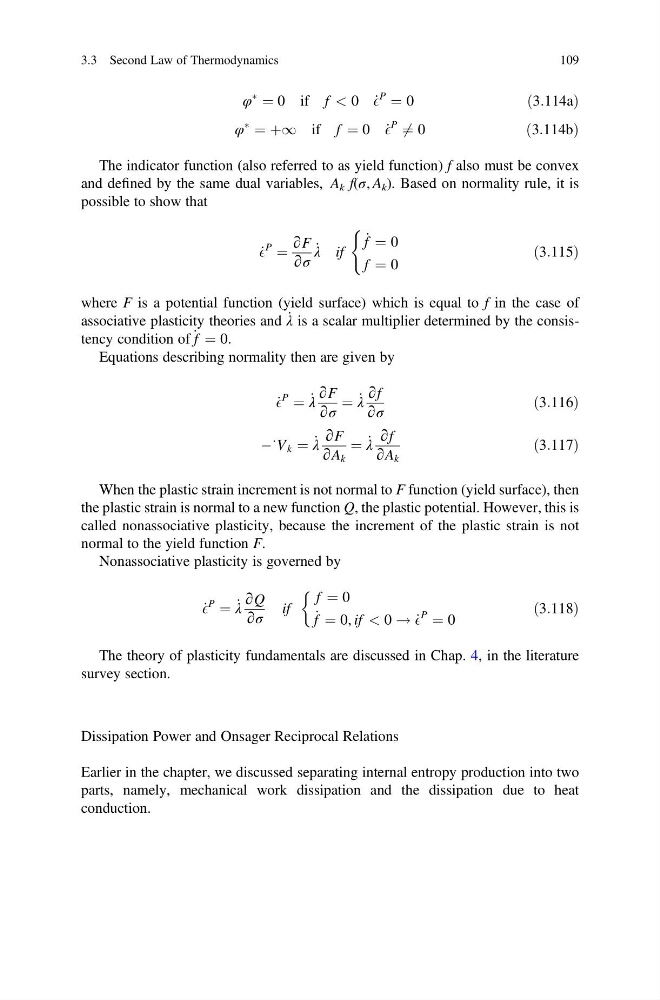
The indicator function (also referred to as yield function) f also must be convex
and defined by the same dual variables, A k f(σ, A k ). Based on normality rule, it is
possible to show that
_
E
P
¼
∂F
∂σ
_
λ if
_
f ¼ 0
f ¼ 0
(
ð3:115Þ
where F is a potential function (yield surface) which is equal to f in the case of
associative plasticity theories and _
λ is a scalar multiplier determined by the consistency condition of _ f ¼ 0.
Equations describing normality then are given by
_
E
P
¼ _
λ
∂F
∂σ
¼ _
λ
∂f
∂σ
ð3:116Þ
À˙V k ¼ _
λ
∂F
∂A k
¼ _
λ
∂f
∂A k
ð3:117Þ
When the plastic strain increment is not normal to F function (yield surface), then
the plastic strain is normal to a new function Q, the plastic potential. However, this is
called nonassociative plasticity, because the increment of the plastic strain is not
normal to the yield function F.
Nonassociative plasticity is governed by
_
E
P
¼ _
λ
∂Q
∂σ
if
f ¼ 0
_
f ¼ 0, if < 0 ! _
E
P
¼ 0
&
ð3:118Þ
The theory of plasticity fundamentals are discussed in Chap. 4, in the literature
survey section.
Dissipation Power and Onsager Reciprocal Relations
Earlier in the chapter, we discussed separating internal entropy production into two
parts, namely, mechanical work dissipation and the dissipation due to heat
conduction.
3.3 Second Law of Thermodynamics
109
Ã
¼ 0 if f < 0 _
E
P
¼ 0
ð3:114aÞ
φ
Ã
¼ þ1 if f ¼ 0 _
E
P
6 ¼ 0
ð3:114bÞ
The indicator function (also referred to as yield function) f also must be convex
and defined by the same dual variables, A k f(σ, A k ). Based on normality rule, it is
possible to show that
_
E
P
¼
∂F
∂σ
_
λ if
_
f ¼ 0
f ¼ 0
(
ð3:115Þ
where F is a potential function (yield surface) which is equal to f in the case of
associative plasticity theories and _
λ is a scalar multiplier determined by the consistency condition of _ f ¼ 0.
Equations describing normality then are given by
_
E
P
¼ _
λ
∂F
∂σ
¼ _
λ
∂f
∂σ
ð3:116Þ
À˙V k ¼ _
λ
∂F
∂A k
¼ _
λ
∂f
∂A k
ð3:117Þ
When the plastic strain increment is not normal to F function (yield surface), then
the plastic strain is normal to a new function Q, the plastic potential. However, this is
called nonassociative plasticity, because the increment of the plastic strain is not
normal to the yield function F.
Nonassociative plasticity is governed by
_
E
P
¼ _
λ
∂Q
∂σ
if
f ¼ 0
_
f ¼ 0, if < 0 ! _
E
P
¼ 0
&
ð3:118Þ
The theory of plasticity fundamentals are discussed in Chap. 4, in the literature
survey section.
Dissipation Power and Onsager Reciprocal Relations
Earlier in the chapter, we discussed separating internal entropy production into two
parts, namely, mechanical work dissipation and the dissipation due to heat
conduction.
3.3 Second Law of Thermodynamics
109