

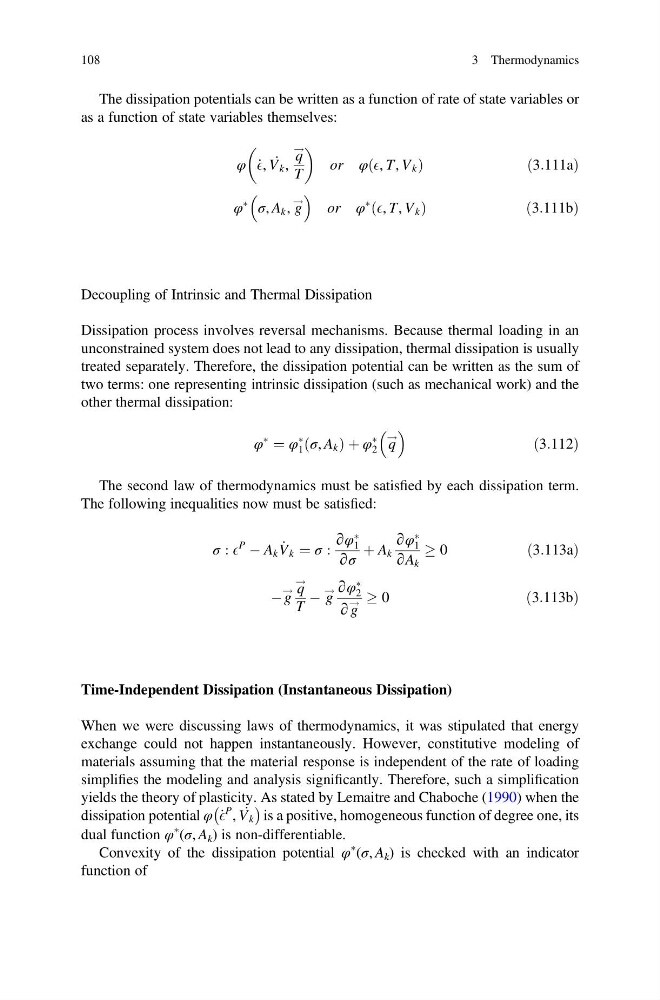
The dissipation potentials can be written as a function of rate of state variables or
as a function of state variables themselves:
φ _
E, _
V k ,
q
!
T
or φ E, T, V k
ð
Þ
ð3:111aÞ
φ
Ã
σ, A k , g
!
or φ
Ã
E, T, V k
ð
Þ
ð3:111bÞ
Decoupling of Intrinsic and Thermal Dissipation
Dissipation process involves reversal mechanisms. Because thermal loading in an
unconstrained system does not lead to any dissipation, thermal dissipation is usually
treated separately. Therefore, the dissipation potential can be written as the sum of
two terms: one representing intrinsic dissipation (such as mechanical work) and the
other thermal dissipation:
φ
Ã
¼ φ
Ã
1 σ, A k
ð
Þþφ
Ã
2 q
!
ð3:112Þ
The second law of thermodynamics must be satisfied by each dissipation term.
The following inequalities now must be satisfied:
σ : E
P
À A k _
V k ¼ σ :
∂φ
Ã
1
∂σ
þ A k
∂φ
Ã
1
∂A k
! 0
ð3:113aÞ
À g
! q
!
T
À g
! ∂φ
Ã
2
∂ g
! ! 0
ð3:113bÞ
Time-Independent Dissipation (Instantaneous Dissipation)
When we were discussing laws of thermodynamics, it was stipulated that energy
exchange could not happen instantaneously. However, constitutive modeling of
materials assuming that the material response is independent of the rate of loading
simplifies the modeling and analysis significantly. Therefore, such a simplification
yields the theory of plasticity. As stated by Lemaitre and Chaboche (1990) when the
dissipation potential φ _
E
P , _
V k
À
Á
is a positive, homogeneous function of degree one, its
dual function φ
à (σ, A k ) is non-differentiable.
Convexity of the dissipation potential φ
à (σ, A k ) is checked with an indicator
function of
108
3 Thermodynamics
as a function of state variables themselves:
φ _
E, _
V k ,
q
!
T
or φ E, T, V k
ð
Þ
ð3:111aÞ
φ
Ã
σ, A k , g
!
or φ
Ã
E, T, V k
ð
Þ
ð3:111bÞ
Decoupling of Intrinsic and Thermal Dissipation
Dissipation process involves reversal mechanisms. Because thermal loading in an
unconstrained system does not lead to any dissipation, thermal dissipation is usually
treated separately. Therefore, the dissipation potential can be written as the sum of
two terms: one representing intrinsic dissipation (such as mechanical work) and the
other thermal dissipation:
φ
Ã
¼ φ
Ã
1 σ, A k
ð
Þþφ
Ã
2 q
!
ð3:112Þ
The second law of thermodynamics must be satisfied by each dissipation term.
The following inequalities now must be satisfied:
σ : E
P
À A k _
V k ¼ σ :
∂φ
Ã
1
∂σ
þ A k
∂φ
Ã
1
∂A k
! 0
ð3:113aÞ
À g
! q
!
T
À g
! ∂φ
Ã
2
∂ g
! ! 0
ð3:113bÞ
Time-Independent Dissipation (Instantaneous Dissipation)
When we were discussing laws of thermodynamics, it was stipulated that energy
exchange could not happen instantaneously. However, constitutive modeling of
materials assuming that the material response is independent of the rate of loading
simplifies the modeling and analysis significantly. Therefore, such a simplification
yields the theory of plasticity. As stated by Lemaitre and Chaboche (1990) when the
dissipation potential φ _
E
P , _
V k
À
Á
is a positive, homogeneous function of degree one, its
dual function φ
à (σ, A k ) is non-differentiable.
Convexity of the dissipation potential φ
à (σ, A k ) is checked with an indicator
function of
108
3 Thermodynamics