

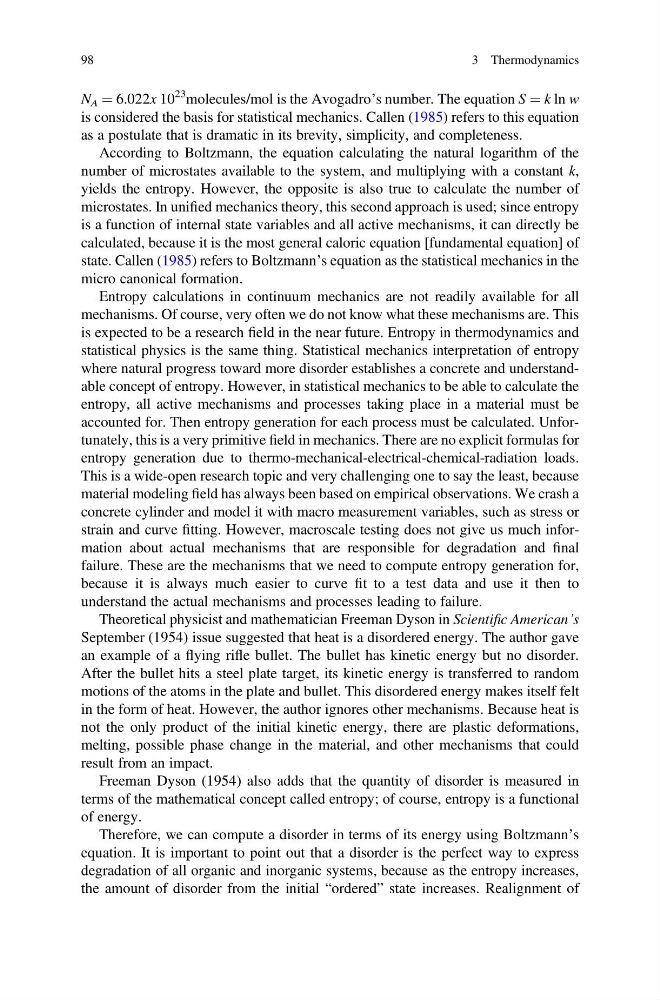
N A ¼ 6.022x 10
23 molecules/mol is the Avogadro’s number. The equation S ¼ k ln w
is considered the basis for statistical mechanics. Callen (1985) refers to this equation
as a postulate that is dramatic in its brevity, simplicity, and completeness.
According to Boltzmann, the equation calculating the natural logarithm of the
number of microstates available to the system, and multiplying with a constant k,
yields the entropy. However, the opposite is also true to calculate the number of
microstates. In unified mechanics theory, this second approach is used; since entropy
is a function of internal state variables and all active mechanisms, it can directly be
calculated, because it is the most general caloric equation [fundamental equation] of
state. Callen (1985) refers to Boltzmann’s equation as the statistical mechanics in the
micro canonical formation.
Entropy calculations in continuum mechanics are not readily available for all
mechanisms. Of course, very often we do not know what these mechanisms are. This
is expected to be a research field in the near future. Entropy in thermodynamics and
statistical physics is the same thing. Statistical mechanics interpretation of entropy
where natural progress toward more disorder establishes a concrete and understandable concept of entropy. However, in statistical mechanics to be able to calculate the
entropy, all active mechanisms and processes taking place in a material must be
accounted for. Then entropy generation for each process must be calculated. Unfortunately, this is a very primitive field in mechanics. There are no explicit formulas for
entropy generation due to thermo-mechanical-electrical-chemical-radiation loads.
This is a wide-open research topic and very challenging one to say the least, because
material modeling field has always been based on empirical observations. We crash a
concrete cylinder and model it with macro measurement variables, such as stress or
strain and curve fitting. However, macroscale testing does not give us much information about actual mechanisms that are responsible for degradation and final
failure. These are the mechanisms that we need to compute entropy generation for,
because it is always much easier to curve fit to a test data and use it then to
understand the actual mechanisms and processes leading to failure.
Theoretical physicist and mathematician Freeman Dyson in Scientific American’s
September (1954) issue suggested that heat is a disordered energy. The author gave
an example of a flying rifle bullet. The bullet has kinetic energy but no disorder.
After the bullet hits a steel plate target, its kinetic energy is transferred to random
motions of the atoms in the plate and bullet. This disordered energy makes itself felt
in the form of heat. However, the author ignores other mechanisms. Because heat is
not the only product of the initial kinetic energy, there are plastic deformations,
melting, possible phase change in the material, and other mechanisms that could
result from an impact.
Freeman Dyson (1954) also adds that the quantity of disorder is measured in
terms of the mathematical concept called entropy; of course, entropy is a functional
of energy.
Therefore, we can compute a disorder in terms of its energy using Boltzmann’s
equation. It is important to point out that a disorder is the perfect way to express
degradation of all organic and inorganic systems, because as the entropy increases,
the amount of disorder from the initial “ordered” state increases. Realignment of
98
3 Thermodynamics
23 molecules/mol is the Avogadro’s number. The equation S ¼ k ln w
is considered the basis for statistical mechanics. Callen (1985) refers to this equation
as a postulate that is dramatic in its brevity, simplicity, and completeness.
According to Boltzmann, the equation calculating the natural logarithm of the
number of microstates available to the system, and multiplying with a constant k,
yields the entropy. However, the opposite is also true to calculate the number of
microstates. In unified mechanics theory, this second approach is used; since entropy
is a function of internal state variables and all active mechanisms, it can directly be
calculated, because it is the most general caloric equation [fundamental equation] of
state. Callen (1985) refers to Boltzmann’s equation as the statistical mechanics in the
micro canonical formation.
Entropy calculations in continuum mechanics are not readily available for all
mechanisms. Of course, very often we do not know what these mechanisms are. This
is expected to be a research field in the near future. Entropy in thermodynamics and
statistical physics is the same thing. Statistical mechanics interpretation of entropy
where natural progress toward more disorder establishes a concrete and understandable concept of entropy. However, in statistical mechanics to be able to calculate the
entropy, all active mechanisms and processes taking place in a material must be
accounted for. Then entropy generation for each process must be calculated. Unfortunately, this is a very primitive field in mechanics. There are no explicit formulas for
entropy generation due to thermo-mechanical-electrical-chemical-radiation loads.
This is a wide-open research topic and very challenging one to say the least, because
material modeling field has always been based on empirical observations. We crash a
concrete cylinder and model it with macro measurement variables, such as stress or
strain and curve fitting. However, macroscale testing does not give us much information about actual mechanisms that are responsible for degradation and final
failure. These are the mechanisms that we need to compute entropy generation for,
because it is always much easier to curve fit to a test data and use it then to
understand the actual mechanisms and processes leading to failure.
Theoretical physicist and mathematician Freeman Dyson in Scientific American’s
September (1954) issue suggested that heat is a disordered energy. The author gave
an example of a flying rifle bullet. The bullet has kinetic energy but no disorder.
After the bullet hits a steel plate target, its kinetic energy is transferred to random
motions of the atoms in the plate and bullet. This disordered energy makes itself felt
in the form of heat. However, the author ignores other mechanisms. Because heat is
not the only product of the initial kinetic energy, there are plastic deformations,
melting, possible phase change in the material, and other mechanisms that could
result from an impact.
Freeman Dyson (1954) also adds that the quantity of disorder is measured in
terms of the mathematical concept called entropy; of course, entropy is a functional
of energy.
Therefore, we can compute a disorder in terms of its energy using Boltzmann’s
equation. It is important to point out that a disorder is the perfect way to express
degradation of all organic and inorganic systems, because as the entropy increases,
the amount of disorder from the initial “ordered” state increases. Realignment of
98
3 Thermodynamics