

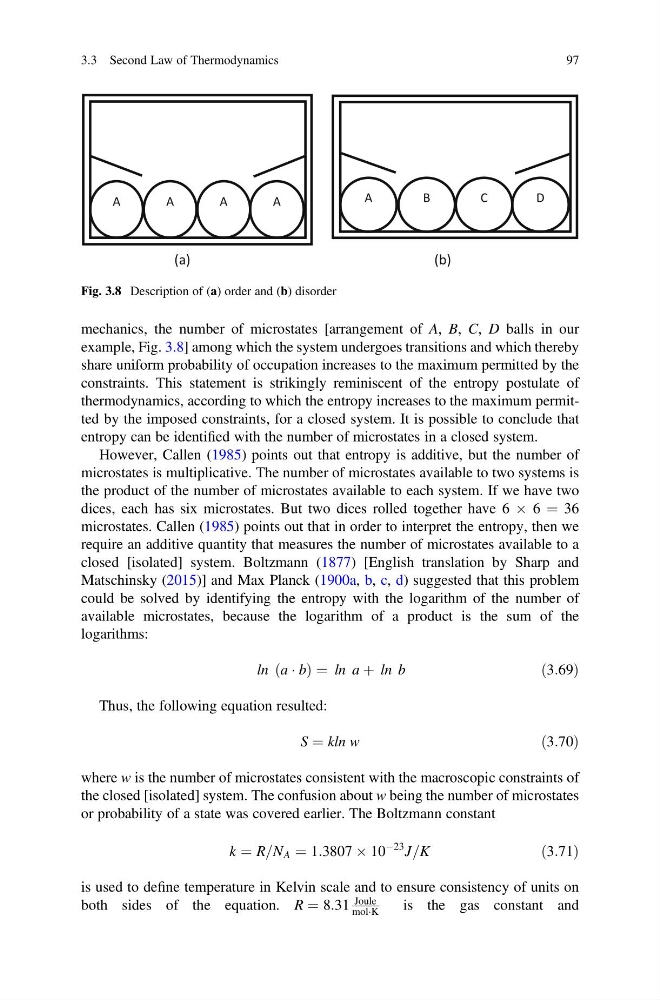
mechanics, the number of microstates [arrangement of A, B, C, D balls in our
example, Fig. 3.8] among which the system undergoes transitions and which thereby
share uniform probability of occupation increases to the maximum permitted by the
constraints. This statement is strikingly reminiscent of the entropy postulate of
thermodynamics, according to which the entropy increases to the maximum permitted by the imposed constraints, for a closed system. It is possible to conclude that
entropy can be identified with the number of microstates in a closed system.
However, Callen (1985) points out that entropy is additive, but the number of
microstates is multiplicative. The number of microstates available to two systems is
the product of the number of microstates available to each system. If we have two
dices, each has six microstates. But two dices rolled together have 6 Â 6 ¼ 36
microstates. Callen (1985) points out that in order to interpret the entropy, then we
require an additive quantity that measures the number of microstates available to a
closed [isolated] system. Boltzmann (1877) [English translation by Sharp and
Matschinsky (2015)] and Max Planck (1900a, b, c, d) suggested that this problem
could be solved by identifying the entropy with the logarithm of the number of
available microstates, because the logarithm of a product is the sum of the
logarithms:
ln a Á b
ð
Þ ¼ ln a þ ln b
ð3:69Þ
Thus, the following equation resulted:
S ¼ kln w
ð3:70Þ
where w is the number of microstates consistent with the macroscopic constraints of
the closed [isolated] system. The confusion about w being the number of microstates
or probability of a state was covered earlier. The Boltzmann constant
k ¼ R=N A ¼ 1:3807 Â 10
À23 J=K
ð3:71Þ
is used to define temperature in Kelvin scale and to ensure consistency of units on
both sides of the equation. R ¼ 8:31
Joule
molÁK
is the gas constant and
(a)
(b)
A
A
A
A
A
B
C
D
Fig. 3.8 Description of (a) order and (b) disorder
3.3 Second Law of Thermodynamics
97
example, Fig. 3.8] among which the system undergoes transitions and which thereby
share uniform probability of occupation increases to the maximum permitted by the
constraints. This statement is strikingly reminiscent of the entropy postulate of
thermodynamics, according to which the entropy increases to the maximum permitted by the imposed constraints, for a closed system. It is possible to conclude that
entropy can be identified with the number of microstates in a closed system.
However, Callen (1985) points out that entropy is additive, but the number of
microstates is multiplicative. The number of microstates available to two systems is
the product of the number of microstates available to each system. If we have two
dices, each has six microstates. But two dices rolled together have 6 Â 6 ¼ 36
microstates. Callen (1985) points out that in order to interpret the entropy, then we
require an additive quantity that measures the number of microstates available to a
closed [isolated] system. Boltzmann (1877) [English translation by Sharp and
Matschinsky (2015)] and Max Planck (1900a, b, c, d) suggested that this problem
could be solved by identifying the entropy with the logarithm of the number of
available microstates, because the logarithm of a product is the sum of the
logarithms:
ln a Á b
ð
Þ ¼ ln a þ ln b
ð3:69Þ
Thus, the following equation resulted:
S ¼ kln w
ð3:70Þ
where w is the number of microstates consistent with the macroscopic constraints of
the closed [isolated] system. The confusion about w being the number of microstates
or probability of a state was covered earlier. The Boltzmann constant
k ¼ R=N A ¼ 1:3807 Â 10
À23 J=K
ð3:71Þ
is used to define temperature in Kelvin scale and to ensure consistency of units on
both sides of the equation. R ¼ 8:31
Joule
molÁK
is the gas constant and
(a)
(b)
A
A
A
A
A
B
C
D
Fig. 3.8 Description of (a) order and (b) disorder
3.3 Second Law of Thermodynamics
97