

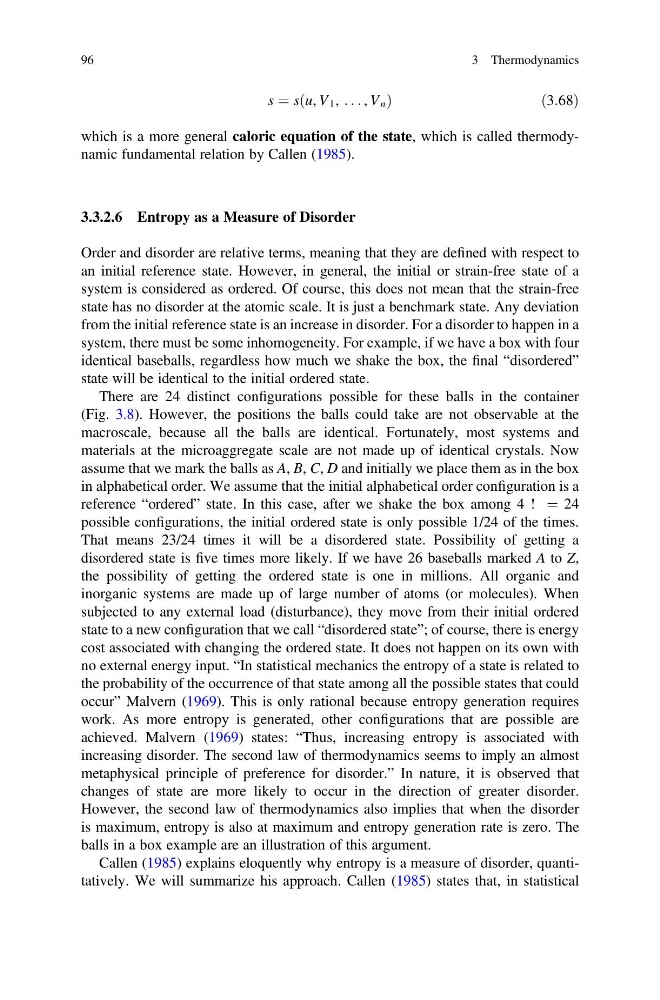
s ¼ s u, V 1 , . . . , V n
ð
Þ
ð 3:68Þ
which is a more general caloric equation of the state, which is called thermodynamic fundamental relation by Callen (1985).
3.3.2.6 Entropy as a Measure of Disorder
Order and disorder are relative terms, meaning that they are defined with respect to
an initial reference state. However, in general, the initial or strain-free state of a
system is considered as ordered. Of course, this does not mean that the strain-free
state has no disorder at the atomic scale. It is just a benchmark state. Any deviation
from the initial reference state is an increase in disorder. For a disorder to happen in a
system, there must be some inhomogeneity. For example, if we have a box with four
identical baseballs, regardless how much we shake the box, the final “disordered”
state will be identical to the initial ordered state.
There are 24 distinct configurations possible for these balls in the container
(Fig. 3.8). However, the positions the balls could take are not observable at the
macroscale, because all the balls are identical. Fortunately, most systems and
materials at the microaggregate scale are not made up of identical crystals. Now
assume that we mark the balls as A, B, C, D and initially we place them as in the box
in alphabetical order. We assume that the initial alphabetical order configuration is a
reference “ordered” state. In this case, after we shake the box among 4 ! ¼ 24
possible configurations, the initial ordered state is only possible 1/24 of the times.
That means 23/24 times it will be a disordered state. Possibility of getting a
disordered state is five times more likely. If we have 26 baseballs marked A to Z,
the possibility of getting the ordered state is one in millions. All organic and
inorganic systems are made up of large number of atoms (or molecules). When
subjected to any external load (disturbance), they move from their initial ordered
state to a new configuration that we call “disordered state”; of course, there is energy
cost associated with changing the ordered state. It does not happen on its own with
no external energy input. “In statistical mechanics the entropy of a state is related to
the probability of the occurrence of that state among all the possible states that could
occur” Malvern (1969). This is only rational because entropy generation requires
work. As more entropy is generated, other configurations that are possible are
achieved. Malvern (1969) states: “Thus, increasing entropy is associated with
increasing disorder. The second law of thermodynamics seems to imply an almost
metaphysical principle of preference for disorder.” In nature, it is observed that
changes of state are more likely to occur in the direction of greater disorder.
However, the second law of thermodynamics also implies that when the disorder
is maximum, entropy is also at maximum and entropy generation rate is zero. The
balls in a box example are an illustration of this argument.
Callen (1985) explains eloquently why entropy is a measure of disorder, quantitatively. We will summarize his approach. Callen (1985) states that, in statistical
96
3 Thermodynamics
ð
Þ
ð 3:68Þ
which is a more general caloric equation of the state, which is called thermodynamic fundamental relation by Callen (1985).
3.3.2.6 Entropy as a Measure of Disorder
Order and disorder are relative terms, meaning that they are defined with respect to
an initial reference state. However, in general, the initial or strain-free state of a
system is considered as ordered. Of course, this does not mean that the strain-free
state has no disorder at the atomic scale. It is just a benchmark state. Any deviation
from the initial reference state is an increase in disorder. For a disorder to happen in a
system, there must be some inhomogeneity. For example, if we have a box with four
identical baseballs, regardless how much we shake the box, the final “disordered”
state will be identical to the initial ordered state.
There are 24 distinct configurations possible for these balls in the container
(Fig. 3.8). However, the positions the balls could take are not observable at the
macroscale, because all the balls are identical. Fortunately, most systems and
materials at the microaggregate scale are not made up of identical crystals. Now
assume that we mark the balls as A, B, C, D and initially we place them as in the box
in alphabetical order. We assume that the initial alphabetical order configuration is a
reference “ordered” state. In this case, after we shake the box among 4 ! ¼ 24
possible configurations, the initial ordered state is only possible 1/24 of the times.
That means 23/24 times it will be a disordered state. Possibility of getting a
disordered state is five times more likely. If we have 26 baseballs marked A to Z,
the possibility of getting the ordered state is one in millions. All organic and
inorganic systems are made up of large number of atoms (or molecules). When
subjected to any external load (disturbance), they move from their initial ordered
state to a new configuration that we call “disordered state”; of course, there is energy
cost associated with changing the ordered state. It does not happen on its own with
no external energy input. “In statistical mechanics the entropy of a state is related to
the probability of the occurrence of that state among all the possible states that could
occur” Malvern (1969). This is only rational because entropy generation requires
work. As more entropy is generated, other configurations that are possible are
achieved. Malvern (1969) states: “Thus, increasing entropy is associated with
increasing disorder. The second law of thermodynamics seems to imply an almost
metaphysical principle of preference for disorder.” In nature, it is observed that
changes of state are more likely to occur in the direction of greater disorder.
However, the second law of thermodynamics also implies that when the disorder
is maximum, entropy is also at maximum and entropy generation rate is zero. The
balls in a box example are an illustration of this argument.
Callen (1985) explains eloquently why entropy is a measure of disorder, quantitatively. We will summarize his approach. Callen (1985) states that, in statistical
96
3 Thermodynamics