

many researchers and authors of thermodynamics have postulated that entropy is a
state function of all the state variables including possibly some variable not observable by macroscale specimen testing.
It is important that we clarify what we mean by “state variables.” For a simple
ideal gas, pressure, temperature, and volume are thermodynamic variables. However, the internal energy and the entropy are state variables (also called state
functions). State variables are expressed by means of thermodynamic variables.
For a variable to be classified as a state variable (also called state function), it must
have an exact differential, based on a vanishing integral in an arbitrary cycle. This
definition assumes that the material is capable of going through an arbitrary cycle
and be restored to its initial state. As an example, we can plastically deform a steel
beam, then melt it or anneal it, and return it to its original state. Therefore, for the
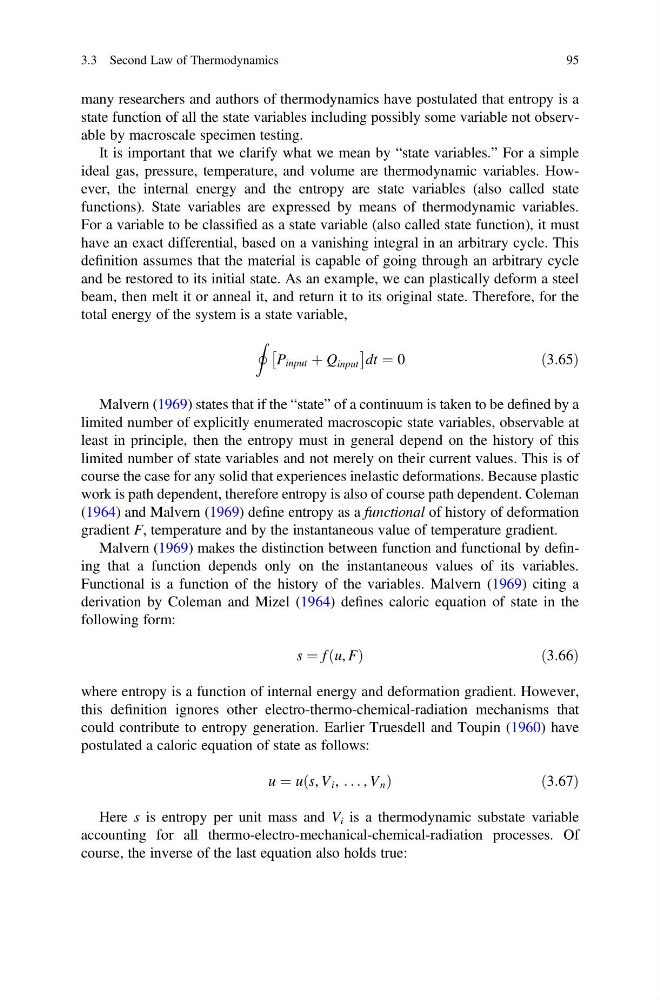
total energy of the system is a state variable,
I
P input þ Q input
Â
Ã
dt ¼ 0
ð3:65Þ
Malvern (1969) states that if the “state” of a continuum is taken to be defined by a
limited number of explicitly enumerated macroscopic state variables, observable at
least in principle, then the entropy must in general depend on the history of this
limited number of state variables and not merely on their current values. This is of
course the case for any solid that experiences inelastic deformations. Because plastic
work is path dependent, therefore entropy is also of course path dependent. Coleman
(1964) and Malvern (1969) define entropy as a functional of history of deformation
gradient F, temperature and by the instantaneous value of temperature gradient.
Malvern (1969) makes the distinction between function and functional by defining that a function depends only on the instantaneous values of its variables.
Functional is a function of the history of the variables. Malvern (1969) citing a
derivation by Coleman and Mizel (1964) defines caloric equation of state in the
following form:
s ¼ f u, F
ð
Þ
ð3:66Þ
where entropy is a function of internal energy and deformation gradient. However,
this definition ignores other electro-thermo-chemical-radiation mechanisms that
could contribute to entropy generation. Earlier Truesdell and Toupin (1960) have
postulated a caloric equation of state as follows:
u ¼ u s, V i , . . . , V n
ð
Þ
ð 3:67Þ
Here s is entropy per unit mass and V i is a thermodynamic substate variable
accounting for all thermo-electro-mechanical-chemical-radiation processes. Of
course, the inverse of the last equation also holds true:
3.3 Second Law of Thermodynamics
95
state function of all the state variables including possibly some variable not observable by macroscale specimen testing.
It is important that we clarify what we mean by “state variables.” For a simple
ideal gas, pressure, temperature, and volume are thermodynamic variables. However, the internal energy and the entropy are state variables (also called state
functions). State variables are expressed by means of thermodynamic variables.
For a variable to be classified as a state variable (also called state function), it must
have an exact differential, based on a vanishing integral in an arbitrary cycle. This
definition assumes that the material is capable of going through an arbitrary cycle
and be restored to its initial state. As an example, we can plastically deform a steel
beam, then melt it or anneal it, and return it to its original state. Therefore, for the
total energy of the system is a state variable,
I
P input þ Q input
Â
Ã
dt ¼ 0
ð3:65Þ
Malvern (1969) states that if the “state” of a continuum is taken to be defined by a
limited number of explicitly enumerated macroscopic state variables, observable at
least in principle, then the entropy must in general depend on the history of this
limited number of state variables and not merely on their current values. This is of
course the case for any solid that experiences inelastic deformations. Because plastic
work is path dependent, therefore entropy is also of course path dependent. Coleman
(1964) and Malvern (1969) define entropy as a functional of history of deformation
gradient F, temperature and by the instantaneous value of temperature gradient.
Malvern (1969) makes the distinction between function and functional by defining that a function depends only on the instantaneous values of its variables.
Functional is a function of the history of the variables. Malvern (1969) citing a
derivation by Coleman and Mizel (1964) defines caloric equation of state in the
following form:
s ¼ f u, F
ð
Þ
ð3:66Þ
where entropy is a function of internal energy and deformation gradient. However,
this definition ignores other electro-thermo-chemical-radiation mechanisms that
could contribute to entropy generation. Earlier Truesdell and Toupin (1960) have
postulated a caloric equation of state as follows:
u ¼ u s, V i , . . . , V n
ð
Þ
ð 3:67Þ
Here s is entropy per unit mass and V i is a thermodynamic substate variable
accounting for all thermo-electro-mechanical-chemical-radiation processes. Of
course, the inverse of the last equation also holds true:
3.3 Second Law of Thermodynamics
95